The euro area faces another challenging year, but we see a continuation of recent soft growth as much more likely than recession. The European Central Bank (ECB) is, nonetheless, now likely to delay its first rate hike to 2020, and could also implement fresh credit-easing measures.
Euro-area growth has slowed sharply in recent months, aggravated by one-off factors, which are now starting to fade. Nonetheless, survey data continue to deteriorate, hinting at more persistent weakness. In Germany, for instance, the expectations component of the Ifo Institute for Economic Research business-climate indicator fell by eight points between September and January. Since 1990, there have been only two faster declines: in 2008 (the global financial crisis) and in 1992 (the European Exchange Rate Mechanism crisis).
Why Has Growth Slowed So Abruptly?
At its January press conference, the ECB placed a heavy emphasis on rising uncertainty—trade tension and the threat of a no-deal Brexit. While the ECB’s points are certainly true, we identify three specific factors for the rapid deterioration in euro-area growth.
First, the region is more exposed to fluctuations in external demand than other large economies—its Achilles’ heel when export growth slows. Second, consumption has also slowed, from an average 1.7% in 2017 to just 1.0% in the third quarter of 2018, largely because of higher inflation and a higher savings rate. And third, rising populism has led indirectly to greater uncertainty (rising trade tension and Brexit) and directly to tighter credit conditions in Italy.
Five Factors that We Think Make Recession Unlikely
Although the outlook now is materially weaker than expected several months ago, it’s important to maintain a sense of perspective about how far growth could slow. When we look more closely at the underpinnings of the economy, we see five factors that make recession unlikely in 2019:
1) Aggressive China policy stimulus. The recent actions of Chinese policymakers have significantly reduced the country’s downside growth risks. There’s likely to be a lag between policy action and impact, but we expect this stimulus to show up in stronger support for global trade growth by the summer. And the euro area is particularly sensitive to the ups, as well as the downs, of the global trade cycle.
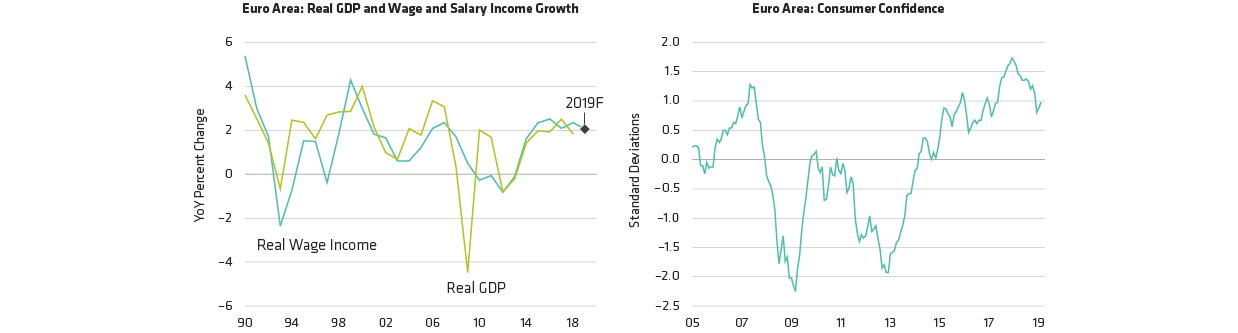
2) Strong gains in real income. Although consumption growth has slowed in recent quarters, real income growth remains strong, and that’s likely to continue over the coming year (Display, left). Moreover, consumer confidence remains relatively high and has actually risen slightly so far this year (Display, right). Barring a major shock, it would be highly unusual for the euro area to fall into recession under these circumstances.