There are plenty of views of the industry from a consultant perspective. Here, we try to offer a perspective that is intentionally different from that—in an attempt to be additive—and rooted in a strategic macro outlook. The recent uncertainty in the macro outlook, strong returns across asset classes and concentration of markets might have consumed the attention of the industry. However, we think there is a case that asset owners face a new paradigm in the investment outlook, one that changes how they need to operate compared with the norms of recent decades. This paradigm shift has implications for return assumptions, asset allocation, governance and organizational structure. In this note, we reflect on what this means for the asset management industry and how it will need to adapt.
The challenge that asset owners face has evolved. For years, the challenge was generating return in a low-yield world. Now, yield is apparently plentiful. For some investors, this might have made asset allocation easier; however, for most we expect that ease is ultimately illusory. This depends on what the objective is, but for DC funds, endowments, sovereign wealth funds and those advising individuals saving for retirement, the objective has to be real returns and the protection of purchasing power, which we think is becoming harder. The key elements of this macro outlook are:
- Returns have been plentiful. However, they likely will not be in the future because valuations are high across asset classes and there are downward risks to long-term economic-growth rates (from demographic change, deglobalization and climate, only partly offset by gains from AI).
- Inflation has apparently been tamed in this cycle, and market-based measures of forward-looking inflation are not unduly elevated. However, the pricing of gold and other non-fiat assets shows a very different picture. Our view of the structural forces at work is that inflation remains a risk long term (public debt, deglobalization).
- The confluence of (1) and (2) is, ultimately, a governance issue. What should the target or benchmark be? Investors need to focus on the generation of real returns and protection of purchasing power in a way that has not needed to be core to the outlook for decades.
- In addition, diversification had been plentiful in recent decades, but that changed in 2022. We think that finding diversifying return streams is going to remain a problem, requiring further shifts in asset allocation and rules of thumb about investing.
We are not going to lay out the evidence for this macro view in this note, as we have extensively covered it in our recent research. This macro view creates challenges for asset owners and suggests a shift both in strategic asset allocation and also in governance. This shift creates opportunities for the asset management industry to respond to it.
An important step in this process is educating asset owners and investors about the change in the investment outlook for the next 10 years and how its difference from the last 40 years implies a need to change strategic asset allocation and governance. By the latter, we explicitly mean a change in the objective function, with the need to protect purchasing power being elevated in importance over other targets for many types of investors.
Multi asset investing is active investing… and OCIO
The vision of the investment environment that we have laid out suggests a change in the status of multi-asset investing. With hindsight (always a reassuring perspective), equities and bonds both delivered positive returns over the last 40 years and managed to do it while having a negative correlation between them. In that context, investors could be forgiven for thinking that they did not need to pay for multi asset investing. They might even have been led, falsely, to believe that there was such a thing as a “passive” approach to multi-asset investing in the form of 60:40. We think that the experience of 2022, with a simultaneous fall in both equities and fixed income, has shaken such comfort. We also believe that the need for a more active approach to multi asset, one that firmly embeds allocations to private assets and non-traditional assets (e.g., non-fiat assets, factor strategies), is essential. Moreover, in a world where the role of traditional active intra-asset class strategies has shrunk, such multi-asset active investing will be a larger part of what people understand active investing to be.
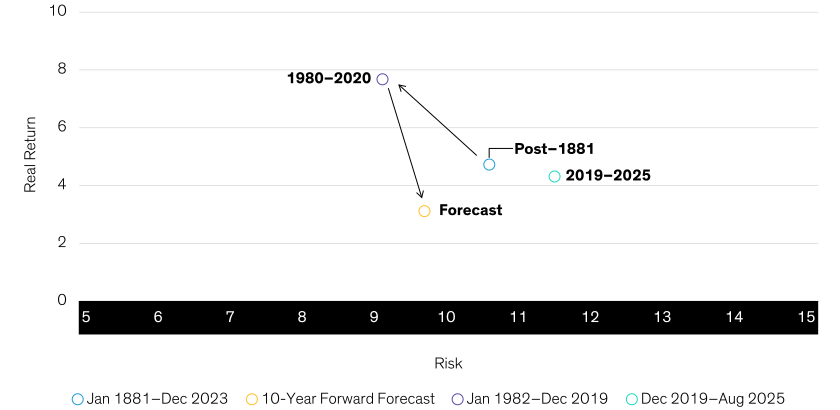
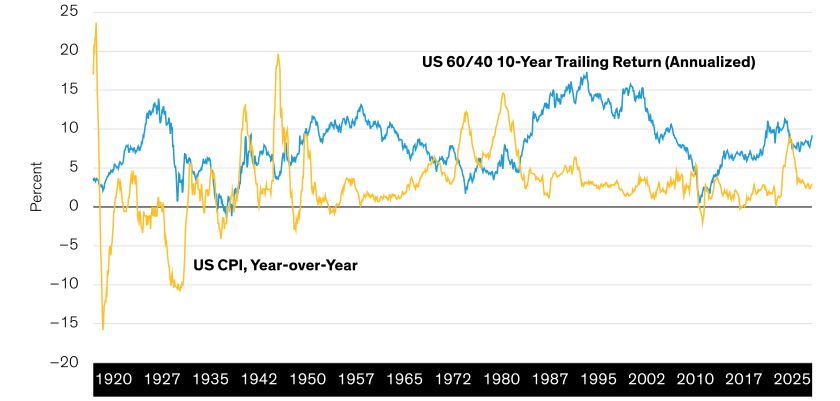
The death of the 60:40 portfolio has been proclaimed many times before (including by the current author), but 2022 provides an example of what can go wrong with such a strategy. A move away from the assumption that 60:40 provides a neutral basis for asset allocation is needed for investors to think more deeply about the need for a different approach to multi asset. Display 1 shows the real return against volatility for stocks, bonds and a 60:40 combination of the two in the US. The period from 1980–2020 provided a super-normal boost to both returns and the internal diversification of the strategy that has underpinned its popularity, but this experience was also far above the long-term normal. Our 10-year forward projection is much more sober, and indeed the return over the last five years (shown in green) has been much worse than this long-term trend, particularly in terms of the volatility experienced.