AI vs. Demographics: The Strategic View

01 October 2025
5 min read

Would shrinking working-age populations be so bad if robots are taking over jobs anyway?

The potential impact of artificial intelligence (AI) on productivity is a key economic and social debate, spurring questions around the impact on jobs, AI’s ability to offset other downward forces on growth and how much it could help fend off the need for governments to inflate away debt burdens.

There’s a huge disagreement about the total productivity gain (Display), with wide-ranging forecasts and methodologies. The actual impact will depend on other factors, such as the exposure of tasks, jobs and industries to AI automation and the breadth of the adoption across economic sectors. 

Divergent Views on Aggregate AI Productivity Gains
Predicted Gain in Annual Labor Productivity from AI over a 10–Year Horizon (Percent)
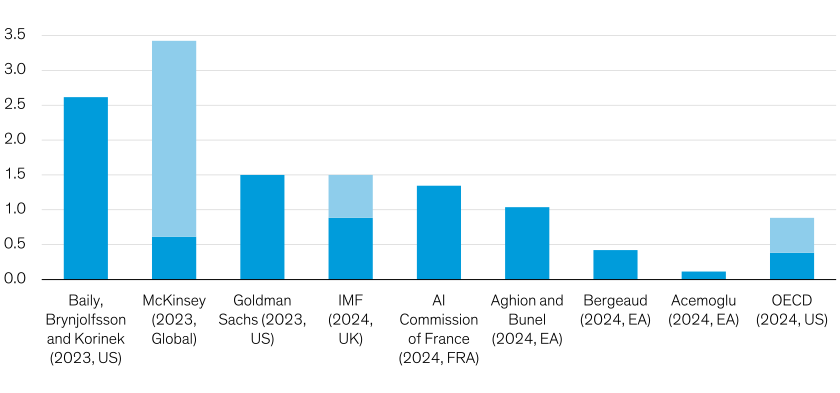
Various predicted gains in annual labor productivity from AI over 10 years

Current analysis does not guarantee future results.
IMF: International Monetary Fund; OECD: Organization of Economic Cooperation and Development. When the source presents a range of estimates as the main result, the lower and upper bounds are indicated by the light blue areas. In cases where predictions are for total factor productivity, the predicted labor-productivity gains are obtained by assuming a standard long-run multiplier of 1.5 for the adjustment of capital stock (Acemoglu 2024, Aghion and Bunel 2024, Bergeaud 2024 and OECD). Estimates refer to the countries or regions indicated in the parentheses.
As of December 8, 2024
Source: https://cepr.org/voxeu/columns/miracle-or-myth-assessing-macroeconomic-productivity-gains-artificial-intelligence and AllianceBernstein (AB)

AI evangelists often equate AI to the steam engine—arguably as the first technological development that sustainably raised per-capita growth since humans developed farming. Very roughly, the Industrial Revolution and subsequent inventions raised per capita trend growth by 0.8% per year. That would be a notable boost, and we are wary of higher forecasts.

AI Is Not Happening in a Vacuum: Growth Constraints Matter, Too 

But any AI productivity boost won’t be the only force coming to bear on growth—it must work against other mega forces that imply downward growth pressure. Some, like demographics, are more predictable; others, like climate change, aren’t. Changes in the labor and capital shares of profit from GDP also play a role.

For the demographic force of a declining working-age population, we assume that the positive case is US immigration rates similar to recent years, with the population growing slightly. A zero-immigration policy would reduce growth slightly. However, the US would still be better off than the rest of the developed world and China, where demographics are a net drain on growth. As for climate change, we think it’s highly unlikely that the world achieves net zero by 2050: the growth implications are widely debated but agreed to be negative.

The combined upward and downward forces on growth will influence real corporate earnings, as will shifts in the profit share of GDP, which has shifted more in favor of corporations in the US. If decisions about what AI is developed and released is left to corporations, this share could rise even more. Elsewhere in the world, profit share has been more stable, so we assume it will remain constant.

We can try “reverse engineering” the question of AI productivity: How much of a boost would fully offset the downward growth forces? If we expect those forces to reduce real earnings and GDP growth in the developed world by 1.1% annualized over the next decade, the required base-case assumption for AI would be at the highest-end historical range of sustained productivity increases. We think that’s imprudent to have as a base-case forecast.

Do Sizable Productivity Gains from AI Mean Mass Job Losses?

The dominant fear with AI is that automation will destroy jobs semipermanently. In the near term, AI-driven productivity gains will come from either substituting for labor and saving the cost of those roles while keeping output constant, or from making a given role more productive. AI could also create new roles, but that would come later.

More than 70% of computer and mathematics tasks, and of office and administrative tasks, are exposed to LLM automation, while the exposures of construction, building and maintenance, and protective services are only around 20%. On this basis, the financial services industry is most exposed to AI, construction and agriculture the least (Display). The degree of AI-based transformation has a range of scenarios, depending on AI adoption rates and job displacement.

Sector Exposure to AI Automation Varies Widely
Large Language Model Automation Exposure by Sector (Percent)
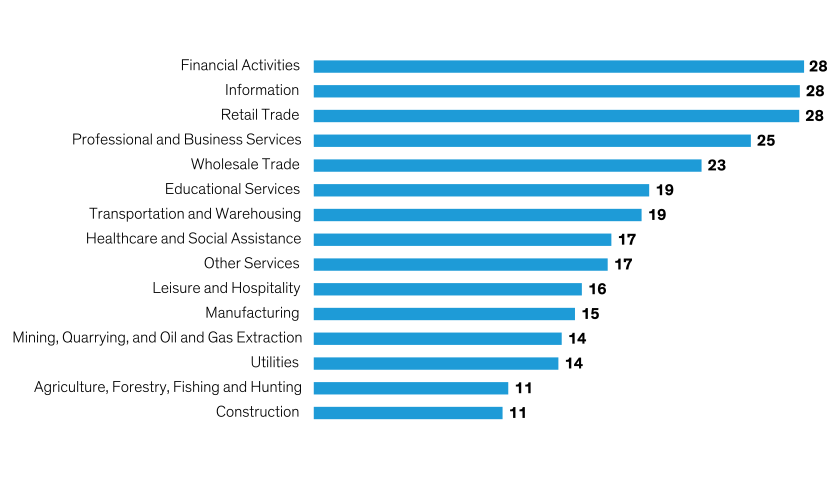
Percentage exposure to large language model automation by sector

Current analysis does not guarantee future results.
Exposure is weighted by industry value-added share. Occupation level automation data is provided by Daron Acemoglu. Value-added data is from Bureau of Economic Analysis (BEA) input-output tables
As of May 12, 2024
Source: BEA, Daron Acemoglu and AB 

One aspect of AI differs from previous rounds of automation since World War II: non-unionized roles seem particularly exposed, with higher-paid white-collar jobs the most exposed. However, Western corporations seem firmly in the driving seat in determining AI development and release, so the arrow seems to point toward gains for capital at the expense of labor (and perhaps of governments, too).

The Impact of AI’s Ascent on the Case for US Exceptionalism

We’ve strongly defended the case for exceptionalism of US growth (and therefore equity returns). The outcomes across a range of AI and demographics assumptions indeed favor the US. Elsewhere, rapid AI adoption would offset a “less bad” possible outcome for climate and demographic change, perhaps suggesting no real growth. This is very optimistic—firms beyond the US have been less effective at harnessing technology, and other major economies have less energy-supply security.

The US, though, is saddled with a more rapidly deteriorating fiscal balance. In our view, the appeal of the dollar as a reserve currency is waning, so the topic of fiscal sustainability is becoming more pressing. With a very generous AI productivity boost required for the US to grow its way out of the debt burden, inflation or financial repression hover as more likely paths.

AI benefits by specific country will depend on adoption rates, the shares of tasks exposed to AI, the ability to meet AI power demand with a secure energy supply, and the balance of job displacement versus making workers more productive. We see a strong case for the US as a relative beneficiary no matter the absolute productivity gain from AI. On all readiness aspects, from labor-market composition to energy supply, there’s a case that an effective role for AI further supports US exceptionalism.

For example, knowledge- and service-oriented sectors are most exposed to AI automation, and the US has the largest share of service employment—nearly 80% (Display). Europe’s share is considerably lower at around 70%, and China’s service-oriented employment is only 46% of the economy.

Services-Heavy US Likely to Be Biggest AI Beneficiary
Share of Employment in Services vs. Manufacturing (Percent)
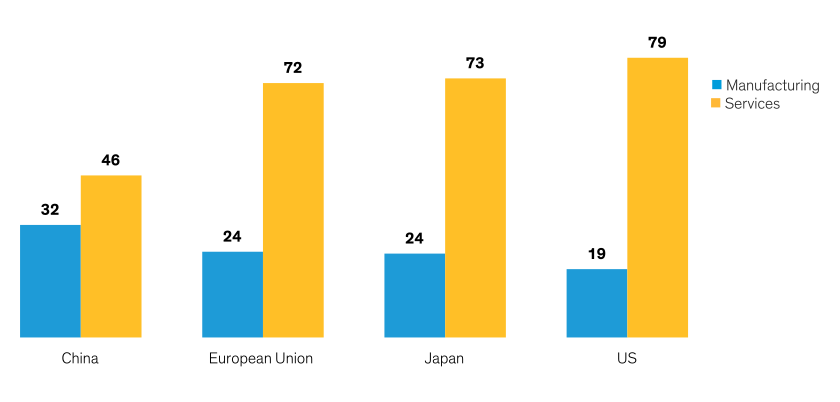
Countries’ shares of employment in services vs. manufacturing

Current analysis does not guarantee future results.
As of December 31, 2023
Source: World Bank and AB

In summary, the more optimistic scenarios for AI productivity improvements could offset other downward forces for the US, though not by enough to shrink the debt burden. So, the case for US exceptionalism and equity overweight still stands, but concerns about fiscal sustainability should erode the status of the dollar. The higher range of AI-driven productivity improvements would increase economic growth rates, but would also be the most negative for the future of jobs.

The views expressed herein do not constitute research, investment advice or trade recommendations, do not necessarily represent the views of all AB portfolio-management teams and are subject to change over time.


About the Authors