Anti-Involution: Getting China’s Snake to Let Go of Its Tail

03 November 2025
3 min read

China’s bid to break its deflationary cycle is unfolding slowly at home—but could speed change in global markets.

China’s “anti-involution” policy to tackle deflation, announced in 2024, is still in its early stages. Some effects are already visible, but compared with China’s last deflation fight in 2014–2015, the policy may take longer to work, in our view. To understand why—and the implications for China’s overseas trade and bond issuance—it helps to consider the scale of the challenge, its causes and how policymakers aim to address them.

In English, involution means “shrinkage,” but the Chinese term suggests a process that curls inward and consumes itself—like a snake devouring its own tail. The metaphor aptly describes how China’s firms, caught in a low-growth and weak-demand cycle, compete relentlessly on price. In 2024, for example, a new-model sports utility vehicle (SUV) went on sale for the equivalent of US$33,000. Its price was soon slashed to US$7,000.

China’s current deflation stems from the property crisis triggered in 2021 by the default of Evergrande, then one of the country’s biggest developers.

Buffer for Economy Led to Overcapacity

Regulators responded with strict measures whose impact extended beyond property (which then accounted for about a quarter of the country’s GDP and a large share of household wealth). Home and land sales collapsed, dragging on growth and fueling the deflation spiral.

To offset the risk, regulators introduced policies to support the manufacturing sector. Because manufacturers are capital-intensive, banks played a key role in delivering credit support. Since 2021, manufacturing has outpaced real estate in growth in both fixed-asset investment and bank loans (Display).

China’s Policy Boost to Manufacturing Contributed to Oversupply
Year-over-Year Growth
Growth of fixed-asset investment and bank loans shows gap that developed between manufacturing and real estate in 2022.

Historical and current analyses do not guarantee future results.
*Three-month rolling average
Through August 31, 2025
Source: CEIC Data, Morgan Stanley and UBS

The policy support, however, has led to manufacturing capacity outpacing demand. Real estate, given its importance to the broader economy and household wealth, partly reflects that demand shortfall. The resulting imbalance is now driving deflation.

Sector-Specific Approach Will Take Time

A key difference between today’s deflation and that of 2014–2015 is where overcapacity lies. Previously, it was concentrated in upstream industries such as heavy manufacturing and infrastructure. Today, it’s in midstream industries like steel, cement and pork farming, and downstream industries such as electric vehicles, solar panels, and instant retail and food delivery. Another difference: in 2014–2015, the excess capacity was mostly in state-owned enterprises (SOEs); today, the focus is on privately owned enterprises (POEs).

Working with SOEs allowed regulators to implement centralized supply-side reforms. While capacity was cut, layoffs were limited, and the government launched a massive urban renewal program to absorb excess supply. The Producer Price Index, near –7% in late 2015, rose to +8% by early 2017.

Dealing with POEs is more complex. The government has less control over layoffs from capacity cuts but wants to avoid additional strains on employment. It’s therefore pursuing industry-specific solutions and relying on companies to implement them. For these reasons, we expect the anti-involution policy to take longer to become fully effective than the 2014–2015 reforms.

Companies Upgrade Overseas Plans

Conversations with firms across sectors show how the policy’s effects vary but share a common theme: overcapacity challenges are pushing many companies to accelerate overseas expansion (Display).

Anti-Involution Spurs Chinese Companies’ Overseas Expansion
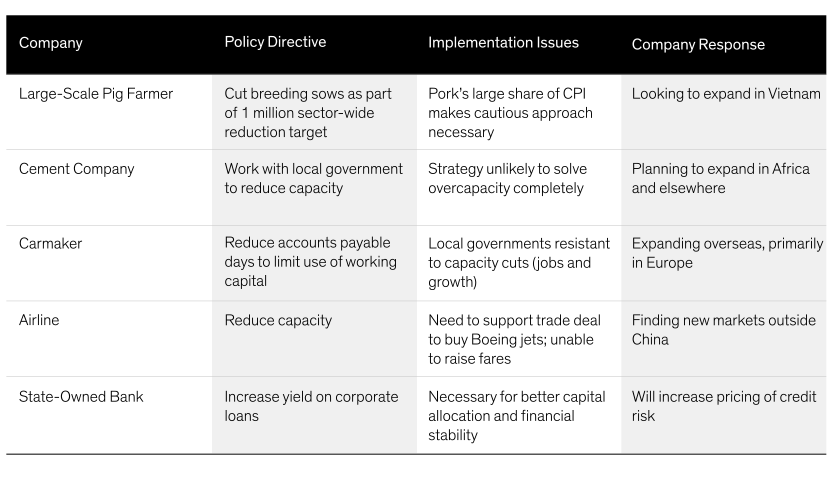
Table: 5 unnamed companies are expanding overseas in response to implantation issues around their specific policy directives.

Current analyses do not guarantee future results.
As of October 26, 2025
Source: AllianceBernstein (AB)

This shift is significant, in our view. China remains the world’s biggest exporter, with annual exports of about US$3.5 trillion (Display, left). Debate continues over whether the country is exporting deflation. The correlation between China’s export prices and other countries’ import prices is high, though it’s unclear that China alone drives it (Display, right).

China’s Deflation and Export Dominance Are a Concern for World Market
China exports $3.5 tn globally, and its export prices correlate closely with its trading partners’ import prices.

Historical and current analyses do not guarantee future results.
Left display as of September 30, 2025; right display through July 31, 2025
Source: Bloomberg, China’s National Bureau of Statistics and WIND

The correlation matters. Lower import prices for Chinese goods can ripple through trading partners’ economies. For example, low-priced Chinese SUVs in Thailand pressure local carmakers to cut prices, potentially triggering a deflationary cycle. China has diversified and expanded its overseas trade in recent years, including in response to US tariffs. As tariffs and deflation persist, we expect that expansion—and the related bond issuance to finance it (Display)—to continue.

Chinese Companies’ Offshore Investment and Issuance Increase
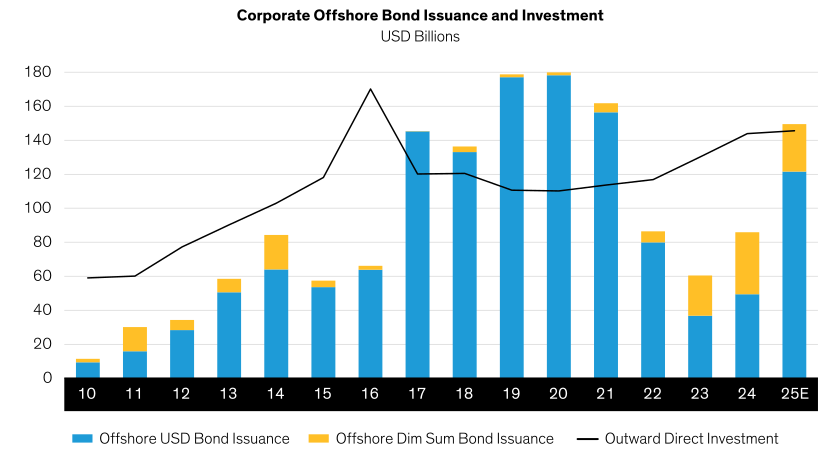
Annual data show dramatic increase in bond issuance since 2023—and largest ever amount in the offshore Dim Sum market.

Historical and current analyses do not guarantee future results.
As of August 31, 2025
Source: Bloomberg, CEIC Data, Ministry of Finance and AB

Trade Tensions May Increase

We believe the overseas effects of anti-involution may prove as significant as its domestic impact. At home, the sector-specific approach and reliance on companies mean rebalancing supply and demand will be slow, especially without demand-side stimulus.

Abroad, trade tensions already heightened by China’s export dominance are likely to persist—and may intensify. Chinese firms constrained by deflation, a weak domestic market and US tariffs will continue to pursue offshore opportunities, supported by both deflation-suppressed pricing and strong technology and product quality.

Investors can expect a steady flow of offshore Chinese bond issuance—both Dim Sum and US dollar—to finance this expansion.

The views expressed herein do not constitute research, investment advice or trade recommendations, do not necessarily represent the views of all AB portfolio-management teams and are subject to change over time.


About the Authors