Chinese Stocks Poised for Bigger Role on Global Market Stage

18 November 2019
2 min read
Chinese Equities Are Underrepresented in Global Indices
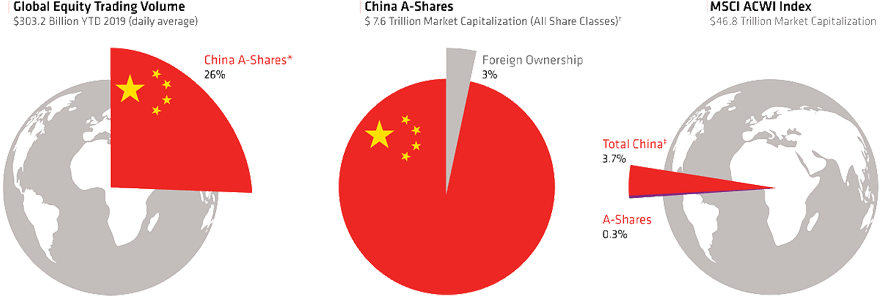

*Based on the volume of A-shares traded in the Shanghai and Shenzhen stock exchanges divided by the volume of global equities traded in 2019 through 30 September
†Includes shares of state-owned enterprises that are not freely floated
‡Includes offshore shares traded in Hong Kong and American depositary receipts traded int he US.
Historical and current analyses do not guarantee future results.
Global equity trading as per 30 September 2019, MSCI ACWI Index composition as per October 2019, Foreign ownership of China A-shares as per March 2019.
Source: Bloomberg, Goldman Sachs, MSCI and AB.

China is the world’s second-largest economy, but its equities are underrepresented in market indices and portfolios worldwide. With a growing stock market capitalization—and more inflows expected from greater index inclusion—foreign investors should take a closer look.

The sheer scale of China’s equity markets is hard to ignore. China A-shares are the second-largest equity market globally by market cap and boast cash turnover volumes just behind the US. Average daily trading volume for the first three quarters of 2019 from domestically traded A-shares is more than a quarter of the global total. Yet Chinese stocks still comprise a disproportionately small piece of global indices and foreign investors’ portfolios.

Foreign investors faced severe restrictions for many years, but things are changing. With the launch of Stock Connect in 2014 and the removal of the QFII/RQFII quota in September this year, access for offshore investors has become much easier. We see this as an encouraging signal that China is committed to continued reform in its financial sector.

Hermit Kingdom No More

Index providers are already responding. MSCI has been boosting the weight of large-cap China A-shares in its benchmarks since May. For example, in the MSCI Emerging Markets Index, A-shares will increase from 0.7% of the index to 3.3% by the end of November. This will be done by quadrupling the inclusion factor for A-shares from 5% to 20% of each stock’s free-float adjusted market capitalization. And there´s much more to come. Assuming full inclusion, China A-shares could account for more than 15%—and China as a whole for close to half—of the MSCI Emerging Markets Index within five years.

What does all this mean for investors? With index trackers such as exchange-traded funds being forced to raise their allocation to Chinese equities due to the gradual increase in index weightings, there is a significant level of guaranteed demand for the foreseeable future. While the Chinese economic growth slowdown is a risk, we think active managers with local research capabilities can help investors navigate volatility during uncertain times and capture the alpha potential from expanding opportunities in this deep and varied market.

The views expressed herein do not constitute research, investment advice or trade recommendations and do not necessarily represent the views of all AB portfolio-management teams and are subject to revision over time. AllianceBernstein Limited is authorised and regulated by the Financial Conduct Authority in the United Kingdom.


About the Authors