Dividend Investing: Thinking Beyond the Vanilla Approach

17 October 2025
4 min read

Multi-asset investors should consider a deep bench of factors besides dividends in the hunt for income.

Dividends remain a key income source for multi-asset investors. But we think there are more ingredients to think about when designing an approach to capture equity income. Yield is important, of course, but other factors may help investors balance income with broader return potential.

A Narrow Focus on Income Alone Has Its Trade-Offs

Over the last three decades, dividend stocks have delivered total returns similar to those of the broad global equity market (Display, left). But equity dividend performance has been episodic, with a high degree of variability versus the broader market (Display, right). 

Dividend Stocks Have Performed, But with Significant Tracking Error
Global and High-Dividend stock returns have mirrored their upward progress over 30 years, but tracking error is high.

Past performance does not guarantee future results.
As of September 30, 2025
Source: MSCI and AllianceBernstein (AB)

As we see it, focusing purely on dividend yield can create another problem: narrowing your investment universe to only high-dividend payers can drive unintentional biases in exposures to market segments. For example, high-dividend indices tend to lean into Europe and defensive sectors such as utilities and consumer staples. Conversely, they’re often underweight the US and technology—the very areas that have driven much of the market’s growth over the past decade (Display). 

High-Dividend: Underweight Tech and Europe
High-Dividend tends to lean away from growth sectors and countries, such as tech and the US

Past performance does not guarantee future results.
High-dividend strategies are represented by the MSCI World High Dividend Yield Index. Global strategies are represented by the MSCI World Index.
As of September 30, 2025
Source: MSCI and AB

In our view, this creates a significant opportunity cost. Many of today’s most innovative and profitable companies—particularly in US tech—reinvest earnings rather than pay dividends. A glimpse at the five largest stocks in global and high-dividend equity benchmarks highlights this point (Display).

Companies such as NVIDIA have seen strong upside in recent years but pay little to nothing in dividends. By excluding growth leaders, traditional dividend strategies risk missing out on key sources of capital appreciation and future growth. We think this trend is likely to continue, given the rise of artificial intelligence. 

High Dividend Stocks Aren’t Necessarily Growth Leaders
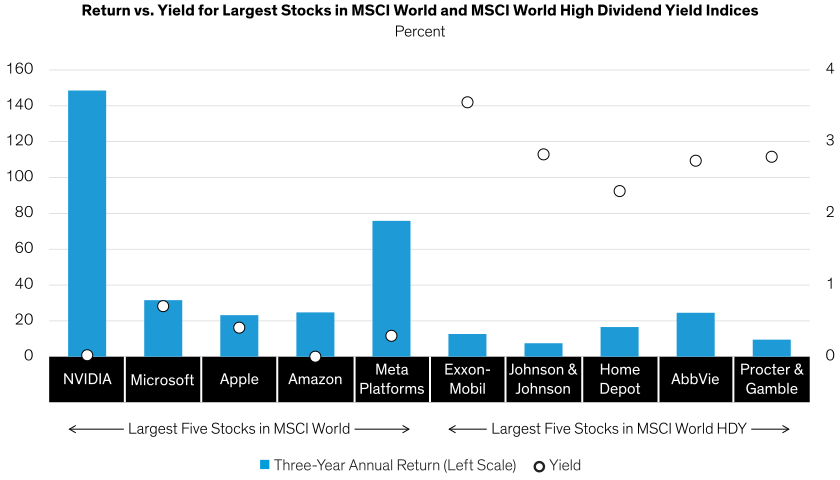
High-Dividend tends to lean away from growth sectors and countries, such as tech and the US

Past performance does not guarantee future results. Specific securities shown are for illustrative purposes only and should not be considered recommendations by AllianceBernstein L.P. It should not be assumed that investments in the securities mentioned have necessarily been or will necessarily be profitable.
As of September 30, 2025
Source: MSCI and AB

A More Holistic Way to Capture Dividend Income

We think a diversified, systematic approach that reaches beyond traditional yield sources to pursue long-term growth potential can be especially effective. By using a quantitative framework, we can tilt toward companies that score well across a broader set of factors, especially:

  • Quality—firms with strong balance sheets and stable earnings
  • Momentum—companies with positive price trends amid ongoing rallies
  • Low Volatility—steady names that add a defensive layer when markets dip
  • Value—business models attractively priced relative to strong fundamentals and prospects

We believe this type of multifactor income produces a more balanced strategy with the potential to deliver competitive income while maintaining growth potential and staying agile across market regimes. The patterns of April’s sharp market downturn and recovery showcased the complementary nature: low-volatility and value stocks offered downside mitigation, while quality, momentum and growth-oriented stocks led the rebound.

Taking Advantage of Regional Market Divergence

Another advantage of a systematic approach is its flexibility to tailor exposures by region. Equity markets vary significantly across geographies, and aligning factor tilts with local strengths can enhance outcomes.

For example, dividend yields tend to be higher—and value opportunities more abundant—in Europe, especially in sectors like financials. The region’s banks and insurers have benefited from rising interest rates, which have boosted net interest margins and improved profitability. These “value compounders” have delivered strong returns in recent years, making Europe a fertile ground for dividend and value tilts.

In contrast, US markets are dominated by growth and innovation, with tech firms offering modest dividends but exceptional earnings growth. In this case, leaning into quality, growth and momentum factors may help capture upside potential alongside higher income-generating assets.

To sum things up, plain-vanilla dividend strategies may offer the income that investors seek, but it’s often at the expense of diversification or exposure to upside potential. A systematic, multifactor approach offers access to more flavors in a balanced strategy that we believe may be better equipped to navigate changing market conditions.


The views expressed herein do not constitute research, investment advice or trade recommendations, do not necessarily represent the views of all AB portfolio-management teams and are subject to change over time.

References to specific securities discussed are for illustrative purposes only and should not to be considered recommendations by AllianceBernstein L.P. It should not be assumed that investments in the securities mentioned have necessarily been or will necessarily be profitable.

MSCI makes no express or implied warranties or representations, and shall have no liability whatsoever with respect to any MSCI data contained herein.

The MSCI data may not be further redistributed or used as a basis for other indices or any securities or financial products. This report is not approved, reviewed or produced by MSCI.


About the Authors