Why Banking Regulation Is Still a Game-Changer for European Financials

13 February 2020
4 min read

European banking regulation has triggered a secular transfer of value from bank equity holders to bondholders. But is this long-running trend played out now? We don’t think so.

The global financial crisis (GFC) was a watershed moment for banks globally. Perceived as the proximate cause of the crisis, banks were the first to be regulated more harshly. Although the events of the GFC are more than 10 years distant now, the repercussions continue to impact European banks’ equity holders— and are still working in favour of their bondholders.

Tougher Regulations Protect Bondholders as well as Customers

Since the GFC, regulators have forced banks globally to raise more capital, shrink their balance sheets and improve their liquidity. The result has been safer banks with more protection for bondholders by virtue of higher capital buffers (Display).

Common Equity Tier 1 (CET1) of European Banks

Higher Capital Ratios Provide More of a Cushion for Bondholders
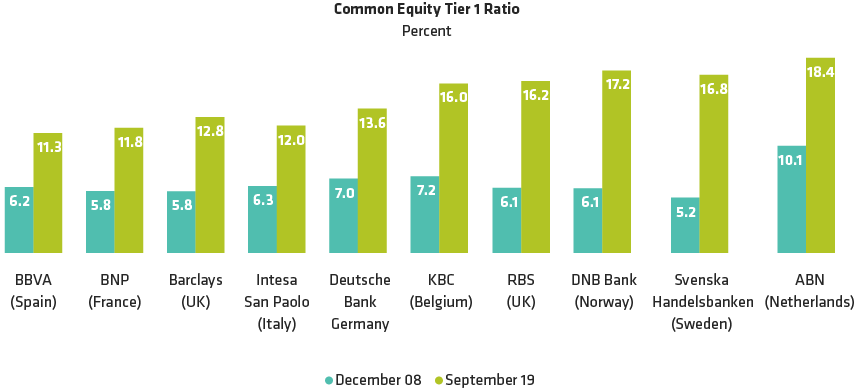
Common Equity Tier 1 (CET1) of European Banks

As of 31 December 2019
Analysis provided for illustrative purposes only and is subject to revision. Historical analysis does not guarantee future results.
For Group 1 Banks. As defined by the European Banking Authority, Group 1 banks are those that have Tier 1 Capital in excess of €3 billion and are internationally active.
Source: ECB and AllianceBernstein (AB)

Return on Equity Still Subnormal

On the other hand, banks’ return on equity has been suppressed. That’s because higher capital has a dilutive effect on equity. And profitability has been weak, particularly in Europe, given low rates, a flat yield curve and a low-growth environment. None of these factors will reverse quickly, in our view.

Return on Equity for European Banks Has Remained Subdued

The New Normal Is Painful for Most Equity Holders
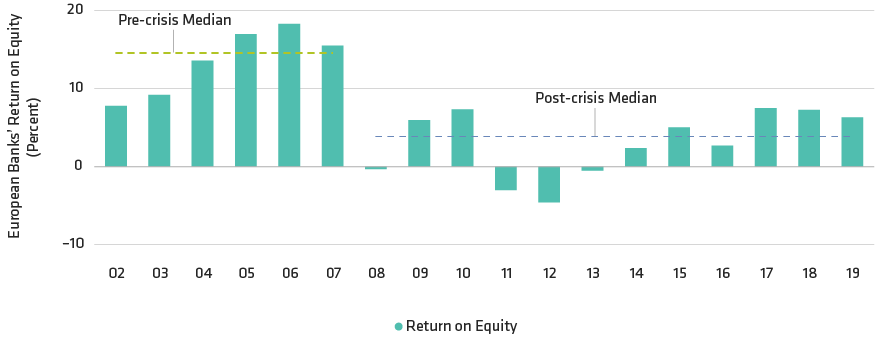
Return on Equity for European Banks Has Remained Subdued

As of 31 December 2019
Analysis provided for illustrative purposes only. Historical analysis does not guarantee future results.
Based on SX7E Euro Bank Stoxx
Source: Bloomberg and AB

Performance Differential Has Been Remarkable

How have these changes been reflected in the market? The most notable effect can be seen in returns of bonds versus stocks. In particular, Additional Tier 1 (AT1) securities* have outperformed banks’ equity by around 13.5% on an annualized basis since the GFC (Display). As the world went into crisis, European stocks and bonds both slumped. Post-crisis, AT1s rebounded—while banks’ equity continued to languish.

Cumulative European Banks AT1 and Equities Returns Since the Financial Crisis

Post-Crisis, Bank Equities Languish While AT1 Soars
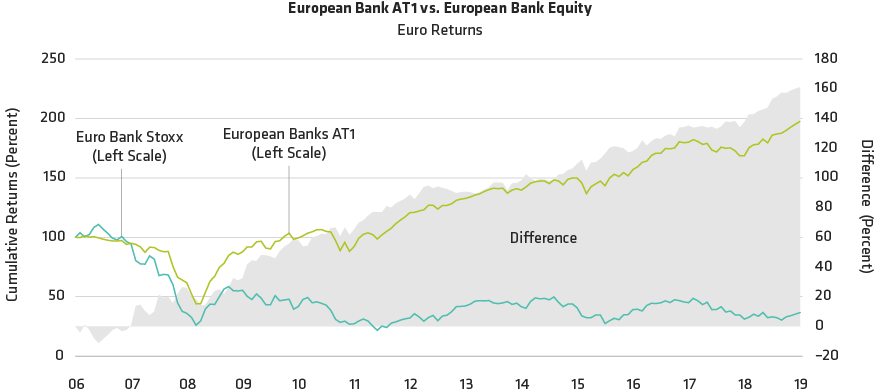
Cumulative European Banks AT1 and Equities Returns Since the Financial Crisis

Through 31 December 2019
Analysis provided for illustrative purposes only. Historical analysis does not guarantee future results.
Based on SX7E Euro Bank Stoxx and Bloomberg Barclays European Banks AT1 benchmark since 30 May 2014 and the Bloomberg Barclays Global Capital Securities before that (both indices are euro-hedged)
Source: Bloomberg Barclays and AB

Performance Drivers Still Intact

This trend is unlikely to reverse anytime soon in Europe, in our view. That’s because we see no signs that European banks are re-leveraging, while weak growth and low or negative rates in the eurozone continue to depress their profitability.

Globally, there are some initial indicators of a stabilization in the growth slowdown. But in Europe, we think growth faces greater risks even though some of the uncertainty surrounding international trade is receding. That’s the view of European Central Bank (ECB) president Christine Lagarde, too, as set out at the ECB’s January press conference. Meanwhile ECB policy looks to be on hold, awaiting the results of a thoroughgoing strategic review that may take a year or more.

A robust, profitable banking sector is the traditional engine of economic growth. But boosting growth by reinforcing the long-term strength of the banking sector is not yet on the table for European governments and central banks. Negative central bank interest rates have shaved off a total of €21.4 billion of banking profits in the eurozone**, and in May 2019 banks paid a record €7.6 billion on their surplus deposits. In other words, eurozone banks are paying €21 million to the ECB every single day.

Eurozone bank executives are challenging these policies. They’ve lobbied hard to convince policymakers of the dangers of long-term negative interest rates, but without success. The current push for increased fiscal spending may ultimately prove more helpful in creating profitable lending opportunities. But it is still very early days to anticipate benefits from this strategy as cautious euro-area governments continue to drag their feet. So far, European banks have only the palliative support of successive long-term funding schemes (TLTROs), plus new tiering arrangements, to relieve the worst impact of the ECB’s negative rate policy. A return to more conventional thinking remains far off, it seems, as the ECB doubles down on its extraordinary monetary stimulus policies.

So, bank shareholders continue to face secular headwinds as they struggle to improve their profitability. To be sure, after significant underperformance there are some high-yielding equity bargains to be found among select European banks with differentiated business models. And even during recent testing conditions, a select few bank stocks have performed well. But it takes skilled analysis to sift future winners from losers, given the challenges banks are facing now from changing markets and evolving technology. Meanwhile, a low-growth limbo suits bank bondholders just fine.

Risk Is Resurfacing—but Not for Bank Bondholders

Years of central bank stimulus have been reflating bubbles across the global economy, sparking fears of a new crisis. Should one appear, the impact could be severe for some over-leveraged non-financial corporates sectors which have piled into the debt party. But by and large, banks in both the US and Europe have de-levered, and the likelihood of re-leveraging in the near future is still low. They remain well capitalized and their bondholders remain well cushioned (Display, below).

Leverage Is Still Growing—But Not in the Financials Sector

Over-Leveraged Non-Financials (And Some Sovereigns) May Present the Bigger Risk
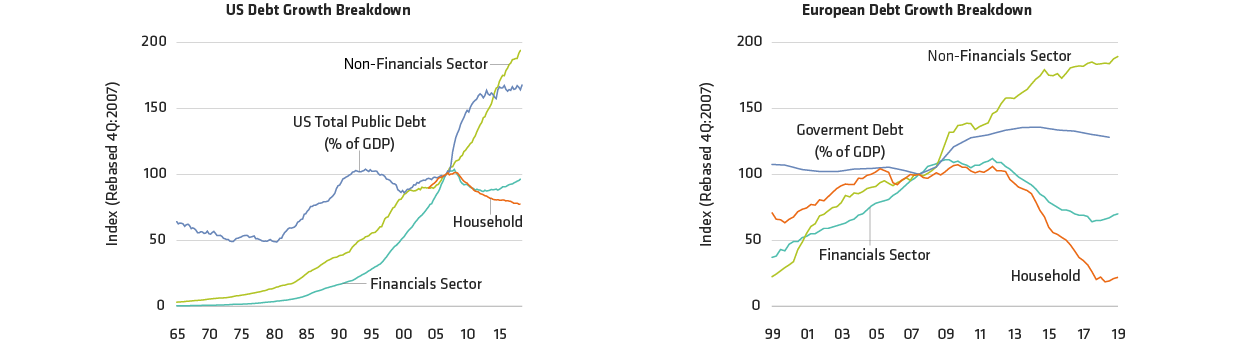
Leverage Is Still Growing—But Not in the Financials Sector

Through 30 September 2019
Analysis provided for illustrative purposes only and is subject to revision. Historical analysis does not guarantee future results.
Source: ECB and Federal Reserve Bank of St. Louis

Is it too late to allocate to AT1s after several years of strong returns? Not while the key drivers of performance remain unchanged. For now, AT1s still have the wind at their backs.
*or legacy Tier 1 securities before the creation of the AT1 market

**Source: Deposit Solutions GmbH

The views expressed herein do not constitute research, investment advice or trade recommendations and do not necessarily represent the views of all AB portfolio-management teams and are subject to revision over time. AllianceBernstein Limited is authorised and regulated by the Financial Conduct Authority in the United Kingdom.