
Capture Emerging Growth Opportunities with Active ETFs
Key Takeaways
- A sagging dollar and relative trade clarity are supporting emerging markets, which have historically delivered strong returns in the year following an earnings bottom.
- We believe skilled active management in emerging-market (EM) equities may lead to more consistent excess returns than passive benchmarks.
- The AB Emerging Markets Opportunities ETF (NYSE: EMOP) uses quantitative and fundamental research to zero in on companies with attractive valuations and positive earnings momentum.
Emerging Markets: A Boost from Tariff Clarity and the Dollar Downturn
After a period of sustained US-led growth, we think the climate has shifted to favor international stocks—including Emerging Markets (EM) equities—thanks in part to a weaker US dollar and more clarity on the tariff picture. As we see it, valuations already reflect tariff risk, and many supply chains have been reworked to cushion against possible disruptions. As the high-tariff scenario recedes, it brightens EM earnings prospects.
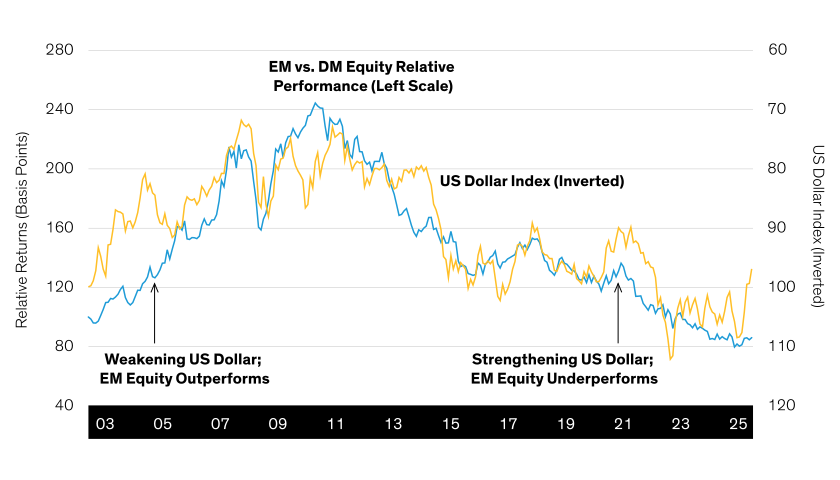
The dollar’s decline is playing a role too. Historically, a weakening greenback has been an EM tailwind (Display). One reason: it attracts capital from foreign investors seeking higher returns. A slumping dollar also makes it cheaper for EM bond issuers to service their debt—much of it denominated in dollars. And it boosts commodity prices, benefiting many EM economies that export these critical building blocks.
US Dollar Weakness Has Historically Been an EM Tailwind
Performance of Emerging- vs. Developed-Market Equities and US Dollar Index
Analysis is provided for illustrative purposes only and is subject to revision. Past performance does not guarantee future results.
Yellow line: ICE U.S. Dollar Index, inverted; Blue line: EM-DM equity relative performance (MSCI Emerging Markets minus MSCI World Index); Emerging-market (EM) equities represented by MSCI Emerging Markets Index; developed-market (DM) equities represented by MSCI World Index; US dollar represented by DXY Index.
Through June 30, 2025
Source: Bloomberg, MSCI and AllianceBernstein (AB)
Earnings Bottom Could Point to Strong Return Prospects
Recent concerns and uncertainty around tariffs may have been one factor taking the steam out of EM companies’ earnings, but as the trade picture has settled down somewhat, the stage could be set for a recovery. In fact, a survey of the current landscape provides an optimistic note.
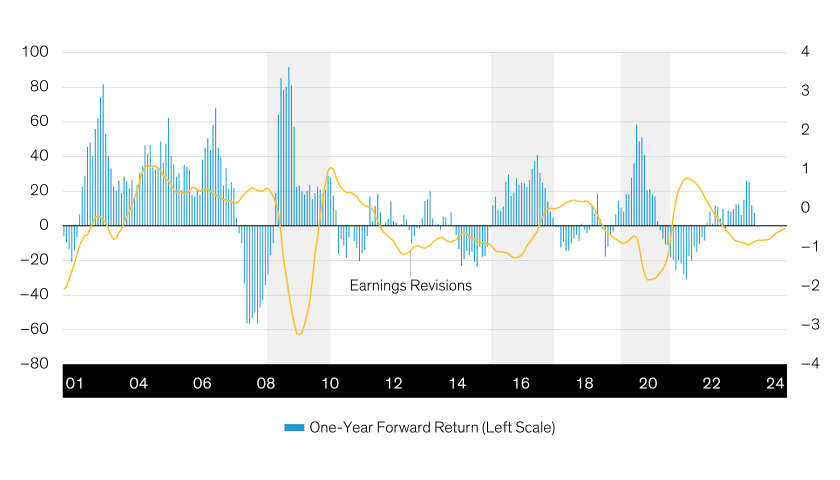
Historically speaking, the EM equity earnings picture often seemed darkest just before the dawn of a rebound. In the past, when EM earnings revisions have bottomed out—such as in 2009, 2016 and 2020—the ensuing year’s equity returns have been quite strong (Display). With earnings revisions recovering, return prospects could be looking up too.
Earnings Bottoms Have Tended to Signal Return Potential Ahead
EM Equity Performance vs. EM Earnings Revisions* (Percent)
Past performance and current analysis do not guarantee future results.
*EM revisions are three-month smoothed. One-Year Forward Return is represented by the performance of the MSCI Emerging Markets Index.
Through December 31, 2024
Source: Bloomberg, FactSet, MSCI and AB
Emerging Markets: Where Being Active Can Make a Bigger Difference
Active management is crucial in the careful calculus of risk and return. Investors gauge potential opportunities, identify and understand the risks, and design portfolios that are intended to prevent taking unnecessary risks while striving to maximize the return potential for the risks they do take.
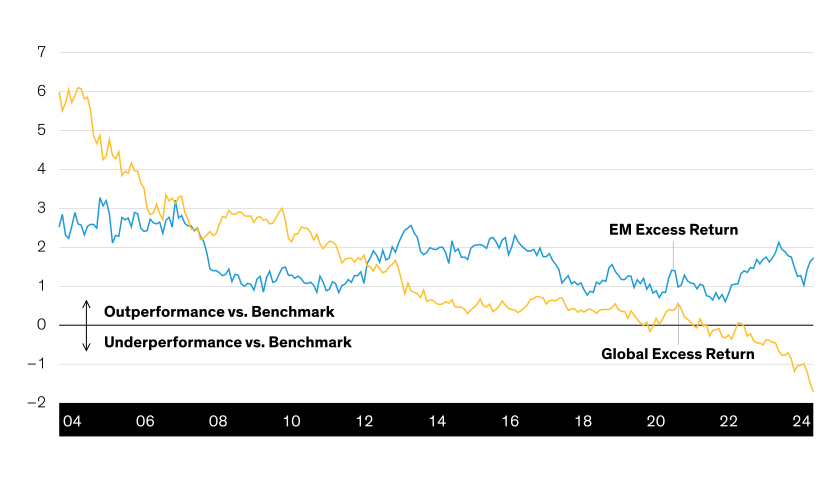
In emerging markets, which are typically less efficient than larger, developed markets, active management has more room to shine. This potential has played out in practice: historically, the median active EM equity strategy has consistently outperformed passive benchmarks (Display). And managers with greater skill and better tools could fare even better.
Emerging Markets: Fertile Ground for Active Equity Managers
Five-Year Rolling Excess Return of Median Strategy (Percent)
Past performance does not guarantee future results.
Based on eVestment universes for EM and global all-cap and large-cap active equity strategies.
Benchmark used for EM excess returns is MSCI Emerging Markets. Benchmark for global excess returns is MSCI World. Based on gross returns before fees.
Through December 31, 2024
Source: eVestment, MSCI and AB
AB’s EMOP ETF: Tapping EM Equity Growth Potential…Actively
Investors looking to access compelling EM growth prospects should explore the AB Emerging Markets Opportunities ETF (NYSE: EMOP). The active, high-conviction strategy combines quantitative and fundamental insights to invest in firms with attractive valuations and positive earnings momentum (Display), helping to ensure timely and strategic entry points. By investing at what we believe to be the right price and right time, EMOP is designed to deliver strong, consistent returns.
EMOP: High Profitability at an Attractive Price and at the Right Time
Portfolio Characteristics vs. MSCI Emerging Market Equity Index

Current analysis does not guarantee future results.
Based on a representative Emerging Markets Opportunities equity account
As of June 30, 2025
Source: Barra, MSCI and AB
If you’re an investor seeking trading guidance, the AB ETF Capital Markets team offers complementary trade advisory services. Reach us at etf.capitalmarkets@alliancebernstein.com, and find out more about AB’s actively managed ETFs here.
How to Take Action
Sign Up
Visibility Into Our ETF Insights.
Get periodic insights, tools and access to events from AB’s ETF experts.
Thank You
Thank you for contacting us. Expect a reply soon.
The MSCI Emerging Markets Index (free float-adjusted market capitalization weighted) represents the equity market performance of emerging markets
The MSCI World Index (free float-adjusted market capitalization weighted) represents large and mid cap securities across 23 developed markets countries and covers approximately 85 percent of the free float-adjusted market capitalization in each country.
The ICE U.S. Dollar Index (DXY) measures the value of the U.S. dollar against a basket of six major currencies using a geometrically weighted calculation.
Investing in securities involves risk and there is no guarantee of principal.
Investors should consider the investment objectives, risks, charges and expenses of the Fund/Portfolio carefully before investing. For copies of our prospectus or summary prospectus, which contain this and other information, visit us online at www.alliancebernstein.com or contact your AB representative. Please read the prospectus and/or summary prospectus carefully before investing.
Shares of the ETF may be bought or sold throughout the day at their market price on the exchange on which they are listed. The market price of an ETF’s shares may be at, above or below the ETF’s net asset value (“NAV”) and will fluctuate with changes in the NAV as well as supply and demand in the market for the shares. Shares of the ETF may only be redeemed directly with the ETF at NAV by Authorized Participants, in very large creation units. There can be no guarantee that an active trading market for the Fund’s shares will develop or be maintained, or that their listing will continue or remain unchanged. Buying or selling the Fund’s shares on an exchange may require the payment of brokerage commissions, and frequent trading may incur brokerage costs that detract significantly from investment returns.
Emerging-Markets Risk: Emerging markets may involve greater risks, such as currency volatility, political and social instability, and reduced market liquidity. Foreign (Non-US) Investment Risk: Investments in securities of non-US issuers may involve more risk than those of US issuers. These securities may fluctuate more widely in price and may be more difficult to trade than domestic securities due to adverse market, economic, political, regulatory or other factors. Currency Risk: Fluctuations in currency exchange rates may negatively affect the value of the Fund’s investments or reduce its returns. Country Concentration Risk: The Fund may not be diversified among countries or geographic regions, and the effect on the Fund’s net asset value, such as political, regulatory and currency risks, may be magnified due to concentration of the Fund’s investments in a particular country or region, such as China. Risks of the Fund’s investments in securities of companies economically tied to China may include the volatility of the Chinese stock market, the Chinese economy’s heavy dependence on exports and the continuing importance of the role of the Chinese government. Recent developments in relations between the US and China have heightened concerns of increased tariffs and restrictions on trade between the two countries. An increase in tariffs or trade restrictions, or even the threat of such developments, could lead to a significant reduction in international trade, which could have a negative impact on the economy of Asian countries and a commensurately negative impact on the Fund. China/Single-Country Risk: Investments in issuers located in a particular country or geographic region typically involve more risk than investments in US issuers because of particular market factors affecting that country or region, including political instability, geopolitical risks or unpredictable economic conditions. Risks of the Fund’s investments in securities of companies economically tied to China may include the volatility of the Chinese stock market; the Chinese economy’s heavy dependence on exports, which may be affected adversely by trade barriers or disputes or may decrease, sometimes significantly, when the world economy weakens; and the continuing importance of the role of the Chinese government, which may take legal or regulatory actions that affect the contractual arrangements of a company or economic and market practices, and cause the value of the securities of an issuer held by the Fund to decrease significantly. Actions by a Few Major Investors: In certain countries, volatility may be heightened by actions of a few major investors. For example, substantial increases or decreases in cash flows of funds investing in these markets could significantly affect local stock prices and, therefore, share prices of the Fund. Sector Risk: The Fund may have more risk because it may invest to a significant extent in one or more particular market sectors, such as the information technology sector. To the extent it does so, market or economic factors affecting the relevant sector(s) could have a major effect on the value of the Fund’s investments.
Distributed by Foreside Fund Services, LLC. Foreside is not affiliated with AllianceBernstein.
The [A/B] logo and AllianceBernstein® are registered trademarks used by permission of the owner, AllianceBernstein L.P.
© 2025 AllianceBernstein L.P.
AL-802514-2025-09-11