
Four Reasons to Leave Cash for Munis in 2025
Key Takeaways
- The opportunity cost to investors staying parked in cash or cash-like instruments may be growing with the Fed eyeing rate cuts.
- Municipal bonds are historically attractive today, offering better after-tax return potential than high-quality taxable bonds—and a path out of cash.
- AB’s Tax-Aware Short Duration Municipal ETF (TAFI) offers active management, income and potential price gains as rates fall—without the volatility of long-term bonds.
After two years of higher interest rates, many investors are still parked in cash or something similar. This positioning may have made sense when the Fed was tightening, but we see the opportunity cost growing as a change in the policy regime looms. With the macro backdrop shifting, 2025 seems like one of the most enticing entry points into municipal bonds in recent memory.
Here are four reasons for investors to consider munis over cash today.
1. With the Fed Poised to Pivot, Cash Will Likely Lag
The Fed paused rate hikes last year, and with inflation easing and the job market somewhat cooler, rate cuts are expected. That prospect has many investors taking a closer look at cash exposure. Historically, yields on money-market funds and short-term instruments have reacted to Fed cuts in real time, so attempting to time the market can be perilous.
2. Municipal Bonds Offer Strong Relative Value
Muni yields are historically attractive today. Once the tax benefits are factored in, munis possess better after-tax return potential than high-quality taxable bonds. We think that makes munis a smart move for investors, particularly those in higher tax brackets.
3. Duration May Be Your Friend if Rates Fall
With rate cuts expected, even some duration exposure could be an opportunity. That’s where short-duration municipal strategies come in. They may benefit investors as yields start falling, and they don’t have the higher volatility of longer-term bonds. Robust after-tax income potential and a possible return boost from price gains suggest this is a sound way to shift out of cash while staying relatively conservative.
4. Cash Is No Longer “Risk-Free”: Meet Reinvestment Risk
As rates fall, investors still in cash will be forced to reinvest it at falling yields. This could lock in lower returns for years. Munis, by contrast, offer investors the ability to lock in attractive after-tax income potential today, with possible capital appreciation as rates fall.
Consider AB’s Tax-Aware Short Duration Municipal ETF (TAFI)
For investors looking to leave cash, TAFI offers a compelling solution (Display). It’s built with diversified exposure to high-quality munis, a strategic allocation to muni credit and a tactical allocation to taxable bonds. With its active management, TAFI can capitalize on market dislocations and credit/curve positioning.
TAFI’s portfolio construction gives investors access to both income and the potential benefit of price appreciation as rates fall—even as it keeps a moderate duration profile. We think this makes it an ideal vehicle for those seeking to move out of cash without taking on the volatility of long-term bonds.
But the muni market tends to reprice quickly once the Fed pivots, so we think it’s time to step off the sidelines and get ready. Using TAFI’s daily liquidity, investors can get in position ahead of rate cuts. That seems like a better path than waiting for the “go” signal from the Fed and possibly missing out on the best part of the rally.
If you’re an investor looking for trading guidance, the AB ETF Capital Markets team offers complementary trade advisory services. You can reach us at etf.capitalmarkets@alliancebernstein.com. And you can find out more about AB’s actively managed ETFs here.
TAFI’s Tax-Equivalent Yield Handily Outpaces Cash Alternatives
AB Tax-Aware™ Short Duration Municipal ETF (TAFI) Yield Comparison
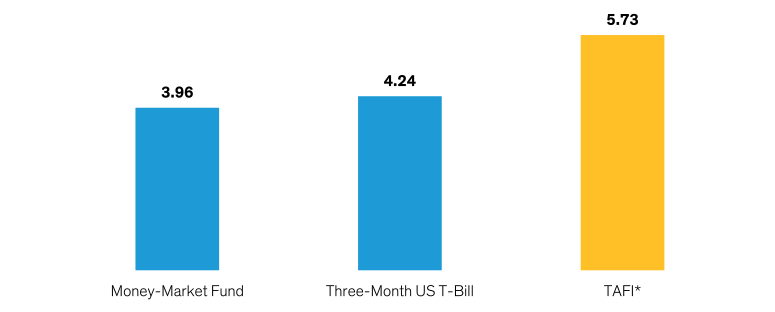
Past performance does not guarantee future results. For illustrative purposes only. Assumes max 40.8% tax rate
*TAFI yield to worst shown on a tax-equivalent basis
As of July 31, 2025
Source: Bankrate, Bloomberg, YCharts, and AllianceBernstein (AB)
Money-Market Fund: Average yield as of 07/31/25 of the funds in the Morningstar Taxable Money Market product category
The performance shown represents past performance and does not guarantee future results. Current performance may be lower or higher than the performance information shown. The investment return and principal value of an investment in the Portfolio will fluctuate, so that shares, when redeemed, may be worth more or less than their original cost. Performance assumes reinvestment of distributions and does not account for taxes. For TAFI standardized performance https://www.alliancebernstein.com/us/en-us/investments/products/etf/fixed-income/ab-tax-aware-short-duration-municipal-etf.-.00039J202.html
A Money Market Fund (MMF) invests in short-term, high-quality debt; a 3-Month T-Bill is a direct, government-backed short-term debt security; and an ETF (Exchange-Traded Fund) is a diversified investment fund, traded on an exchange, holding various assets like stocks, bonds, or commodities. Key differences include the nature of the investment (pooled vs. direct), risk profile (MMFs and T-bills are generally very low-risk, while ETFs vary widely by underlying assets), and how they are traded (MMFs and T-bills have limited trading windows, while ETFs trade continuously throughout the day).
How to Take Action
Sign Up
Visibility Into Our ETF Insights.
Get periodic insights, tools and access to events from AB’s ETF experts.
Thank You
Thank you for contacting us. Expect a reply soon.
Yield to Worst (YTW) denotes the lowest possible amount of interest which can be earned on a callable bond.
Important Information
Investing in securities involves risk and there is no guarantee of principal.
Shares of the ETF may be bought or sold throughout the day at their market price on the exchange on which they are listed. The market price of an ETF’s shares may be at, above or below the ETF’s net asset value (“NAV”) and will fluctuate with changes in the NAV as well as supply and demand in the market for the shares. Shares of the ETF may only be redeemed directly with the ETF at NAV by Authorized Participants, in very large creation units. There can be no guarantee that an active trading market for the Fund’s shares will develop or be maintained, or that their listing will continue or remain unchanged. Buying or selling the Fund’s shares on an exchange may require the payment of brokerage commissions and frequent trading may incur brokerage costs that detract significantly from investment returns.
Duration measures the sensitivity of a portfolio’s price to interest rate movements.
A WORD ABOUT RISK:
Below Investment Grade Securities Risk: Investments in fixed-income securities with lower ratings (commonly known as junk bonds) are subject to a higher probability that an issuer will default or fail to meet its payment obligations. These securities may be subject to greater price volatility due to such factors as specific municipal or corporate developments and negative performance of the junk bond market generally and may be more difficult to trade than other types of securities. Bond Risk: The Fund is subject to the same risks as the underlying bonds in the Portfolio such as credit, prepayment, call and interest-rate risk. As interest rates rise the value of bond prices will decline. Derivatives Risk: Derivatives may be more sensitive to changes in market conditions and may amplify risks. Municipal Market Risk: Economic conditions, political or legislative changes, public health crises, uncertainties related to the tax status of municipal securities, or the rights of investors in these securities may negatively impact the yield or value of a municipal security. Tax Risk: The US Government and the US Congress may periodically consider changes in federal tax law that could limit or eliminate the federal tax exemption for municipal bond income, which would in effect reduce the income received by shareholders from the Fund by increasing taxes on that income.
Investors should consider the investment objectives, risks, charges and expenses of the Fund/Portfolio carefully before investing. For copies of our prospectus or summary prospectus, which contain this and other information, visit us online at abfunds.com or contact your AB representative. Please read the prospectus and/or summary prospectus carefully before investing.
AllianceBernstein L.P. (AB) is the investment adviser for the Fund. Distributed by Foreside Fund Services, LLC. Foreside is not related to AB
AL-790114-2025-08-14