Commercial Real Estate: As Europe’s Banks Step Back, Insurers Step In

September 08 2026
4 min read

Europe’s bank-led lending model is evolving. That’s good news for insurance investors.

Banks in Europe still dominate commercial real estate lending. But tighter regulatory capital requirements and balance-sheet constraints have been steadily pushing activity into private markets, echoing a more advanced transition from public to private financing in the United States. The shift is still in its early stages. But we believe it will transform the investment landscape and the opportunity set for insurers.

Fixed-income investments dominate most European insurers’ asset allocations, with corporate credit often playing a starring role. Privately originated commercial real estate debt has the potential to diversify that exposure. Rather than primarily relying on the earnings power of a corporate issuer, the debt is supported by contractual rental income, property cash flows and the value of the underlying real assets—the apartment buildings, data centers or warehouses that underpin the loans. Both floating-rate and fixed-rate loans are possible.

But commercial real estate’s value to insurers is functional as much as financial. Its appeal lies not only in the returns it generates but in the way it can help insurers solve portfolio construction challenges. This includes the ability to match assets to liabilities, diversify exposure to corporate earnings and increase regulatory capital efficiency.

A Capital Efficient Opportunity

Demand for real estate debt over the last few years hasn’t been limited to insurers. That’s partly because a rise in the base rates used to price loans has increased real estate debt’s ability to generate equity-like returns without equity risk. That’s an attractive proposition for many institutional investors. But it’s a temporary quirk in pricing that won’t last forever.

In this case, it also misses the point. For insurance investors, it’s real estate’s return on risk capital—not its absolute return—that matters most. Satisfying both of those objectives is important. But in most market environments, the key consideration for insurers isn’t which asset offers the highest yield, but which one offers the best return after accounting for credit risk and regulatory capital requirements.

Commercial real estate loans do this remarkably well. Senior loans are typically backed by strong collateral and come with conservative loan-to-value ratios, robust cash-flow coverage and favorable regulatory treatment under Europe’s Solvency II regulatory regime. Many can be treated as having investment-grade risk characteristics even though no public rating exists and attract capital charges similar to investment-grade bonds.

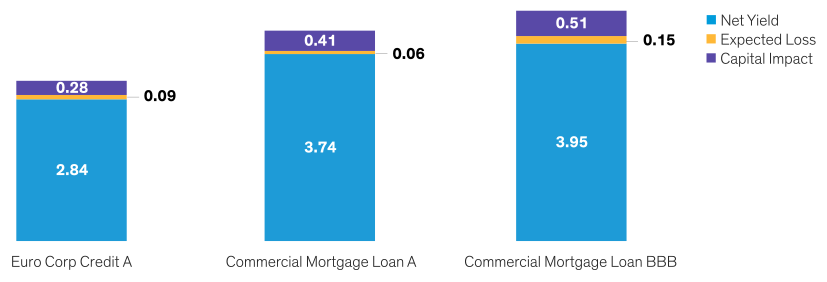
Some loans come with the potential to retain a larger share of their yield advantage even after allowing for expected losses and the cost of capital. As the following Display illustrates, loans with internal ratings that correspond to A and BBB generated higher yields than A-rated corporate credit. The additional income compensated insurers for the higher capital burden, underscoring why commercial real estate debt can act as an attractive complement to investment-grade corporate bonds.
How Real Estate Loans Stack Up Against Corporate Debt
Bar chart compares net yield, expected loss and capital impact of A and BBB CRE loans and A corporate credit.

Expected loss estimates the credit losses that might occur over a full market cycle, most likely due to default.
Capital Impact reflects the opportunity cost of the regulatory capital an insurer must hold to own the asset.
As of  August 20, 2026
Source: AllianceBernstein (AB)

Relative Value, Regional Differences

Europe is a fragmented and often inefficient market, with different legal systems and creditor protections. Banks’ appetite to lend, while broadly on the decline, still varies by country. These factors can create distinct relative value opportunities for seasoned private lenders with strong origination capabilities and underwriting expertise across property types and loan structures.

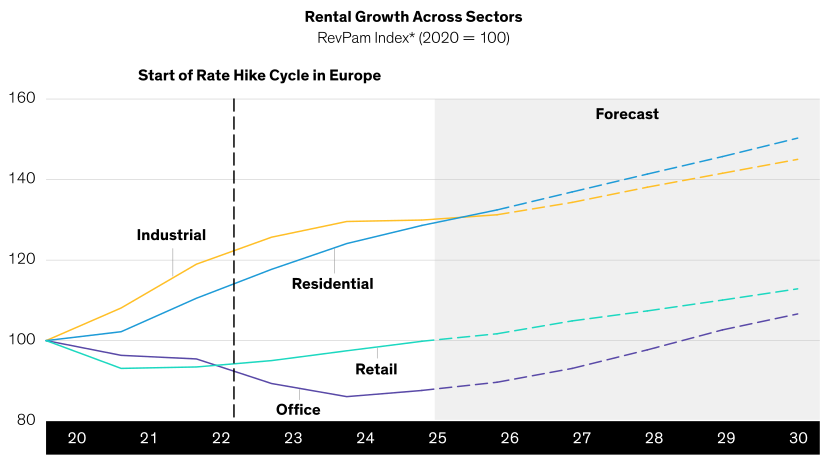
What’s more, most sectors in Europe have demonstrated stable or growing rental levels—a trend that has broadly remained intact even as interest rates have increased and property valuations declined. We expect that to persist (Display).

European Commercial Real Estate Cash Flows Still Robust
Lines representing cash flow slope upward as of 2024 for industrial, residential, retail, office, projected to keep rising.

For illustrative purposes only.
*Revenue per available square meter
As of December 31, 2025
Source: Greenstreet

It’s important, of course, that lenders engage in thorough due diligence before making loans. This should involve identifying a credible repayment path, such as refinancing after the borrower has executed on its business plan, or preparing for more troubled exits or recapitalizations should the business plan fall short.

In the current environment we expect most risks will be deal-specific, underscoring the need for careful due diligence and underwriting. But we see that as an environment that will favor experienced lenders.

Even so, we believe neither geography nor sector should dominate allocation decisions. Instead, every opportunity should be assessed individually on several key factors, including asset quality, leverage, sponsor strength, business-plan execution, legal jurisdiction and covenant protection. The most attractive opportunities are often those where capital is scarce, complexity is high, and borrowers value execution certainty and structuring expertise.

As private credit markets across Europe expand and become more standardized, we think it’s likely to get easier to create intersecting commercial real estate debt portfolios across multiple channels, which may increase diversification. For example, investing 10% of risk capital into a single London office tower or a portfolio of 300 logistics properties in Germany will result in the same concentration to the borrower. But the latter provides broad diversification through location and the various tenants of each property.

The foundations of European real estate finance are changing. As banks become more selective and insurers take on a larger financing role, commercial real estate debt may emerge as an increasingly important building block in insurance portfolios.

The views expressed herein do not constitute research, investment advice or trade recommendations, do not necessarily represent the views of all AB portfolio-management teams and are subject to change over time.


About the Authors