High yields, a flattening curve and strong demand appear poised to propel munis.
Despite volatility, muni markets finished strong in 2025, and we are optimistic for a repeat in 2026. We expect steady investor demand and rate cuts to continue to fuel market momentum. In our view, investors who stay flexible will be best positioned to navigate volatility and seize new opportunities. And given munis’ high after-tax yields, investors could be well compensated along the way.
Rate Cuts, Supply and Demand to Set the Tone
As in 2025, the path to higher returns in 2026 won’t be a straight line. We expect several factors to shape municipal market performance, starting with interest rates. A divided Federal Reserve resumed easing in December, although long-delayed jobs and inflation data led them to hint at a pause in January. Barring a major upside surprise, however, we think policymakers will eventually continue to cut—and have the room to do it.
Inflation remains high in some areas of the economy but well below 2022 peaks. Unemployment levels appear stable yet weaker, with hiring clearly slowing in some sectors. And we anticipate cooling economic growth. As a result, we expect the Fed to cut the benchmark rate to 3%, and possibly lower, over the coming year.
One potential headwind in 2026 is an increase in new issuance. Muni market new issuance hit a record $565 billion ($517 billion tax-exempt and $48 billion taxable) in 2025. According to J.P. Morgan, with municipalities facing rising capital improvement costs, issuance is likely to reach $600 billion ($545 billion tax-exempt and $55 billion taxable) in 2026.
Heavy issuance typically raises concerns about whether investor demand will keep pace. In early 2025, demand slackened as investors worried about trade-war fallout and munis’ tax-exempt status under the One Big Beautiful Bill Act. But today those anxieties appear to be in the rearview mirror. Demand for municipals has surged, with inflows into muni funds reaching $50 billion in 2025.
A potentially significant tailwind: nearly $8 trillion sidelined in money market funds, waiting for re-entry. We expect a portion of that to return to bond markets over the coming two to three years as the Fed eases and cash rates fall.
When investors look for the most attractive risk-adjusted opportunities to deploy that cash, municipals are likely to top the list. The tax-equivalent yields for investment-grade and high-yield municipals are roughly 6% and 9%, respectively. For investors who pay taxes on capital gains, these yields compare favorably to returns in most other asset classes. The hunt for higher yields may push municipal bond prices higher.
Work the Curve, Target Credit
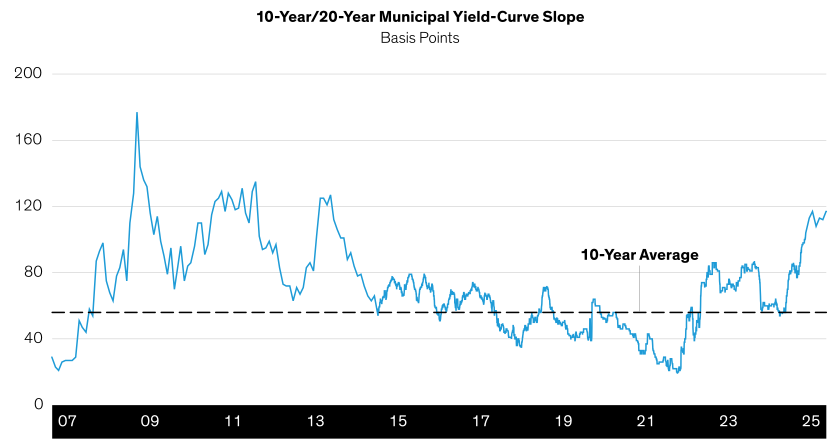
Compelling yields, a steep yield curve, strong credit fundamentals and an easing Fed continue to offer attractive entry points for muni investors. Against this backdrop, consider the following strategies:
1. Lengthen duration. Investors should consider lengthening their portfolio duration, or sensitivity to interest-rate changes, relative to the benchmark. We expect yields to fall as the economy continues to slow and the Fed revisits its rate-cutting cycle. Falling yields benefit bond prices, especially at longer durations.
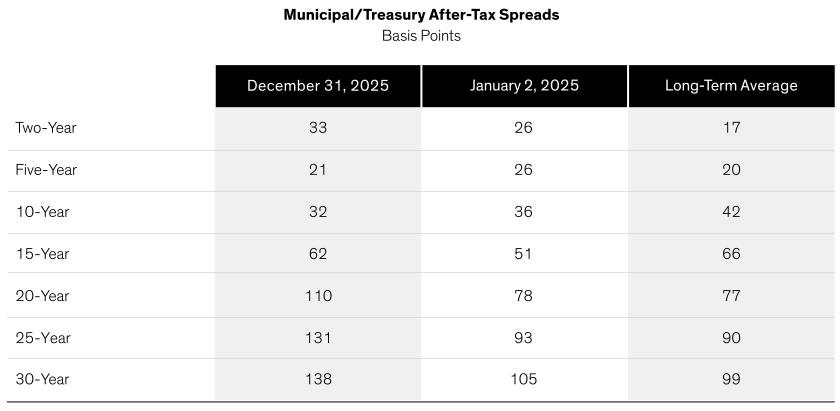
2. Lift a barbell. We think it’s also a good idea to pair longer maturities with short-term bonds in a “barbell” maturity structure. In our analysis, both the short and long ends of today’s municipal yield curve are attractively valued when comparing current spreads to their five-year averages (Display).