Can Value Stocks Offer Resilience to AI Disruption?

May 14 2026
3 min read

Value companies tend to either benefit or buffer as AI uncertainties play out.

High-growth technology stocks still dominate the investment landscape, fueled by the promise of AI. But recent signs of a broadening market are revealing that more industries beyond just tech are positioned to benefit. We think large-cap value stocks are well-poised for this shift, especially since AI can be both a disruptive and driving force in today’s dynamic market.   

The AI revolution is redefining entire market segments. Greater uncertainty over which companies will win or lose the AI race is adding a layer of investment risk, as investors struggle to predict the long-term livelihood of fast-growth companies leading the way. 

AI Is Shaking Up Businesses

For instance, AI concerns recently forced a rapid reset of software stocks, with the market reacting indiscriminately to the technology’s disruptive potential. 

Rapid improvements in AI are also raising concerns about the long-term earnings of companies that rely on white-collar labor or have few physical assets. Investors are increasingly worried that AI could disrupt established business models across industries such as finance, online travel and clinical research services.

AI potentially could significantly change the job market, with ripple effects across many businesses. For instance, companies that depend on large office workforces—such as office real estate investment trusts (REITs), already struggling with lower post COVID-19 occupancy—may face added pressure if AI reduces demand for white-collar jobs. 

McKinsey & Company estimates AI will automate 30% of all hours worked in the next four years. But what will this mean for jobs? AI was cited for sweeping layoffs at hyperscaler Meta Platforms and apparel icon Nike, perhaps the early global wave among 92 million displaced workers projected by the World Economic Forum by 2030.

How Value Can Sidestep AI Risks 

Value stocks might be better insulated from some AI threats, in our view. Large-cap value companies especially tend to comprise “old economy” and cyclical industries with foundations more in the physical world than the cloud. As a result, value strategies tend to be less exposed to potential AI disruptors compared to growth approaches, and far less weighted in vulnerable industries like software, office REITS and entertainment in particular (Display). Value-oriented firms also stretch across a particularly broad range of industries, which we believe adds even more insulation from AI’s twists and turns. 

Value Stocks Tend to Be Less Exposed to AI Disruption
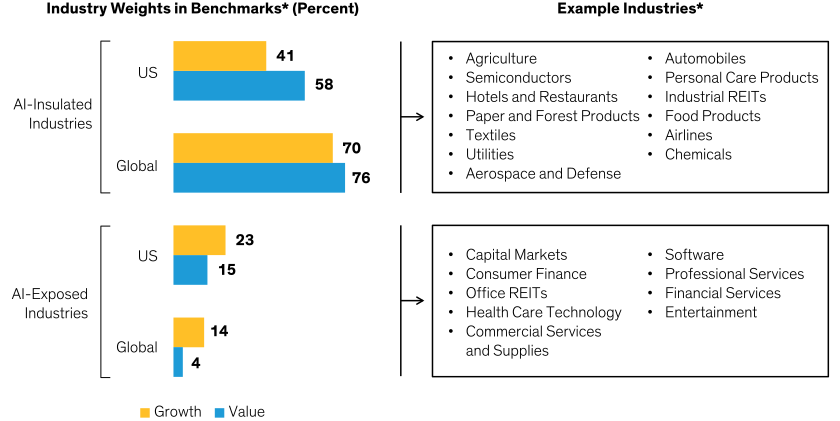
AI-insulated industries like agriculture, textiles, utilities, autos and airlines tend to dominate value stocks.

Current analysis does not guarantee future results.
*AI-insulated and AI-exposed industries are based on research classifications made by AB value equity analysts. Industries are based on the Global Industry Classification Standard. Example industries comprise a portion of the industry weight in each benchmark for AI-insulated and AI-exposed categories.
US stocks represented by the Russell 1000 Value Index and Russell 1000 Growth Index; global stocks represented by the MSCI EAFE Value Index and MSCI EAFE Growth Index.
As of March 31, 2026
Source: Bloomberg, FTSE Russell, MSCI and AllianceBernstein

Alongside this resilience, some value stocks can also be lifted by AI disruption. Many value companies are rooted in physical assets that should become more valuable as AI drives demand for energy, data centers, semiconductors and infrastructure. We think this is partly behind the outperformance of US and global value stocks versus the S&P 500 and the MSCI World respectively in early 2026. 

However, value has other inherent qualities that position it well for strong performance in the AI era. For example, we think value stocks can benefit from trends across more “old economy” industries like healthcare, travel, agriculture and construction that are less subject to the vagaries of AI disruption. These are fertile areas where selective investors can unlock value in companies with solid cash flows, business catalysts, viable management strategies and earnings quality. And they’re where active value selection comes in—the process of separating the wheat from the chaff to harvest idiosyncratic opportunities across a dense field. 

Resilient Industries: From Aircraft to Agriculture

Commercial aircraft manufacturing is a good example. The industry is still broadly challenged in the wake of COVID-19-driven disruptions across the aerospace supply chain. But demand is up and steady for new avionics components and lightweight plane materials, with aerospace provider RTX and carbon fiber maker Hexcel well-positioned to meet it. 

Agriculture is also on our radar, as commodity prices, farmer incomes and heavy machinery demand have significantly dropped since the COVID-19 pandemic. But the shift is on to maximize yield volume across shrinking acreages, and we see Deere & Co. and CNH Industrial as niche leaders in modern equipment and infrastructure that deliver that outcome. 

These diverse trends share a common feature: They aren’t likely to be thrown off course by AI. As AI creates new risks across sectors, we think large-cap value stocks can provide a buffer in two ways: The transformational potential of AI could fuel growth across sectors, benefiting value companies. And as it disrupts industries, value stocks can play defense with their typically lower valuations and less exposure to AI-impacted sectors. This combination makes large-cap value stocks a surprisingly solid way to position equity allocations for the AI era’s unpredictable risks and potential rewards.  

The views expressed herein do not constitute research, investment advice or trade recommendations, do not necessarily represent the views of all AB portfolio-management teams and are subject to change over time.

References to specific securities discussed are for illustrative purposes only and should not to be considered recommendations by AllianceBernstein L.P. It should not be assumed that investments in the securities mentioned have necessarily been or will necessarily be profitable.

MSCI makes no express or implied warranties or representations, and shall have no liability whatsoever with respect to any MSCI data contained herein. The MSCI data may not be further redistributed or used as a basis for other indices or any securities or financial products. This report is not approved, reviewed or produced by MSCI.


About the Authors