Capital Markets Outlook: 4Q 2023

26 October 2023
6 min read

What You Need to Know

As 2023 heads into its final quarter, the current period of market resistance is likely to persist. However, in 2024, the “resistance” theme we’ve been discussing should give way to economic “normalization.” As we see it, this should lead to more reasonable valuations, which will create opportunities for patient investors. 

Key Takeaways

  • As we close the book on 2023, the theme of “resistance” should transition to “normalization.” Despite a challenging second half of the year, our assessment of the capital-markets landscape still shows opportunities in the stock and bond markets.
  • While equity market conditions remain less than picture perfect, we are still finding opportunities for investors. These include some of the more defensive sectors within areas like low volatility, high dividend and quality growth.
  • Fixed-income yields are up across the board, and high-yield bonds look particularly appealing. In the tax-exempt space, we think munis could be poised for strong returns, given attractive yields and the stage of the monetary-policy cycle. 

Prepare for Resistance to Give Way to Normalization

After a strong first half of 2023, markets struggled to sustain the rally in the third quarter, with returns mostly lower across asset classes. The period initially started strong as the rally pushed into July, but then cooled as we entered August; September brought a sharp sell-off in stocks as the longer end of the yield curve rose meaningfully (Display 1).

3Q 2023: Markets Faced Resistance as High Valuations and Even Higher Rates Led to Questions Around Long-Term Fair Value
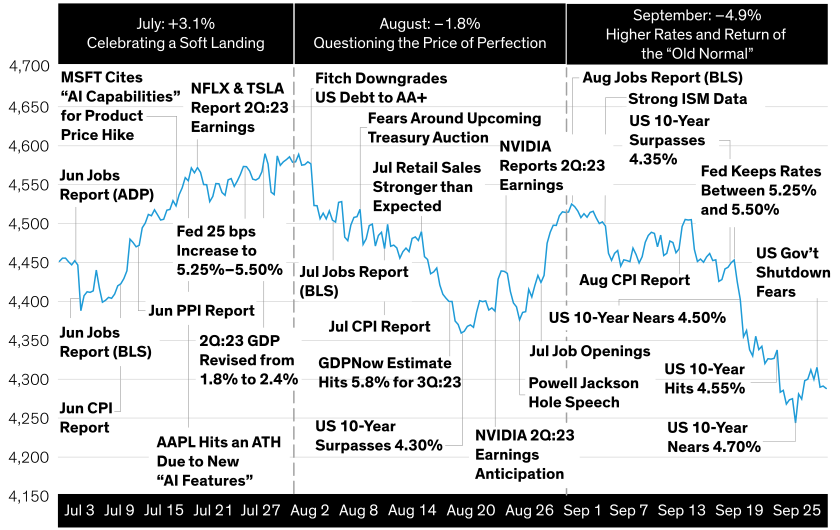
Line graph with time (July to September 2023) on the X-axis and S&P 500 index value on the Y-axis; key economic events are highlighted along the line.

Historical analysis and current forecasts do not guarantee future results.
AAPL: Apple; ATH: all-time high; bps: basis points; BLS: US Bureau of Labor Statistics; CPI: Consumer Price Index; GDP: gross domestic product; ISM: Institute for Supply Management; MSFT: Microsoft; NFLX: Netflix; PPI: Producer Price Index; TSLA: Tesla
Returns are price returns of the S&P 500 Index. Events are placed at approximate points.
As of September 30, 2023
Source: Bloomberg and AB

So what does the macro and market picture look like as the final quarter gets under way? First, inflation’s path lower will continue to not be linear. After bottoming this past June, headline inflation bounced higher during the third quarter. This bounce is expected to peak in December, before gradually settling near the Fed’s target later next year. Second, interest rates will remain higher than the post-global financial crisis era—a situation that increases the chances that a current unknown “breaks.” Finally, we expect economic growth to hold up, but to start to show signs of softening.

To keep a better eye on these three variables, the consumer bears watching. A tight labor market and receding inflation have bolstered take-home pay, but the sizable excess savings consumers built up during the pandemic are declining. Credit card rates have jumped by over 40% over the past two years, and mortgages are more expensive (Display 2). Both of these could create consumer-spending headwinds—a factor in our lower growth forecasts.

Higher Interest Rates for Consumers Will Impact Economic Growth
Line charts with time on the X-axis and rates on the Y-axis, visualizing credit card and mortgage rates from 2021 to 2023.

Historical analysis and current forecasts do not guarantee future results.
Left display through May 31, 2023; right display through September 30, 2023
Source: Refinitiv and AB

As growth slows, inflation declines to target and the labor market softens, we expect the Fed to start cutting policy rates during the second half of 2024. Lower rates should bolster bond returns and support equity market valuations—as well as lower uncertainty premiums.

Despite the more challenging returns we saw in the third quarter, our assessment of the capital-markets landscape still reveals opportunities in equity and fixed income.

Not an Ideal Equity Market—but Potential in the Right Neighborhoods

Corporate earnings will have a higher bar to clear than they did in the first half. While 79% of S&P 500 firms beat their second-quarter earnings-per-share estimates—well above five- and 10-year averages—the results didn’t really move the needle, given what investors had already discounted. And comparisons aren’t getting any easier.

On a positive note, valuations have softened from near-bubble levels as fears over inflation and growth have come back into focus. Higher-beta stocks proved they weren’t immune to mean reversion, as they hit a speed bump. Popular equity indices seem to be expensive and still concentrated in a handful of large stocks, but a closer look reveals opportunities beyond those big names.

As investors seek out potential, we think it makes sense to stay in a better neighborhood in the current environment. A case in point: during the current resistance phase of the market, our preferred factors and other defensive factors were able to outpace the market and remain attractively valued (Display 3).

We Advise Staying in a Better Neighborhood in the Current Environment
Line graph with defensive factors and S&P 500 plotted; bar chart showing valuation rankings among listed categories.

Past performance does not guarantee future results. 
*Percentile rankings are based on monthly valuations (i.e., relative P/E of 1Q for each factor vs. Russell 1000) from 1990 to present. Return on assets (ROA): LTM earnings divided by average total assets. Low beta: exponentially weighted beta with a one-year half-life over the last five years. Return on equity (ROE): net income divided by average shareholder’s equity. Price to FCF: LTM cash flow from operations less three-year average capex to market cap. 
Left display as of September 30, 2023; right display as of August 31, 2023
Source: Bloomberg, Piper Sandler and AB

Though our base case doesn’t call for a recession, that’s not the same thing as calling for a recovery. That’s why we continue to emphasize a quality growth approach to equity investing. One place that focus leads us is to select healthcare companies (Display 4) doing business aligned with durable trends (such as heart valve replacements) at attractive price points.

Select Quality Growth Opportunities in Healthcare
Durable Trends, Such as Heart-Valve Replacements, Are Available at Attractive Price Points
Bar charts and illustrations showing healthcare sector returns, TAVR growth, and company valuation across industries.

Past performance does not guarantee future results.
Based on consensus estimates. Right display: industries within MSCI World Healthcare. Left and right displays as of September 30, 2023; middle display as of June 30, 2023
Source: The Lancet, OECD, S&P, Strategas Research Partners and AB

The prospects of higher-for-longer rates and the lower likelihood of Fed rate cuts should boost risk aversion. In a volatile world, return patterns matter more, and that makes the relatively attractive valuations of defensive sectors intriguing. We also think quality dividend-paying stocks are worth considering, given their rising income stream over time (Display 5), and value stocks seem to offer an attractive entry point for investors considering selective rebalancing into that equity style.

Many Favorable Attributes in Dividend Equities
Rising Income-Growth Potential, Defensive Qualities and the Right Price
Three bar/line graphs about S&P 500 dividends, yields, and valuations, showing historical and recent data.

Past performance does not guarantee future results.
*Assuming investing on July 31, 2023; using consensus free-cash-flow forecast for 2023 and 2024, while assuming free cash flow grows at 7% annually afterward. Data extend out to 2030, as the average maturity year of the Bloomberg US Aggregate Index is eight years. 
†Using fed funds rate as proxy; 2023 and 2024 fed funds rate forecasts are based on future implied rate, while 2025 and after are based on Fed dot plot (2025, 2026 and long-run) forecasts.
Left and middle displays as of September 30, 2023; right display as of August 31, 2023 
Source: Bloomberg, US Federal Reserve and AB

Attractive Bond Yields—Highlighted by High-Yield Bonds

Potential isn’t exclusive to equities in this environment—especially as yields remain high due to a multitude of fundamental and technical reasons.

Yields on both investment-grade and high-yield bonds have climbed to levels rarely, if ever, seen over the last decade (Display 6).


Yields Are at 10-Year Highs and Spreads Are Still Around Average
Percent of Time Since 2013 that Yields and Spreads Have Been Below Today's Levels
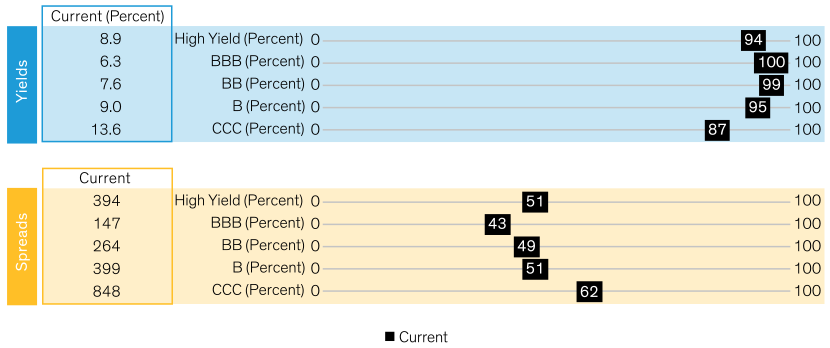
Table showing current yield and spread percentages for various bond ratings, with horizontal bar graphs.

Past performance does not guarantee future results.
Spread: option-adjusted spread. High yield is represented by Bloomberg US Corporate High Yield Index. Quality index spreads measured by the credit quality sub-indices of Bloomberg US Corporate High Yield. BBB is represented by quality sub-index of Bloomberg US Corporate Index. Data from September 2013 to September 2023. 
As of September 30, 2023
Source: Bloomberg, J.P. Morgan and AB

While there is concern that spreads are not wide enough for the potential risks we are facing, the good news is that yields alone have been highly predictive of forward returns (Display 7). However, we do expect those returns to be heavily front-loaded, with the bulk of returns coming over the next year or two. So time is a material factor in capitalizing on these opportunities.

Yields Suggest Attractive Five-Year Forward Returns for High Yield
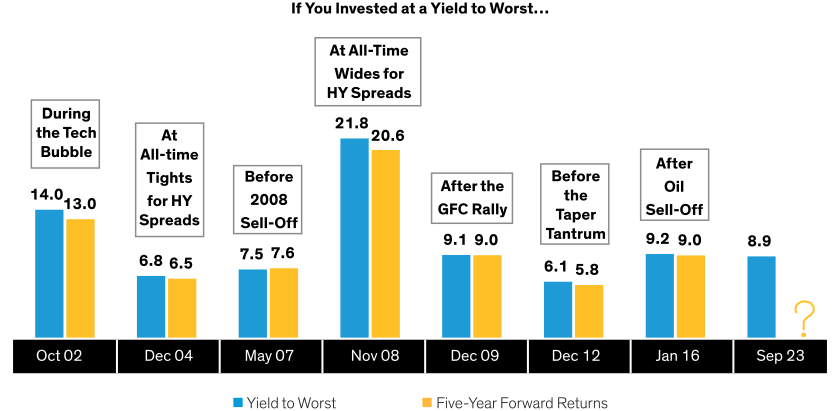
Bar chart with time from 2002 to 2023 on the X-axis and high-yield spreads and five-year returns on the Y-axis, comparing values across notable market events.

Past performance and historical analysis do not guarantee future results.
HY: high-yield; GFC: global financial crisis; YTW: yield to worst
YTW and returns represent Bloomberg US Corporate High Yield Index
As of September 30, 2023
Source: Bloomberg and AB

Even as concerns of an economic slowdown persist, the underlying health of the high-yield space remains robust, especially as it starts from a stronger foundation compared with past slowdowns. Furthermore, only 10% of existing bonds must be refinanced in the next two years, reducing the risk of issuers being compelled to refinance at more costly rates. And while CCC-rated bonds typically bear more default risk, they make up a very small portion of bonds coming due in this two-year window.

Municipal Bonds: Set Up for a Strong Run?

On the tax-exempt side of the fixed-income world, municipal bond yields followed Treasury yields higher in the third quarter. Outflows from the market increased, causing after-tax yield spreads to rise substantially: at the 10-year maturity, yields climbed from the low 40-basis-point range to the mid-70s.

Muni credit investments were a bright spot, as declining credit spreads fueled outperformance. While spreads are lower now, they’re still above historical averages. The supply outlook could also offer support, with relatively low issuance leaving demand to chase fewer bonds. We think this environment creates an attractive entry point: high yields, cheap valuations and wide credit spreads.

The muni yield curve currently features high yields on shorter-maturity bonds and a steeper slope in the 12- to 20-year maturities, enabling investors to add duration exposure using a “barbell” maturity structure. A strategy that combines exposures in those two maturity ranges to achieve an overall duration target has fared better through the first three quarters of 2023 than approaches targeting duration through a concentrated structure, or a “ladder” design.

Given where yields and the policy cycle are today, we think munis are set up for strong performance. Yields have been in the range of 3.5% or higher over the past few months—and were above 4% at the end of the third quarter. Historically, munis have returned an average of 6.6% in one-year periods when yields were between 3% and 3.5%, and have returned an average of over 9% when yields were over 3.5% (Display 8). What’s more, they’ve historically beaten cash after the Fed has paused a cycle of rate hikes.

Will History Repeat Itself for Municipal Bonds?
Munis Seem to Be Set Up for Strong Absolute and Relative Performance
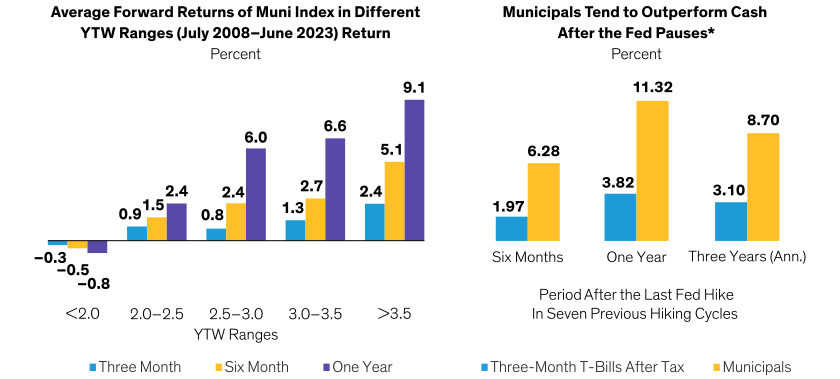
Bar charts with municipal index returns shown by yield-to-worst (YTW) range and by post-Fed hike periods, also including T-bills and cash for comparison. The X-axes display YTW ranges and Fed hike periods; the Y-axes represent returns. Multiple categories (municipal index, T-bills, cash) are compared within each bar group.

Past performance does not guarantee future results. There is no guarantee any investment objective will be achieved. 
YTW: yield to worst
*Municipal returns are for the Bloomberg Municipal Index. Tax rate assumed is 40.8%. Data represent average returns for six-month, one-year and three-year periods after Fed rate hike pauses on September 1, 1974; October 1, 1987; March 1, 1989; March 1, 1995; June 1, 2000; July 1, 2006; and January 1, 2019. 
As of September 30, 2023
Source: Bloomberg, J.P. Morgan and AB

To sum things up, during this time of resistance, and as we head down the path toward normalization, we firmly believe that well-researched opportunities in capital markets can lead to favorable outcomes for patient investors. 

The views expressed herein do not constitute research, investment advice or trade recommendations and do not necessarily represent the views of all AB portfolio-management teams. Views are subject to revision over time.