Does Your Financial Plan Depend Too Much on One Stock?

September 10 2026
4 min read

Big winners may lift portfolios for a time—but concentration risk can bring a downside, too.

One or a few high-performing stocks can provide a big boost to portfolio values. But they’re hard to come by and often struggle to maintain their momentum over time. Because these stocks increase portfolio concentration, investors must balance the risk of overexposure against the tax cost of diversifying. A thoughtful, tax-aware plan may help bring portfolios back in line.

All great stock stories seem to start the same. Someone owns the right company at the right time, holds on as it soars and watches portfolio value come along for the ride. Investors fortunate enough to be in this position feel a strong incentive to leave their chips on the table and ride the winner. Tax concerns can be another incentive to stick with it. High-fliers often have a low cost basis, so selling could bring a sizable tax bill. But there’s a risk of hanging on too long, and it could mean an unhappy ending.

The “Lottery Stock” Problem: It’s Hard to Own the Winning Ticket

The first challenge in writing a single-stock success story is that few investors ever own the winning ticket in the first place. History suggests that high-flying stocks that beat the market are uncommon, based on the returns of individual S&P 500 stocks versus the overall index.

In fact, the median S&P 500 stock—the one in the middle of the return distribution—underperformed the overall index across every time period (Display). And the challenge has intensified in recent years: underperformance has been much more pronounced in time periods ending in 2020 or later.

Single Stocks Have Struggled to Keep Pace with the Market
Median Annualized Relative Returns of Single Stocks vs. S&P 500
Median annualized relative returns of single stocks versus the S&P 500 over various time periods

Past performance does not guarantee future results.
Through December 31, 2025 
The display shows the median annualized return for a single stock versus the S&P 500 across multiple time periods. Negative numbers indicate underperformance.
Source: S&P and AllianceBernstein (AB)

Of course, some individual stocks do win, sometimes by wide margins. So, it’s true that a small number of stocks have the potential to deliver extraordinary gains. But for most investors, their lottery tickets are more likely to end up middle of the pack or worse.

The Endurance Challenge: Past Winners Don’t Stay Winners

For investors who are fortunate enough to have their hands on a winning stock, a big payoff isn’t guaranteed because stocks that outperform often fail to stay ahead of the pack (Display). The median stock that beat the S&P 500 in the first half of each time period underperformed in the second half.

Winning Stocks Often Lose Momentum
Median Annualized Relative Returns of Single Stock vs. S&P 500 (2000-2025, Percent)
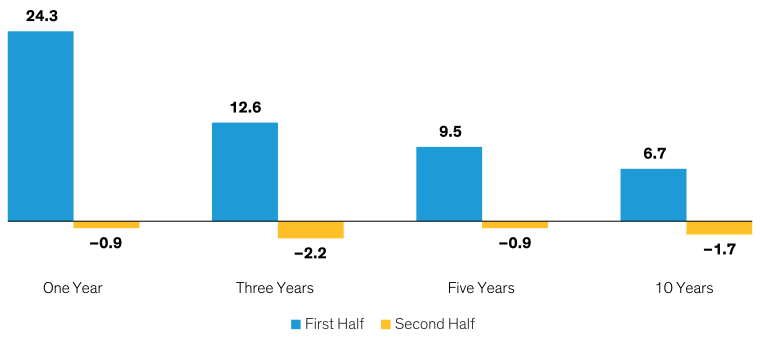
Median annualized relative returns of single stock vs. S&P 500 from 2000 to 2025

Past performance does not guarantee future results.
Through December 31, 2025
The display shows the median annualized return for a single stock versus the S&P 500 across multiple time periods, with performance segmented into the first half and second half of each time period. Negative numbers indicate underperformance.
Source: S&P and AB

The change of fortune was especially clear over longer periods. In the first half of five-year periods, the median first-half winner beat the S&P 500 by an annualized 9.5% per year but underperformed by 0.9% in the second half. Looking at 10-year periods, the median first-half winner beat the S&P 500 by an annualized 6.7% but underperformed by 1.7% in the second 10 years.

Together, these findings define the single-stock challenge. Investors must first be fortunate enough to have a winner, own it at the right time and then reduce the concentrated risk before gravity takes over. For taxable investors, getting the timing wrong could be costly, and embedded capital gains can complicate plans to reduce the exposure.

Concentration Risk vs. Tax Impact: A Key Investor Trade-Off

That’s why the diversification decision shouldn’t be framed as a simple sell-or-hold choice. For investors with concentrated stock, the question is rarely “should I sell everything today?” More often, it’s “will my after-tax wealth be higher in five or 10 years if I pay taxes now to diversify?”

That decision involves three factors:

  • Selling today pulls the tax bill forward, leaving less capital to reinvest and compound.
  • Diversifying the portfolio may reduce the risk of pre-tax underperformance, especially if the concentrated stock isn’t among the relatively few standout winners.
  • Paying some taxes now by trimming the position could make the eventual tax bill smaller later on.


Paying some taxes now can feel painful because the tax bill is immediate and visible. The cost of staying concentrated may seem less black and white, but diversifying today may narrow the range of after-tax wealth outcomes—most importantly by mitigating the downside risk if the concentrated stock falters.

Strategies such as staged selling, tax-loss harvesting, charitable gifting, donor-advised funds, exchange funds, Section 351 ETF exchanges or other customized approaches may reduce the tax drag of diversifying. They can also be combined through a multi-phase transition into a separately managed account. This approach enables investors to diversify gradually while also managing taxes and risk. The specific choice depends on individuals’ unique circumstances.

Lottery stocks that create strong gains exist, but they’re uncommon, hard to identify in advance and prone to losing momentum. Instead of ignoring taxes or trying to eliminate risk entirely, investors should balance the known cost of realizing capital gains against the less visible risk of not diversifying. In the end, the most valuable question may not be whether a stock can still win but whether a financial plan depends on it—and whether diversifying now could reduce the risk of falling short.

The views expressed herein do not constitute research, investment advice or trade recommendations and do not necessarily represent the views of all AB portfolio-management teams. The views should not be considered to be legal or tax advice. The tax rules are complicated, and their impact on a particular individual may differ depending on the individual’s specific circumstances. Views are subject to revision over time.


About the Authors