Three Reasons Why It Pays to Be Active as a Muni Investor

March 25 2026
4 min read

In today’s era of automation, some situations demand a more active approach. Municipal bond investing is one.

The municipal bond market is inefficient, fractured and constantly in flux, and active muni investors are much better equipped to navigate it than are passive ones—an advantage that we believe can improve outcomes.

In fact, we found that—historically—an astonishing 98% of active muni strategies have meaningfully outperformed passive approaches over rolling three-year periods, and 87% have outperformed passive strategies over two-year periods. Further, active strategies delivered better upside and downside capture through some very volatile markets. Here’s why.

Active strategies can proactively align with market shifts and dislocations, while passive approaches cannot. By continually adjusting a portfolio, active investors can flex with current conditions, better manage risks and capture opportunities as they arise.

As we see it, much of the active muni manager’s edge comes from three strategies: yield-curve and duration positioning, municipal credit selection, and dynamic sector rotation, especially into Treasuries.

Yield-Curve Positioning: Responding to Shifts and Shapes

The shape and slope of the yield curve frequently change in response to economic growth expectations, inflation expectations, central-bank policies and more.

Active managers may choose to own different combinations of maturities along the municipal yield curve to take advantage not only of relative yield levels but also of expectations for changes in the shape of the yield curve down the road. Whether a barbell, ladder or concentrated position, there’s no “all weather” maturity structure, because different environments call for different approaches.

For example, a barbell maturity structure invests in short- and longer-term muni bonds, while minimizing exposure to the middle of the curve. A barbell structure currently holds the highest yield for the same level of duration. A barbell pairs short‑term bonds with exposure to 15–20‑year bonds to maximize yield plus roll (Display).

Yield Curve Positioning is Key
Shows yield to worst and duration for various maturity approaches and superior bond roll among 15 to 20 year bonds.

Historical returns do not guarantee future results. 
Maturity structures were created using relevant maturity buckets and the Bloomberg Municipal Bond Index; Barbell is 20% in the one-year index, 25% in the three-year index and 55% in the 20-year index; Concentrated is 100% in the 10-year index; Ladder is equal weights to the one-year through 22-year indices.
As of February 28, 2026 
Source: Bloomberg, Municipal Market Data and AllianceBernstein (AB)

With today’s muni curve remaining steep, we think a barbell structure that emphasizes longer dated bonds can help investors capture elevated yields while enjoying a potential price boost.

Concentrated and laddered maturity structures are good fits for other circumstances. A concentrated, or bullet, structure invests in a very narrow maturity range. By contrast, a laddered portfolio spreads bond holdings evenly across maturities.

Credit Selection: Leaning In (or Out) as Needed

Income is a key contributor to muni returns, and active strategies can take advantage of a broad muni universe to help maximize it. One way to boost income is by strategically adding municipal credit.

Muni credit, which includes non-investment-grade, BBB-rated and A-rated issues, historically has offered significantly more yield than the highest-quality bonds. We believe  muni credit will continue to offer attractive income, especially when on a tax-equivalent basis to corporate bonds (Display).

Muni Credit: High Yield Remains Attractive, but Selectivity Matters
Shows 10 years of spreads between AAA and high yields munis and compares after-tax yields for muni and corporate bonds.

Historical and current analyses do not guarantee future results. 
AAA bonds represented by the AAA-rated subset of the Bloomberg Municipal Bond Index; high-yield bonds represented by the Bloomberg Municipal High-Yield Index.
*Tax rate assumptions using a 40.8% tax rate
Through February 28, 2026
Source: Bloomberg and AB

While credit spreads have tightened, we currently see opportunities in select sectors such as prepay energy and affordable housing. The credit universe isn’t static, so we think investors should stay selective when leaning in.

Dynamic Sector Rotation: Active’s Incremental Leg Up 

For investors subject to high tax rates, municipal bonds have generally made sense over the years, as they do today. But market technicals such as supply and demand can make relative after-tax yields highly variable over time. In fact, tax-advantaged muni yields have occasionally been lower than after-tax yields for Treasuries (Display).

When Treasuries Yield More than Munis, Active Investors Can Selectively Add Them
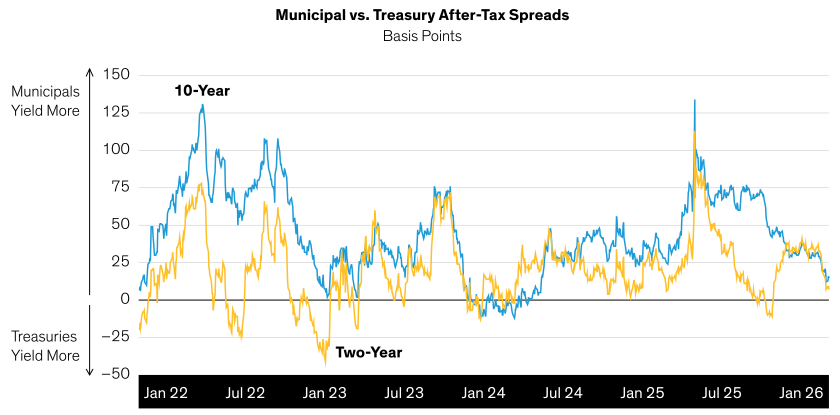
Compares 10-year and 2-year after-tax yields from 2022 to January 2026.

Historical analysis does not guarantee future results. 
Assumes a 40.8% tax rate 
Through January 22, 2026
Source: Bloomberg, Municipal Market Data and AB

As we see it, this ongoing dynamic presents opportunities for nimble investors. For example, when spreads suggest that munis are becoming too expensive relative to Treasuries, a small opportunistic position in Treasuries may be appropriate. Conversely, rotating away from Treasuries and back into high-grade municipals seems prudent when spreads widen and munis are again considered fairly valued or relatively cheap.

From mapping the yield curve to thoughtful sector and security selection, small ongoing adjustments can have a big impact on a municipal bond portfolio. In our view, capturing higher after-tax yields, managing volatility and having the dry powder to lean back into munis when needed can all lead to better outcomes. That’s why we believe staying active matters and flexibility pays off in the end.

The views expressed herein do not constitute research, investment advice or trade recommendations, do not necessarily represent the views of all AB portfolio-management teams and are subject to change over time.


About the Authors