Value Stocks: The Cash-Flow Case for a Continuing Comeback

June 23 2026
7 min read

Are value stocks finally turning the corner? Recent trends are encouraging.

It’s easy to understand why investors are skeptical about value stocks. After nearly two decades of chronic weakness, value’s strong rebound since early 2025 hasn’t offered enough proof that the turnaround has staying power. Yet in our view, the market backdrop is shifting—and early signs strengthen the case for rebuilding exposure to value.

Value investing has a distinguished pedigree, but its reputation has been bruised. First articulated by Benjamin Graham and David Dodd nearly a century ago, the value philosophy rests on a simple insight: markets often overreact to uncertainty or disappointment. Using fundamental research, value investors seek to identify mispriced companies and capture recovery potential when market perceptions begin to change. 

For the last 20 years, that discipline was tested. Value stocks thrived from 1980 through 2007, but after the global financial crisis (GFC), growth stocks have led, helped by low rates, abundant liquidity and technology-driven earnings growth. Value-stock discounts failed to revert to the mean as expected. Apart from a brief rebound after the COVID-19 pandemic, value persistently trailed growth (Display), and many actively managed value strategies struggled to keep pace.

Can Value Stocks Restore Their Glory After Two Tough Decades?
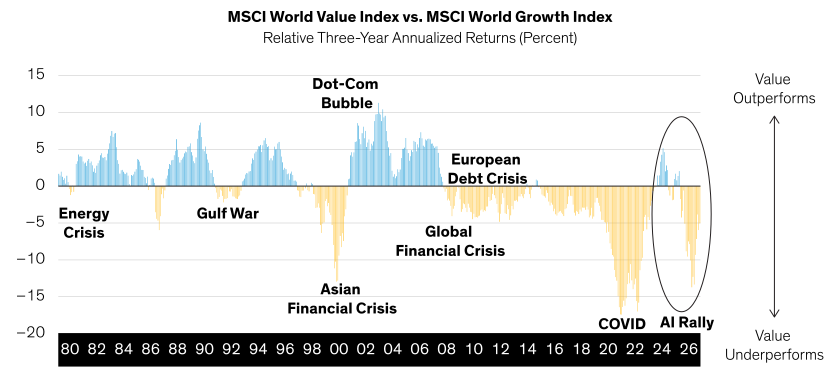
Column chart shows MSCI World Value Index vs MSCI World Growth Index from 1980 through 2026, indicating when value outperformed or underperformed, annotated for major market events.

Past performance does not guarantee future results.
As of May 31, 2026
Source: MSCI and AllianceBernstein (AB)

Recent Signs Are Encouraging

From 2025 through May 2026, value staged an impressive global comeback, including during volatile market episodes. The recovery hasn’t been linear—and growth reasserted itself at times—but the pattern suggests that value’s leadership may be becoming more durable, in our view.

We believe several catalysts have supported the recovery (Display). Earnings growth has exceeded expectations, while select value companies have benefited from European defense spending, rising demand for commercial aircraft and a recovery in agricultural commodity prices. Corporate governance improvements in Japan and China have provided additional support. Meanwhile, rising interest rates, in response to higher inflation expectations, could also boost value stocks by reducing their risk premium relative to growth stocks.

Diverse Catalysts Have Supported Value’s Recovery
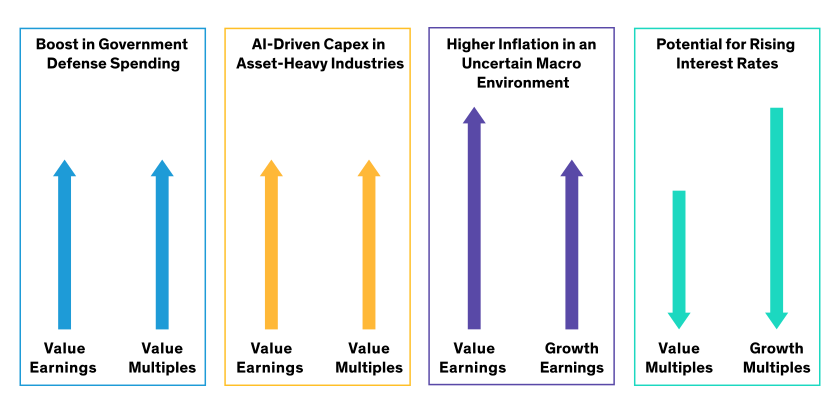
Illustrative diagram uses arrows to indicate the catalysts that have supported a recovery in value equities such as a boost in government defense spending and AI-driven capex.

Current analysis for illustrative purposes only and does not guarantee future results.
As of June 22, 2026
Source: AB

The AI boom is often seen as a growth equity story. Yet AI capital expenditure has also buoyed asset-heavy industries, such as semiconductor manufacturers and power infrastructure suppliers, which include many value-oriented companies. 

Have Investors Missed the Rebound?

After such a strong run, investors may question whether it’s too late to add exposure to value. 

We don’t think so. Yes, the recovery has narrowed the traditional price-to-forward-earnings (P/FE) valuation discount between global value and growth stocks to 41% (Display). On that measure alone, the value opportunity may appear less attractive than it did before the rebound. 

Viewed through a different lens, however, we believe the valuation gap remains compelling. Our research shows that the price-to-cash-flow ratio of global value stocks is 57% lower than growth stocks—a meaningful discount of 14 percentage points to the historical average. 

Evaluating the Discount: Value’s Cash Flows Are Especially Attractive
Left chart shows the global value discount to growth stocks on price to forward earnings over time. Right chart shows the value discount based on price-to-cash-flow.

Past performance and current analysis do not guarantee future results.
*Price-to-forward earnings (next 12-months) since January 1, 2000
†Price-to-cash flow since January 1, 2000.
As of May 31, 2026
Source: FactSet, IBES, MSCI and AB

Finding Value in Free Cash Flows

These metrics reinforce why we think investors may need a broader tool kit for identifying value today. We believe free cash flow (FCF) is a more effective gauge of value potential than traditional valuation metrics, such as price-to-book (P/B) and P/FE ratios. 

Since the GFC, the traditional link between low P/B multiples and eventual earnings recovery diminished, making it harder for investors to rely on book value alone to signal future upside. As business models evolved—particularly with the rise of asset-light companies in technology and services—book value became a less reliable proxy for intrinsic worth. 

So, why are cash flow–based measures more effective? Because companies’ cash flows can’t be manipulated as easily as their reported earnings figures. In addition, a company’s cash-generating ability offers a clearer view of its underlying economic value. Strong cash flows are a sign of healthy business dynamics that enable a company to reinvest in its businesses, thereby enhancing earnings potential. By contrast, businesses with weak FCF may struggle to sustain earnings growth over time.

This distinction has reshaped opportunities for value investors. Many asset-light companies that wouldn’t have qualified as value stocks on P/B ratios in the past are attractive value investments based on their FCF projections. As we see it, FCF metrics better capture a company’s ability to generate returns over time, helping investors identify businesses where market prices are undervalued. 

Duration Matters in an Uncertain World 

Current market conditions warrant special attention to the duration of cash flows. Today’s debate over AI is tied to a simple question: Do current valuations of the hyperscalers overestimate their ability to generate future earnings from AI, especially as the massive capex required for the infrastructure build-out erodes their FCF? 

When we search for value opportunities, we ask that question of all portfolio candidates. Companies whose valuations depend heavily on profits far in the future may be more exposed if rates, capital costs or technology assumptions shift. By contrast, many value companies derive more of their worth from more predictable cash flows expected over the next three to five years. In other words, their valuations depend less on distant growth forecasts.

In the illustrative example below (Display), two firms generate $500 in cash over a five-year period. Company A has steady cash flows of $100 a year, while company B will get most of its cash in five years. Investors use a discount rate to calculate the present value of cash flows because a dollar received today is worth more than a dollar received in the future. Applying a discounted cash-flow analysis shows that the present value of company A’s cash flows is $410, or 40% more than company B’s. 

Short-Duration Cash Flows Are More Predictable, Less Exposed to Rate Uncertainty
Left chart shows illustrative example of two companies with short and long duration cashflows, indicating the present value of future. Right chart shows performance of the cheapest quintile of price/free cash flow companies since 1990 vs MSCI World.

Past performance and current analysis do not guarantee future results.
*Hypothetical example for illustrative purposes only. Present value reflects what future cash is worth today. Because a dollar received later is worth less than a dollar received now, each payment is reduced based on how far in the future it arrives and the discount rate applied. Cash that arrives sooner keeps more of its value, so a company with earlier payments has a higher present value than one receiving the same total later.
†Quintile 1 is the cheapest quintile of stocks in the MSCI World Index based on price/FCF ratios.
As of June 1, 2026
Source: Compustat, IDC, MSCI, Worldscope and AB

Our research suggests that the cheapest quintile of global stocks on a P/FCF basis have outperformed the market since 1990 (Display, above). But a simple screen isn’t enough; some cheap cash-flow stocks are value traps. So, we believe active research and positioning is needed to assess the durability, timing and reinvestment potential of those cash flows—as well as for risk management.

Where can investors find shorter-duration cash flows? Examples can be found in industries such as semiconductor equipment suppliers, which are benefiting from AI spending. We believe mining also deserves attention, as an asset-heavy industry, where smart capital expenditures can unlock value opportunities. Many value stocks in these industries can be found outside the US, offering investors a way to broaden portfolios that may have become heavily tilted toward US growth stocks over the last decade.

That doesn’t mean investors should abandon growth; rather, we think they should broaden the opportunity set. In an era of higher capital costs, technological disruption and geopolitical uncertainty, we believe selective exposure to companies with higher-visibility cash flows and underappreciated resilience can help diversify portfolios and balance allocations. The early signs of a new chapter for value are becoming harder to ignore.

The views expressed herein do not constitute research, investment advice or trade recommendations, do not necessarily represent the views of all AB portfolio-management teams and are subject to change over time.

MSCI makes no express or implied warranties or representations, and shall have no liability whatsoever with respect to any MSCI data contained herein. The MSCI data may not be further redistributed or used as a basis for other indices or any securities or financial products. This report is not approved, reviewed or produced by MSCI.


About the Author