
South Korea’s Rising Governance Tide: How to Ride the Value-Up Wave

09 March 2026
3 min read

Korea’s value-up reforms are realizing important governance gains. Proxy voting can help cement them.

Corporate governance in South Korea has become an investment opportunity. Since 2024, the government has used persuasion and legal pressure to improve governance in several areas, including capital allocation and protection of minority shareholders. The results have been positive, and we see potential for further gains. The best way for investors to capture these, in our view, is through a combination of fundamental research and proxy voting.

The scale of the opportunity can be gauged from the Korea Value-Up Index (KVI), which showcases companies that meet a range of governance criteria. Since its launch in late 2024, the KVI has outperformed the more broadly based Korea Composite Stock Price Index (KOSPI 200) by more than 30% (Display).

Value-Up: Strong Governance Helps Fuel Shareholder Returns
Index Return (October 7, 2024 = 100)
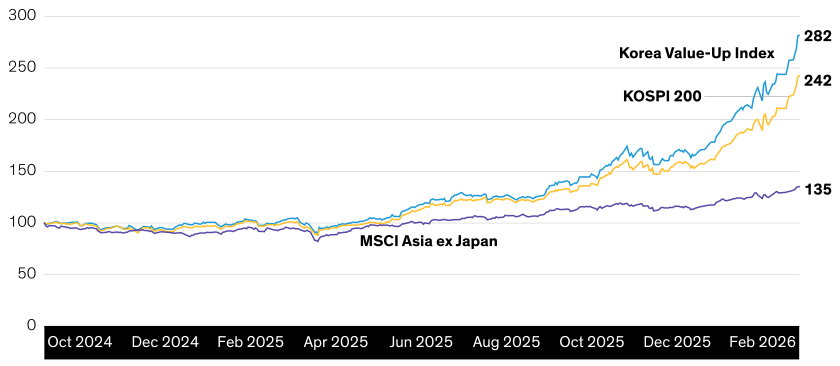
Line chart showing the Korea Value‑Up Index outperforming the KOSPI 200 from late 2024 to early 2026.

Historical analysis does not guarantee future results.
Through February 27, 2026
Source: Bloomberg

The outperformance has been driven to a small extent by flows into KVI-linked exchange-traded funds (ETFs), but it mainly reflects a positive correlation between strong corporate governance and higher investment returns. This correlation lies at the heart of the investment opportunity in South Korea, in our view, and underscores the importance of active stewardship.

Reforms Carry Legal Weight

The reforms are significant because they aim to change a key structural feature of the South Korean economy and share market. Since the 1950s, the country’s economy has been dominated by chaebols—large, family-owned conglomerates characterized by cross-shareholdings, low return on equity and conflicts between controlling and minority shareholders. They are widely regarded as causing the “Korea Discount,” or the lower valuations at which Korean shares typically trade relative to global peers.

Inspired partly by similar initiatives in Japan, the South Korean government in early 2024 launched the Corporate Value-Up Program to promote improvements in capital efficiency, higher shareholder returns and stronger governance. The KVI and associated ETFs were market-led projects to help drive the reforms.

Importantly, the campaign gained legal weight in 2025 when the government amended the Commercial Act to make clear that directors had a fiduciary duty toward all shareholders—a measure aimed at strengthening the position of minority owners. In February 2026, the government tightened the screws, amending corporate tax laws to require that high-dividend companies disclose Value-Up plans to continue receiving tax benefits.

The use of hard law goes a step further than Japan, which relies on a voluntary Corporate Governance Code. The effects of the Value-Up program are beginning to show. According to J.P. Morgan, the average total payout ratio of South Korea’s banking sector is expected to improve from 36% in 2023 to more than 50% by 2026, evidence that efforts to optimize capital allocation are under way.

The Power of Research-Based Proxy Voting

The Value-Up movement and proxy voting complement each other by being, respectively, market-wide and issuer-specific. Investors can reinforce the reform momentum by using targeted proxy voting to reward progress, reinforce expectations and signal concerns directly to management teams.

Proxy voting is most effective, in our view, when partnered with deep research and consistent methodology. Our global voting approach maintains country-specific standards for board independence, executive pay, audit practices and capital allocation. For significant holdings, investment analysts help incorporate company-specific fundamental insights to enable more constructive voting strategies. Research-based proxy voting does not mean voting for the sake of voting; we regard it as an active management tool.

The value of this approach can be seen from our track record of proxy voting in South Korea and the correlation between our support of management (an indicator of governance quality) and companies’ share-price performance. To show this, we grouped companies into equal-weighted baskets based on the number of proposals where we voted against management (VAM) and averaged their stock returns for the subsequent year. Zero-VAM companies—those most aligned with our governance expectations—went on to outperform their peers by more than 200 basis points a year on average (Display).

Korean Companies Aligned with AB Expectations Posted Stronger Results
Average Annual Return by Degree of Alignment with AB’s Proxy Votes: 2017–2025 (Percent)
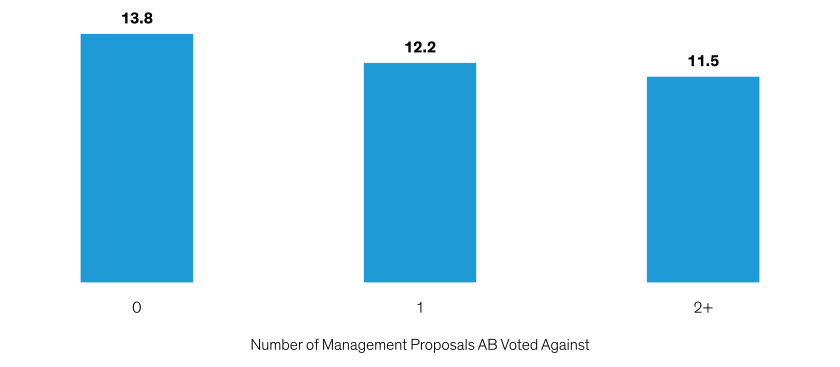
Bar chart showing higher subsequent stock returns for companies with fewer AB votes against management.

Historical analysis does not guarantee future results.
Returns are USD-hedged and include dividends. Results are based on the total stock return of individual companies in a calendar year, grouped based on the number of management proposals AB voted against at the shareholder meeting the prior year. The sample comprises 1,436 shareholder meetings from 2016 through 2024.
Through December 31, 2025
Source: Institutional Shareholder Services, International Data Corporation and AllianceBernstein (AB) 

Governance Unlocks Value

How should investors approach the value-up opportunity? The key is, first, to use research to identify opportunities where better governance might lead to higher valuations. Proxy voting can then exert influence at the company level to make those improvements happen.

It helps, in our view, to have a broad philosophical view about what proxy voting should ideally achieve. Our own philosophy is to challenge companies to be their best, to go beyond merely complying with the local governance regime (such as the Korea Stock Exchange). In the 2025 Korea proxy season, we opposed management in 58% of meetings, reflecting our rigorous expectations.

It also helps to have a keen focus on issues where voting can make a difference. As a rule of thumb, board composition and remuneration are key concerns—not just in South Korea, but in most jurisdictions.

Are directors sufficiently independent? Does the board demonstrate diversity of thought? Is it committed to protecting minority interests and long-term value creation? Is the remuneration policy transparent? Is executive pay aligned to company performance and shareholder experience?

We believe that by pairing active management (research) with active stewardship (proxy voting) investors can do more than benefit broadly from South Korea’s reforms—they can capture issuer-specific opportunities for further upside, too.

Landon Shea, Investment Stewardship Associate and Research Lead, was instrumental in the research supporting this blog.

MSCI makes no express or implied warranties or representations, and shall have no liability whatsoever with respect to any MSCI data contained herein. The MSCI data may not be further redistributed or used as a basis for other indices or any securities or financial products. This report is not approved, reviewed or produced by MSCI.

AB engages issuers where it believes the engagement is in the best interest of its clients.

The views expressed herein do not constitute research, investment advice or trade recommendations, do not necessarily represent the views of all AB portfolio-management teams and are subject to change over time.


About the Authors