



menu Australia's Institutions Australia's Institutions
  • Capabilities
    Overview Alternatives Equities Fixed Income Multi-Asset Institutional Solutions Group
  • Investment Spotlight
    Systematic Fixed Income Emerging Markets
  • Insights
    All Insights Institutional Research AB IQ Capital Markets Outlook Investment Insights ESG in Action Digital Hub Portfolio Perspectives Beyond Consensus
  • About Us
  • Our Firm & Sites
 

Market Matters

What Geopolitical Turmoil and a Changing World Order Mean for Investors

24 March 2025
8 Minute Read
Inigo Fraser Jenkins
Inigo Fraser Jenkins Investment Strategist

A generational shift in the geopolitical and economic landscape goes deeper than tariffs and trade wars. It will impact expected returns, the types of return investors need—even how they think about risk.

An Evolving World Order Could Bring Changing Attitudes

The US-led post-WWII order, a staple of the landscape, seems to be fading—upending fundamental assumptions about international relations.

The shift seems driven by a US view that supporting global institutions is limiting its power. The tariff tempest has tested global investors’ trust in the US, which may not be easy to repair. This could be impacting views on US assets, bonds and the dollar.

In 2022, when stocks and bonds tumbled, the US dollar helped blunt the impact. But it has tumbled since early April, and US government bonds haven’t defended as effectively. A question hangs over markets: Have global investors changed their attitudes toward US assets?

The Mounting Challenge of Government Debt

The tariff battle has grabbed the headlines lately. But strategically, we think defense, the dollar, trade and debt are all closely linked.

The US seems eager to strengthen military power and have the dollar dominate international finance. But rising debt poses a challenge. By 2050, US debt could top 150% of gross domestic product (Display).

In 2024, the cost of debt service exceeded the US defense budget for the first time. Boosting growth or cutting other spending don’t seem likely to solve the issue, nor does boosting productivity. This might lead the US to pursue devaluing the dollar, helping exporters while preserving reserve-currency status.

The US Government Debt Burden Is Rising
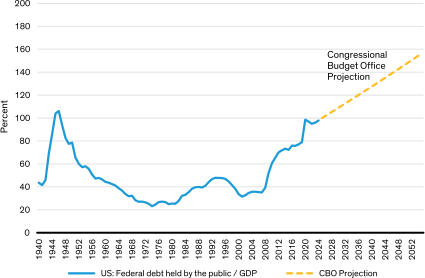
US Federal Debt Held by the Public as a Percentage of Gross Domestic Product

Current analysis do not guarantee future results.

GDP The Congressional Budget Office (CBO) projection represents data that supplements its March 2025 report. The Long-Term Budget Outlook: 2025 to 2055. As of April 3, 2025. Source: CBO and AllianceBernstein (AB).

Dollar Risks Are Likely Higher Today

The clearest implication of a desire to weaken the US dollar would be for non-US investors to hedge more exposure.

Non-US investors typically hedge a larger share of US dollar exposure in bond portfolios than in equity portfolios to offset unfavorable currency movements.

Bonds tend to be less volatile than developed-market currencies, while equities are generally more volatile. The dollar has strengthened in recent decades, so non-US investors have benefited from hedging less dollar exposure.

But we think risks around the dollar have increased, so investors should consider hedging more of their US dollar assets—even if it’s expensive in the near term.

“

Global investors should consider hedging a greater share of US dollar assets in their allocations.

Investors shouldn’t interpret our suggestion to hedge more US currency exposure as a view that US exceptionalism is dead. Despite recent policy shocks, structural forces remain that make the US an attractive strategic destination for global investors:

Growth in the US working-age population is likely to decline but remain positive; in other developed countries and China it’s contracting.

Companies with structurally higher profitability and a successful tech sector imply the ability to continue earning higher margins.

Supply chains for US firms are geographically stronger than for companies in other regions.

The sheer scale and scope of the US home market make it an appealing opportunity set.

The US dollar remains the world’s reserve currency. The trade war could hasten its eventual replacement, but right now there’s no credible alternative.

The Need for Real Returns Suggests an Equity Overweight

Investors still need to outpace higher inflation, necessitating a strategic overweight to stocks—despite less-than-optimal conditions.

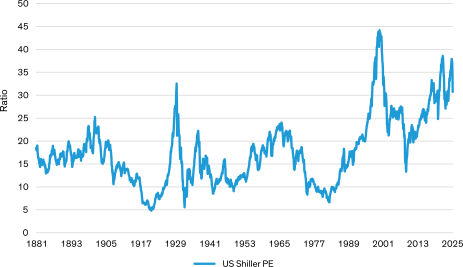
Strategically, investors face lower growth and higher inflation. More tactically, 2025 earnings per share growth could be weaker—possibly negative. And equities are expensive, including in the US (Display).

But investors still need returns that outpace inflation—“positive real returns.” So, the strategic case to overweight equites still stands: the global stock market is the largest real asset.

We expect further US equity outflows, given global investors’ negative sentiment. This could mean more near-term US underperformance, but we still see a case for US exceptionalism.

US Stocks Are Still Expensive by Historical Standards

Shiller Cyclically Adjusted Price/Earnings Ratio for US Equities

Past performance does not guarantee future results.

As April 5, 2025

Source: Robert Shiller’s database and AB

Higher Equity Exposure Brings a Need to Bolster Defense

Investors still need assets that could deliver positive real returns. But volatility seems likely to stay higher, so there’s also a need for more defensive positions.

US Treasuries held up early in the tariff dispute, but became less effective at diversifying, with prices falling before rebounding. The close positive correlation of bond yields to the dollar also broke down.

Given higher dollar risks, global investors should consider hedging more exposure. The term premium for investing in longer US government bonds will likely rise, which would steepen the yield curve.

While US Treasuries’ negative correlation with equities can be challenged, as in April, we’re still confident they can play their role as safe assets in a portfolio, along with other diversifying assets.

Other Diversifying Options to Consider

Additional portfolio diversifiers include certain investments across the equity, fixed income and alternatives arenas.

Other diversifying exposures for portfolios could include private assets and factors—low volatility has generally been effective. Actively managed strategies are also worth considering. In place of some government bond positions, more exposure to investment-grade credit could make sense.

We also see a place for gold in portfolios overweight in risky real assets. Its “expensiveness,” in our view, simply underscores a world where most asset classes are fully valued. Gold has had little correlation with equities, even in higher-inflation environments. Central banks’ demand for gold seems likely to remain strong, and the G7 economies’ heavy debt could tempt policymakers to allow higher inflation or currencies to weaken against the precious metal.

“

Investors can’t afford to stop taking risk. In a lower-growth/higher-inflation world, they need a strategic allocation with a path to positive real returns.

In Summary…

The tariff tempest has hastened a new investment regime with lower growth, higher inflation and more turbulence. It has tested global investors’ attitudes toward US assets. But portfolios still need to outpace inflation. We think that calls for an overweight of risk assets—including equities. But diversify with defensive investments.

Inigo Fraser Jenkins
Inigo Fraser Jenkins Investment Strategist

Market Matters

Delivering timely research-driven insights for navigating dynamic markets.

Discover More

The views expressed herein do not constitute research, investment advice or trade recommendations and do not necessarily represent the views of all AB portfolio-management teams. Views are subject to revision over time.

    Terms and Conditions of Use Privacy Policy Cookie Settings Complaints and Dispute Resolution Whistleblowing Australian FSC Standard 23 AB's Approach to Carbon Neutral Modern Slavery Statement Consumer Warning Investor Alert

    This information is for exclusive use of the wholesale person to whom it is provided and is not to be relied upon by any other person. It is not intended for retail or public use and may not be further distributed without prior written consent of ABAL.
    This webpage has been prepared by AllianceBernstein Australia Limited (“ABAL”)—ABN 53 095 022 718, AFSL 230 698. Information in this webpage is only intended for persons that qualify as “wholesale clients,” as defined by the Corporations Act 2001, and is not to be construed as advice. This webpage is provided solely for informational purposes and is not an offer to buy or sell securities. The information, forecasts and opinions set forth in this webpage have not been prepared for any recipient’s specific investment objectives, financial situation or particular needs. Neither this webpage nor the information contained in it are intended to take the place of professional advice.
    You should not take action on specific issues based on the information contained in this webpage without first obtaining professional advice. Past performance does not guarantee future results. Projections, although based on current information, may not be realized. Information, forecasts and opinions can change without notice and ABAL does not guarantee the accuracy of the information at any particular time. Although care has been exercised in compiling the information contained in this webpage, ABAL does not warrant that this webpage is free from errors, inaccuracies or omissions. ABAL disclaims any liability for damage or loss arising from reliance upon any matter contained in this webpage except for statutory liability which cannot be excluded.
    No reproduction of the materials on this webpage may be made without the express written permission of ABAL. This information is provided for persons in Australia only and is not being provided for the use of any person who is in any other country.

    © AllianceBernstein L.P.