
How to Invest Smarter in the Race for Electrification

08 July 2026
4 min read

While opportunities abound across the energy value chain, renewables may come onstream the fastest. 

As economies become increasingly electrified and power demand grows, the transmission, storage and infrastructure needed to support reliable electricity delivery are evolving. In our view, these trends are creating attractive opportunities across the technologies and infrastructure that underpin the energy transition.

Power Needs Are Growing

Power needs across the world are growing at a pace and scale that will require multiple sources of generation. Renewable energy projects are set to become a much larger part of the energy mix because of two key advantages: low costs and speed to market. While market and policy conditions may influence deployment in some regions, we believe renewable energy’s long-term growth trajectory remains intact (Display).

Energy Transition Investment Continues to Scale, Led by Clean Power and Grids
Global Energy Investment (US Dollars, Trillion)
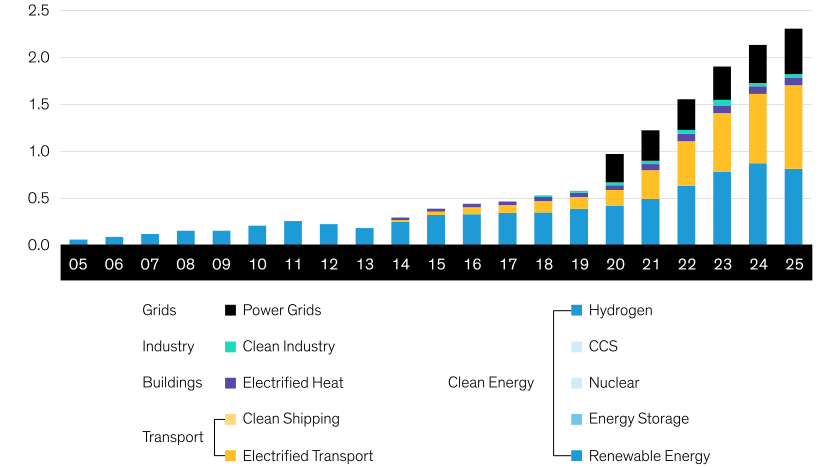
Global energy investment has soared from less than US$ 0.5 trillion pre-2018 to almost US$ 2.5 trillion in 2025.

Past performance  does not guarantee future results.
As of January 31, 2026
Source: Bloomberg NEF (BNEF) 

The Need for Speed

Speed to market is an important consideration. In the US, for instance, AI is substantially increasing power demand even as older, higher-cost coal-fired power plants are being retired.

Rising power needs have been driving demand not only for renewable energy but also for gas-fired generation, reciprocating gas engines and nuclear power. 

Even so, wind and solar are often the most viable additions to the power mix for two reasons. They can come online quickly and, when paired with battery storage, remain cost-competitive with fossil-fuel alternatives even without subsidies. 

For instance, because order books for natural gas turbines are sold out for many years, adding fossil-fuel power often takes longer. And while adding battery storage increases the cost per megawatt-hour, it helps make renewable power more reliable.  As a result, regulators may allow data-center projects faster grid connections if they include on-site battery storage. In addition, equipment costs have fallen to historic lows, and the cost of producing clean power continues to decline globally (Display). 

Wind and Solar Have Some of the Lowest Costs of Production
Levelized Cost of Electricity (USA): US Dollar per Megawatt-Hour
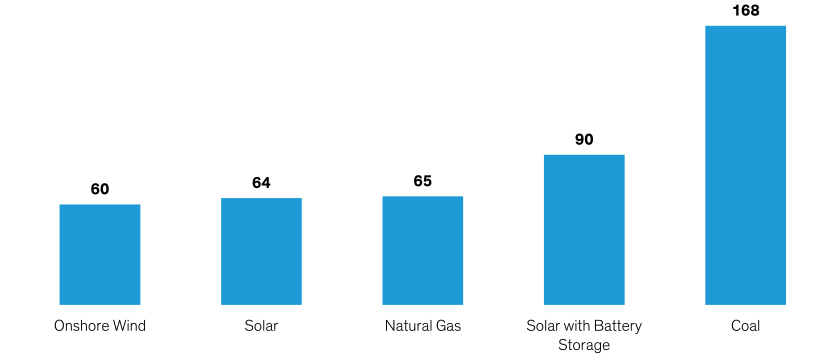
While energy from coal costs US$ 168 per megawatt-hour, onshore wind and solar cost US$ 60 and US$ 64, natural gas US$ 65.

Past performance does not guarantee future results.
As of February 17, 2026
Source: Bloomberg NEF (BNEF)

All else equal, a loss of US government subsidies for renewables would make gas relatively more attractive. But in our analysis, wind and solar remain viable based solely on economics, and continued robust state and utility spending further supports utility-scale, commercial, industrial and community projects. 

Of course, the path to renewable profits and returns hasn’t been smooth. Some renewable-energy developers have been badly hurt by post-COVID interest-rate rises and cost inflation, and even at current share price levels we believe investors should be highly selective in this subsector. 

Energy Infrastructure Needs Upgrading

Grid upgrades and reinforcement will be critical to meeting rising power demand (Display). In the US and much of the developed world, grids are approaching or have exceeded their planned life. Yet these aging grids must carry massively increased loads, driven by AI-related power demand and the growing need for resilience against climate, geopolitical and other risks. 

We Believe that Electrification and Grid Resiliency Spend Will Continue to Grow
Both US electrification and transmission spending have risen sharply.

Past performance and current forecasts do not guarantee future results.
Left display as of 15 January 2025; right display as of November 2025
Source: Federal Reserve and US Energy Information Administration

Companies such as Prysmian (copper and fiber cables, systems and accessories), Hitachi (cables and transformers), Hubbell (cable distribution) and Schneider (smart-grid solutions that improve grid reliability and flexibility) have benefited from increased grid spending. In many cases, demand remains strong and order backlogs extend several years into the future. In China, Contemporary Amperex Technology (CATL: battery manufacturing) also has a substantial order backlog. Investors will need to be selective, however, as not all component suppliers benefit from the same competitive advantages.

Watch Points for Investors 

Investors should pay particular attention to companies’ operational efficiency metrics and to the regulatory, competitive and market factors that could materially affect potential investments. 

Given the global nature of many of these businesses, it’s important to ensure that companies across the supply chain provide adequate data disclosures. Countries outside the US may have stringent sustainability requirements that require companies with supply chains in their jurisdictions to comply with local sustainability regulations. Offenders may face fines and greater difficulty raising capital. 

Selectivity Is Key

Some of the early optimism around clean energy companies has dissipated, and certain segments of the market continue to face challenges, including input cost fluctuations. That said, the power transition remains underway and continues to create a wide range of opportunities, in our view.

For investors, the keys to success will be thorough analysis and continued vigilance. That means focusing not only on business models and company fundamentals but also on competitive positioning, execution and the long-term trends shaping the energy transition.

References to specific securities discussed are for illustrative purposes only and are not to be considered recommendations by AllianceBernstein L.P.

The views expressed herein do not constitute research, investment advice or trade recommendations, do not necessarily represent the views of all AB portfolio-management teams and are subject to change over time.


About the Authors