

Past performance does not guarantee future results.
As of July 15, 2024
Source: “Investment Outsourcing Special Report,” Pensions & Investments and AllianceBernstein (AB)
Market Matters
A possible lower-return, higher-inflation environment could prompt investors to reexamine portfolio design, focusing more on long-term purchasing power. That evolution—and the artificial intelligence (AI) revolution—could mean big changes for asset managers.

In a more challenging investment regime, we see a bigger role for investing in an explicitly multi-asset context.
In 2022, both stocks and bonds declined, showing the risk of a relatively “passive” 60/40 multi-asset strategy. We see a need for a more explicitly active approach, including strategies built to beat cash or inflation or to generate income.
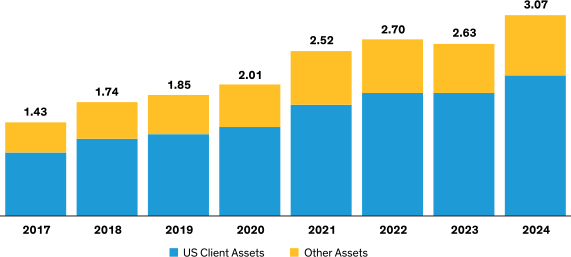
Interest has grown in outsourced chief investment officer (OCIO) arrangements with asset managers (Display) to help with the challenge of achieving a specific real return and diversifying with traditional building blocks. There’s also renewed interest in moving beyond traditional strategic asset allocation and considering factors.
Total Outsourced Chief Investment Officer Assets (US Dollar Trillions)
Past performance does not guarantee future results.
As of July 15, 2024
Source: “Investment Outsourcing Special Report,” Pensions & Investments and AllianceBernstein (AB)

Private asset exposures will likely keep rising, given the need for real returns and diversification beyond public markets.
Asset managers will likely be asked to both source private investments and help investors combine public and private assets thoughtfully. We think liquidity will be the limit to private allocations because portfolios are currently less liquid and public-market liquidity is more fragile.
We think investors will increasingly view liquidity as a spectrum, favoring investments with shorter maturities or that provide liquidity at defined times. So, while the past decade has seen most capital flow into private equity, we expect flows to broaden to other segments of private assets—including debt. Asset allocators and asset managers must allocate thoughtfully across these different risk types.
Asset managers are well positioned to advance the design of retirement-savings strategies.
A less-friendly investment landscape and growing longevity are challenges for defined contribution plans, where individuals bear more of a burden to save for retirements that may last decades. The asset-management industry has a key role to play in tackling this challenge.
We think asset managers need to rethink traditional target-date glide paths to solve for a leaner investment outlook and longer retirements. Avenues include increasing equity exposure to build savings, diversifying into areas like private assets, reducing long-term bond exposure and emphasizing income.
Retirement saving is an active decision; there seems to be no such thing as a passive glide path or allocation.”
With lower returns possible, alpha generation could play a greater role in asset allocation.
Concentrated markets have challenged active managers, but returns from broad passive exposures could be lower in the future. This could make alpha a larger share of returns, and portable alpha strategies offer the ability to extract alpha from markets that might not be large portfolio allocations.
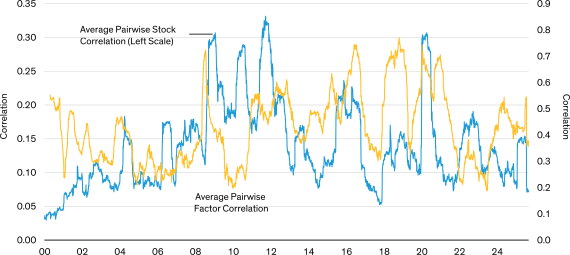
Passive investments have soared, but lower returns and a more nuanced view of active fees could boost managers who can generate persistent alpha beyond simple, lasting factor exposures. Concentration is still a challenge, but low correlations (Display) seem favorable for active management.
Average Pairwise Factor and Stock Correlations
Historical analysis does not guarantee future results.
Stock correlations are based on daily stock returns for the constituents of the MSCI All-Country World Index over rolling six-month periods.
Date from July 4, 2000, through November 11, 2025
Source: FactSet, LSEG I/B/E/S, MSCI and AB
Asset managers can help investors by originating tokenized assets and building them into multi-asset portfolios.
Much of the investment commentary about blockchain-based assets in investments starts by extolling the virtues of the technology, but we think the macro outlook and investors’ needs will lead to a significant uptake in digital assets in the years ahead. Cryptocurrency is the most in demand right now versus other digital assets, and some crypto assets make sense. They can serve as a part of a complementary allocation to gold and broader real-asset exposures in portfolios.
Stablecoins, a type of cryptocurrency tied to a stable asset, have clearer regulation and broader acceptance in the US. However, we don’t view them as a gamechanger in the way investment views are formed, and they seem unlikely to change the range of investment options the way crypto does.
As we see it, the real prize is tokenization, especially of real assets. This process would make real assets more practical for investors who need to add exposure, given possible higher inflation and lower growth ahead. And they would help maintain portfolio liquidity. The promise of creating fractional exposure to illiquid, hard-to-access assets could become a key element of portfolio design over time.
We also believe that tokenization will ultimately subvert the concept of asset classes and will be critical to make cross-asset active investing more efficient.
Investing in digital tokens, such as cryptocurrencies and other blockchain-based assets, carries risks and we recommend that investors conduct their own research thoroughly and consult with financial advisors specialising in digital assets before investing. Key risks to consider include market volatility, regulatory, security, liquidity and lack of consumer protection.
Big changes could be in store for asset managers as the use of AI develops.
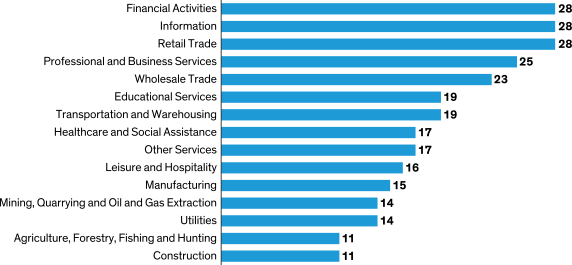
The financial industry—including asset management—is the most exposed to automation from AI (Display), featuring many automation-friendly tasks. Currently, asset managers are focusing AI usage on administrative tasks, communication and alternative-data analysis.
Over time, AI should transform analysts’ roles and financial models’ structure. Models could become better predictors, but the ability to explain predictions may not improve. It’s harder to automate investment decisions. While science has fixed laws, markets at best have evolving rules of thumb. Also, human accountability and explanations will always be needed when models fail.
Automation by Sector Weighted by Value-Added Share
Current analysis does not guarantee future results.
Occupation-level automation data is provided by Daron Acemoglu. Value-added data is from the Bureau of Economic Analysis input-output tables.
As of May 12, 2024
Source: Daron Acemoglu, Bureau of Economic Analysis and AB
There’s a case to be made that investors face a new investment paradigm that will change how they operate. This could have far-reaching implications—from asset allocations to organizational structure. The same is true for asset managers, who deliver the tailored solutions they demand.
Market Matters
Delivering timely research-driven insights for navigating dynamic markets.
The views expressed herein do not constitute research, investment advice or trade recommendations and do not necessarily represent the views of all AB portfolio-management teams. Views are subject to revision over time.
MSCI makes no express or implied warranties or representations and shall have no liability whatsoever with respect to any MSCI data contained herein.
The MSCI data may not be further redistributed or used as a basis for other indices or any securities or financial products.
This report is not approved, reviewed or produced by MSCI.
This is a marketing communication. This information is provided by AllianceBernstein Schweiz AG, Zürich, a company registered in Switzerland under company number CHE-306.220.501. AllianceBernstein Schweiz AG is a financial service provider within the meaning of the Financial Services Act (FinSA) which is not subject to any prudential supervision in Switzerland. Further information on the company, its services and products, in accordance with Art. 8 FinSA can be found on the Important Disclosures page at www.alliancebernstein.com. It is provided for informational purposes only and does not constitute investment advice or an invitation to purchase any security or other investment nor is it a recommendation to subscribe to a financial service. The views and opinions expressed are based on our internal forecasts and should not be relied upon as an indication of future market performance. The value of an investment can go down as well as up and investors may not get back the full amount they invested. Capital is at risk. Past performance does not guarantee future results.
This information is directed at Qualified Investors only and is not intended for public use.