

menu AllianceBernstein AllianceBernstein
  • Funds
  • Our Clients
    Overview Global Insurance Family Offices
  • Capabilities
    Alternative Strategies Equity Strategies Fixed Income Strategies Multi-Asset Strategies Institutional Solutions Group Responsible Investing
  • Investment Spotlight
    Systematic Fixed Income Emerging Markets Alternatives. We Deliver, Differently
  • Insights
    All Insights in English Einblicke auf Deutsch Institutional Research AB IQ Investment Insights Retirement Insights Market Matters Podcasts The Book
  • About Us
    Why Us Awards Corporate Responsibility Contact Us
  • Our Firm & Sites
 

Market Matters

What Higher US Dollar Risk Means for Investors

15 September 2025
8 Minute Read
Inigo Fraser Jenkins
Inigo Fraser Jenkins Investment Strategist
David Hutchins
David Hutchins, FIA Portfolio Manager–Multi-Asset Solutions

Fiscal pressures, geopolitics and volatile policies have made the dollar less of a safe haven. The shift away from it will likely be slow, but poses risks for portfolios.

There’s a lot of commentary on whether the US dollar’s recent slide will continue, and its status as a safe haven has been questioned. Dollar risk is up too—out of concerns about fiscal sustainability, geopolitics and domestic policy choices.

While we haven’t seen signs of investors moving money out of dollar assets yet, we do expect a shift toward other assets in the coming years.

Investors who keep the same rules of thumb about the dollar may face more currency risk than they bargained for. We think it’s wise to revisit exposure to the US dollar.

Generally speaking, we think non-US investors should hedge more dollar exposure than before, with the hedging approach specific to each investor.

The Changing Link Between the Dollar and Bond Yields

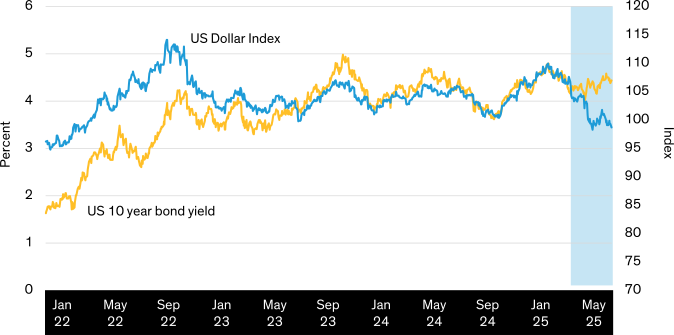
Since the US imposed steep tariffs in early April, the relationship between the dollar’s value and US bond yields—their correlation—has shifted.

On days when the dollar weakens, US bond yields have been rising (Display). We think this behavior signals doubt on the part of investors about the dollar’s traditional role as a safe-haven asset.

The correlations of gold, silver and bitcoin have also risen—even without higher inflation expectations. This suggests that investors are seeking these assets as potential alternatives to government-backed currencies as the debate about the dollar’s status and risk continues.

Dollar/Bond-Yield Relationships Suggests Changing Risk Perception

US 10-Year Treasury Bond Yields vs. US Dollar Index

Past performance does not guarantee future results.

As of June 30, 2025

Source: LSEG Data & Analytics and AllianceBernstein (AB).

Why Investors Are Worried About the Dollar

For investors outside the US, dollar risks range from rising fiscal strain to rival nations’ search for alternatives to the popular currency.

The US offers investors broad and deep capital markets with abundant opportunities. But uncertainty about the country’s future policy decisions has shaken their confidence in the dollar—and dollar-denominated assets.

The immediate worry about the dollar is fiscal sustainability. The One Big Beautiful Bill could boost US net debt by $3.3 trillion over the next decade, according to the Congressional Budget Office. Many major nations have debt burdens at the upper end of the post-WWII range, but the US has an added challenge: the annual cost of servicing government debt now exceeds the defense budget. If long-term rates rise, that’s a pressure point.

The second concern is that US lawmakers might impose unfavorable terms on outside investors who hold US assets. This could mean converting US debt securities into much longer-term debt securities, or perhaps imposing a service fee on bond coupons. The potential for a change in the rules for foreign investors creates risk.

The third uncertainty is geopolitical. Rivals of the US, particularly Russia and China, feel compelled to find payment systems beyond US reach. If we consider today’s geopolitical context as a new cold war between the US and China, it implies more impetus for rival nations to find dollar alternatives.

All Talk and No Flow? Assessing Capital in Motion

There’s been much discussion of a mass movement out of US assets, but investment fund flows show no sign of selling.

We think investors should recognize the growth exceptionalism underpinning the case for US stocks. And despite the uproar, we haven’t seen net flows out of US assets this year. Some assets will likely leave US bonds, but so far, the liquidity need has dominated.

To make a strategic allocation away from US bonds, investors will have to adapt their governance to accept less liquidity—and that might be hard. However, there’s evidence that non-US investors are hedging more dollar exposure.

What is Currency Hedging?

For illustrative purposes only.

Is the Dollar Still the World’s Reserve Currency?

A gradual outflow from the dollar into other assets seems most likely, with no sizable alternative to the dollar’s reserve status.

China won’t likely make its currency convertible, and gold doesn’t have enough scale to replace the dollar. A fragmentation of payment systems that would include central bank digital currencies and private digital money could be a threat, though there are hurdles to broader adoption.

We don’t see a clear alternative to the dollar’s reserve status today, but we expect it to weaken over time. The more notable change is toward greater risk, which has implications for non-US investors with dollar-based investments.

“

We don’t see a clear reserve alternative to the US dollar, but we do expect the currency to weaken over time.

Currency Hedging: The Options

The dominant share of the global equity market is dollar-denominated, leaving investors with a hedging decision.

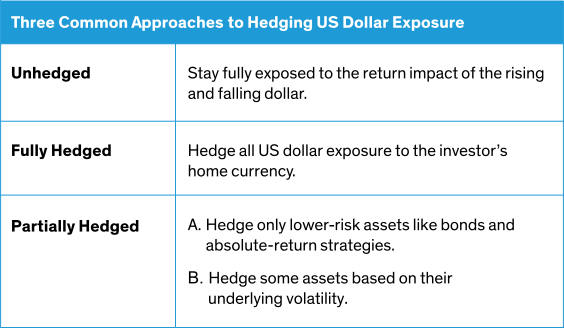
Some investors don’t hedge currency exposure—they’re either unaware of the risk or have a strong home-country bias and little currency risk. Full hedging is common for mutual funds designed from a one-currency perspective, and for investors who don’t want currencies to dominate returns (Display).

Other investors, often smaller wealth advisors and certain institutions, hedge only lower-risk assets such as bonds and absolute-return strategies. Sophisticated institutions and wealth managers may hedge some assets based on their volatility.

Of course, investors should consider their individual situations when determining currency hedging.

Choices for Dollar Hedging

For illustrative purposes only.

In Summary…

Risks to the US dollar have certainly increased, and we expect to see a gradual outflow from the world’s reserve currency into other assets. Broadly speaking, we think all investors should consider reducing exposure to the dollar in their portfolio allocations.

Inigo Fraser Jenkins
Inigo Fraser Jenkins Investment Strategist
David Hutchins
David Hutchins, FIA Portfolio Manager–Multi-Asset Solutions

Market Matters

Delivering timely research-driven insights for navigating dynamic markets.

Discover More

The views expressed herein do not constitute research, investment advice or trade recommendations and do not necessarily represent the views of all AB portfolio-management teams. Views are subject to revision over time.

    Terms of Use Privacy Policy Cookie Settings Management Company Important Disclosures Modern Slavery Statement

    This is a marketing communication. This information is provided by AllianceBernstein Schweiz AG, Zürich, a company registered in Switzerland under company number CHE-306.220.501. AllianceBernstein Schweiz AG is a financial service provider within the meaning of the Financial Services Act (FinSA) which is not subject to any prudential supervision in Switzerland. Further information on the company, its services and products, in accordance with Art. 8 FinSA can be found on the Important Disclosures page at www.alliancebernstein.com. It is provided for informational purposes only and does not constitute investment advice or an invitation to purchase any security or other investment nor is it a recommendation to subscribe to a financial service. The views and opinions expressed are based on our internal forecasts and should not be relied upon as an indication of future market performance. The value of an investment can go down as well as up and investors may not get back the full amount they invested. Capital is at risk. Past performance does not guarantee future results.

    This information is directed at Qualified Investors only and is not intended for public use.

    © AllianceBernstein L.P.