Shaping Market Exposures to Clients’ Needs
With active ETFs, advisors can target the specific outcomes clients demand, such as generating income or thoughtfully seeking diversification with growth exposure to thematic trends. This enables advisors to align portfolios more closely with their clients’ goals, differentiating their value proposition in the process.
- Upgrade Your Core: A disciplined, repeatable way to upgrade core exposure by combining fundamental security selection with systematic risk controls. Investors can pursue incremental excess returns while limiting unintended risks and keeping benchmark drift in check.
- Active Credit Selection: Applying analysis across historical executions and macro-level relationships between events and pricing can help deliver systematic alpha (risk-adjusted “excess return” over a benchmark) with benchmark-like volatility alongside excess returns and yield.
Adapting to Market Conditions
Unlike rules-based index strategies, active management provides the flexibility to respond to changing market environments. This adaptability supports more consistent alignment with investors’ objectives and allows managers to capitalize on dislocations.
- Thematic Strategies: Long-term secular growth trends can be targeted along with signals like earnings revisions to capture momentum in fast-evolving market segments.
Professional Management and Structure that Reduces Friction
With active ETFs, investors have access to professional investment management. Experienced portfolio teams comb the markets for opportunities while managing evolving risks, forming a powerful combination with the structural advantages of ETFs:
- Liquidity: ETFs are tradeable during the day, giving investors and advisors substantial flexibility and control.
- Cost Advantage: Because they often have competitive expense ratios relative to traditional active funds, ETFs may reduce fee drag.
- Flexibility: Unlike rules-based passive strategies, active ETFs can raise cash as the manager sees fit and can put new cash to work where most opportunistic.
- Transparency: Daily disclosure of portfolio holdings enables a clear understanding of exposures so financial advisors can properly manage and monitor risks.
Together, these ETF features reduce the frictions that have historically limited active management’s impact relative to market benchmarks.
What Active ETFs Can Do for Your Clients…and for You
Actively managed ETFs are an important growth area in portfolio construction. They can provide advantages for long-term strategic allocations by tapping into inefficient markets, managing volatility or enhancing income. Other market segments may benefit from a tactical mix of active and passive, with advisors shifting the mix based on evolving risks and opportunities.
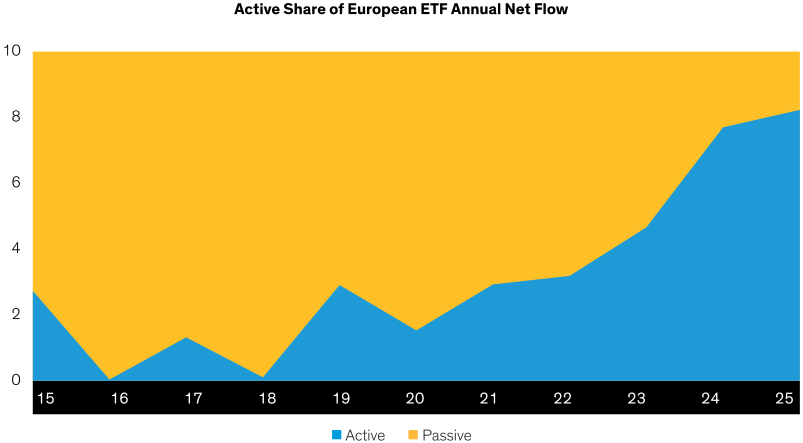
As flows into active ETFs accelerate, financial advisors who tap into their potential can create tangible benefits for clients. A thoughtful blend of passive and active strategies can target investors’ desired outcomes more effectively and keep advisors at the forefront of innovation in ETF portfolio design.