Debunking the Biggest ETF Myths

8 min read

By understanding how the vehicle works, investors and advisors can discover tangible benefits of ETFs.

Exchange-traded funds (ETFs) have been part of European capital markets for more than two decades, and their adoption has accelerated meaningfully in recent years. Investors value many of the features ETFs offer, including exchange listing, intraday liquidity, transparency and competitive costs relative to comparable vehicles.

Since their regional debut at the turn of the millennia, ETFs have served European investors well through some very trying market cycles. Yet misperceptions linger about what they are, how they trade and the roles they can play in portfolios. Let’s look at the five most enduring myths about ETFs and the reality behind them.

Myth One: Long-Term Investors Don’t Need ETFs

Some investors with a long-term time horizon assume the ETF structure offers little value to them. The logic is straightforward: if a portfolio is not being traded frequently, why does intraday tradability matter?

In our view, that framing is too narrow. ETFs can be useful even for long-term investors who trade infrequently. Most long-term portfolios still require periodic rebalancing, manager changes or strategic reallocations. In those moments, ETFs can offer operational simplicity, broad accessibility through brokerage accounts and efficient implementation.

The value of the ETF structure also extends beyond convenience. Because ETFs trade on exchange, they can provide an additional layer of market access and liquidity, including during more volatile or disrupted environments. Over time, their operational efficiencies and competitive cost profile may also help reduce performance drag.

Put simply, ETFs aren’t just for tactical traders. They can also be effective building blocks for long-term investors seeking efficient portfolio implementation.

Myth Two: ETFs Are Only Useful for Passive Investors

For many investors, the term “ETF” has become synonymous with “passive investing.” It’s understandable, given that passive strategies have long dominated ETF assets globally.

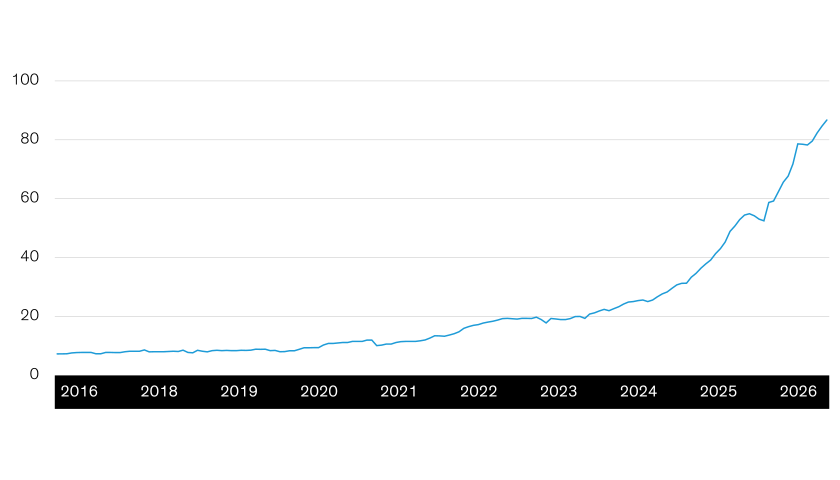
But the vehicle itself is not inherently passive. An ETF is simply a wrapper. It can be used to deliver index exposure, systematic strategies or fully active portfolios. In fact, active ETFs have become an increasingly important part of the market, evolving from more rules-based approaches into manager-driven strategies designed to seek outperformance within specific asset classes and segments.

For many investors, the real portfolio question isn’t passive versus ETF. It’s about how passive and active building blocks can work together. ETFs can serve both purposes: they can provide efficient beta exposure, and they can also deliver differentiated active insights in a transparent, exchange-traded format.

European Active ETF AUM
Billions

Historical analysis is no guarantee of future results.
As of 28 February 2026
Source: Broadridge and AB

Myth Three: An ETF’s Average Daily Volume Tells You How Liquid It Is

This is one of the most common misunderstandings in ETF investing. The assumption often comes from how investors think about individual stocks, where average daily volume can offer a rough indication of trading capacity.

ETFs work differently. An ETF’s on-screen trading volume reflects activity in the secondary market, where investors buy and sell ETF shares with one another. But ETFs also have a primary market, in which authorized participants can create or redeem shares in response to investor demand. As a result, the trading capacity of an ETF is not limited to the number of shares that traded on an exchange on a given day.

A more complete view of ETF liquidity considers the liquidity of the underlying securities, the efficiency of the creation and redemption process, and the ability of market makers to facilitate trades. In practice, this means an ETF with modest average daily volume may still be able to accommodate sizable transactions if the underlying portfolio is sufficiently liquid. This is often demonstrated by stable spreads on ETFs, regardless of the size of trading volumes, indicating robust liquidity in both the primary and secondary markets.

The key takeaway is that average daily volume can be informative, but it is not a complete measure of ETF liquidity.

Myth Four: Premiums and Discounts to NAV Are Costly to Investors

Investors accustomed to mutual funds may view ETF premiums and discounts to net asset value (NAV) as a sign that something is wrong under the hood. In reality, these price differences are often a normal part of how markets function.

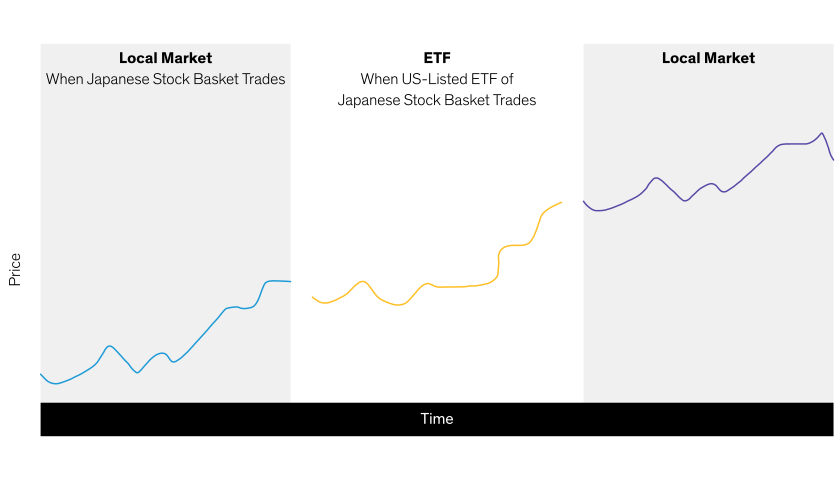
Premiums and discounts often reflect real-time price discovery. Consider an international equity ETF trading in Europe or the US while the local market for its underlying holdings is closed. The ETF price may adjust to reflect new information, even though the reported NAV is still based on earlier market prices. A similar pattern can occur in fixed income, where many bonds trade over the counter and may not update continuously during the day.

ETFs Can Help with Price Discovery
Adjusting to Real-Time News and Information When Underlying Markets Are Closed

Illustrative example only.
Source: AB

In those situations, the ETF price may actually provide a more current estimate of fair value than the published NAV. Rather than indicating market dysfunction, a premium or discount may simply show that the ETF is incorporating information faster than the underlying pricing data.

That does not mean all premiums and discounts should be ignored. Persistent or unusually wide deviations deserve attention. But in many cases, modest premiums and discounts are not a flaw in the ETF structure; they’re evidence that the market is doing its job.

Myth Five: ETFs Might Break the Market in a Major Sell-Off

Because ETFs trade efficiently and can change hands quickly, some investors worry that they could worsen market stress during periods of heavy selling. This concern is often raised in less liquid areas of the market, such as high-yield bonds.

In practice, however, ETFs have often supported market functioning during periods of disruption rather than undermined it.

One reason is that secondary-market ETF trading doesn’t automatically result in one-for-one trading in the underlying securities. When one investor sells ETF shares and another investor buys them, exposure changes hands without necessarily requiring the fund to transact in its portfolio holdings. That ability to transfer risk in the secondary market can help reduce pressure on the underlying cash market.

ETFs can also contribute to price discovery when underlying markets become harder to trade. For example, during the Greek sovereign debt crisis in 2015, ETFs with Greek equity exposure continued to trade on foreign exchanges even while the Athens Stock Exchange was closed. Those ETFs gave investors a mechanism to adjust exposure and provided a live market signal when direct trading in the underlying securities was unavailable.

This example demonstrates how ETFs can serve as an additional venue for liquidity and price discovery during periods of market stress.

Looking Beyond the Label

ETFs are not a one-size-fits-all solution. Each underlying strategy is different and should be evaluated carefully for individual investors’ objectives. But we believe many of the most common concerns about the structure stem from misunderstanding rather than evidence.

For long-term investors, we think ETFs can be valuable in both active and passive portfolios. They’re generally more liquid than average daily volume alone may suggest, informative when trading away from NAV and supportive of market functioning during stressed conditions.

With a clear understanding of how the ETF vehicle works, investors and advisors alike will be well equipped to look beyond the label. Thoughtful deployment of ETFs can provide flexible, efficient tools for capturing a wide range of return sources to fit diverse portfolio objectives.

The value of an investment can go down as well as up and investors may not get back the full amount they invested. Capital is at risk. There can be no assurance that any investment objectives will be achieved. 

ETFs are subject to risks relating to listing, liquidity, trading and settlement and may also involve fees and tax considerations that affect overall investment returns.