




menu AllianceBernstein AllianceBernstein
  • Funds
    Offshore Funds OEIC Funds Active UCITS ETFs
  • Capabilities
    Alternatives Equities Family Offices Fixed Income Multi-Asset Active UCITS ETFs
  • Investment Spotlight
    Defensive Equities Emerging Markets European and Global Growth Multi‑Asset Income EDGE Systematic Fixed Income Thematic Trends US Investing
  • Responsible Investing
  • Insights
    All Insights Economic Perspectives Investment Insights Market Matters Podcasts The Book
  • About Us
    Why Us Corporate Responsibility Awards Contact Us
  • Our Firm & Sites
 

Market Matters

Exploring the World of Actively Managed ETFs

18 September 2026
5 Minute Read
Julie Gunts
Julie Gunts Global Head of ETFs
 Brett Sheely
Brett Sheely Head of ETF Specialists

Actively managed exchange-traded funds (ETFs) are rapidly becoming more popular, offering access to active strategies in a flexible, efficient vehicle. Here’s what you need to know about them.

Actively managed ETFs are gaining popularity among European investors, combining the potential benefits of active management with the flexibility and efficiency of the ETF vehicle.

Actively managed ETFs offer compelling features such as transparency, intraday liquidity and lower-cost access to active management. As in other regions of the world, their momentum is growing in Europe.

Active ETFs can be a strategic complement to passive strategies in diversified portfolios, providing access to differentiated exposures, adaptive management, greater efficiency and potential outperformance.

When evaluating active ETFs, investors should look beyond the investment strategy to also consider the broader ecosystem supporting the fund. This includes the strength of the issuer’s capital-markets team, market-maker support and the resources to support clients throughout the ETF’s lifecycle.

What Active ETFs Bring to the Table

With active ETFs, investors can access actively managed strategies delivered in a flexible, transparent vehicle.

Liquidity: ETFs can be traded during the day, which gives investors a substantial amount of flexibility in reshaping their portfolio exposures.

Transparency: ETFs disclose their portfolio holdings on a daily basis. This transparency provides a clearer understanding of exposures, enabling financial advisors to monitor and manage risks.

Flexibility: Unlike rules-based passive strategies, active ETFs can be nimble in areas where the fund manager best sees fit, enabling them to implement views quickly instead of waiting for passive indices to be rebalanced.

Cost Advantage: Because active ETFs have lower expense ratios than traditional actively managed funds, they may reduce the drag of fees.

A Fast-Growing Market as Investors’ Needs Evolve

Actively managed ETFs are gaining momentum among European investors.

ETFs have become an important portfolio-building tool for European investors, and active ETFs give investors more choices in how to use ETFs.

Here are two examples. Thematic investing pursues opportunities emerging from long-term structural changes, including AI and healthcare advances, that traditional indices might not fully capture. Systematic fixed-income investing doesn’t track an index—it uses research, data and technology to evaluate a broad universe consistently and identify opportunities that meet specific criteria.

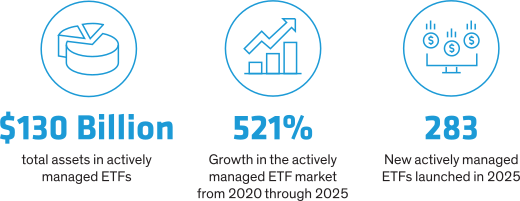
Choice continues to expand. Europe has $130 billion in active ETFs, with assets and the number of strategies growing (Display).

Europe's Active ETF Market by the Numbers

Current analysis does not guarantee future results.

© 2026 Morningstar, Inc. All rights reserved. The information contained herein: (1) is proprietary to Morningstar and/or its content providers; (2) may not be copied or distributed; and (3) is not warranted to be accurate, complete, or timely. Neither Morningstar nor its content providers are responsible for any damages or losses arising from any use of this information. As of April 30, 2026 Source: Morningstar
Deploying Active ETFs in Portfolio Building

Actively managed ETFs are becoming one of the most important growth areas among strategic portfolio-construction building blocks.

Lately, actively managed ETFs have been growing in popularity, picking up steam in both their share of overall ETF market inflows and the number of newly launched funds. There are a number of reasons for the rise of active ETFs, including adaptability, differentiated outcomes and potential outperformance.

Passive ETFs, which track indices representing markets or market segments, tend to be linked closely to the rules of an index’s construction and its scheduled rebalancing activity. Active ETFs are able to respond quickly as market conditions, risks and opportunities evolve. Many investors seek out active ETFs to gain access to targeted outcomes that passive ETFs can’t deliver efficiently. These might include a focus on growth, income generation or downside risk mitigation.

A skilled active ETF manager also has the potential to outperform markets. Outperformance may come from managing volatility, reducing concentration versus passive strategies and security selection. Active ETFs offer diverse strategies, including investing in stocks tied to long-term themes reshaping markets or using a systematic approach to identify attractive bonds.

Active and passive ETFs don't need to be an “either/or” decision. Passive ETFs offer efficient broad market exposure, while active ETFs can complement that exposure in areas where research, security selection or a more flexible approach may add value. In some market segments, a tactical mix of active and passive exposures may make sense.

There is no guarantee that any investment objectives will be achieved.

“

Active ETFs provide access to differentiated outcomes not available through traditional indices, helping investors pursue their specific goals.”


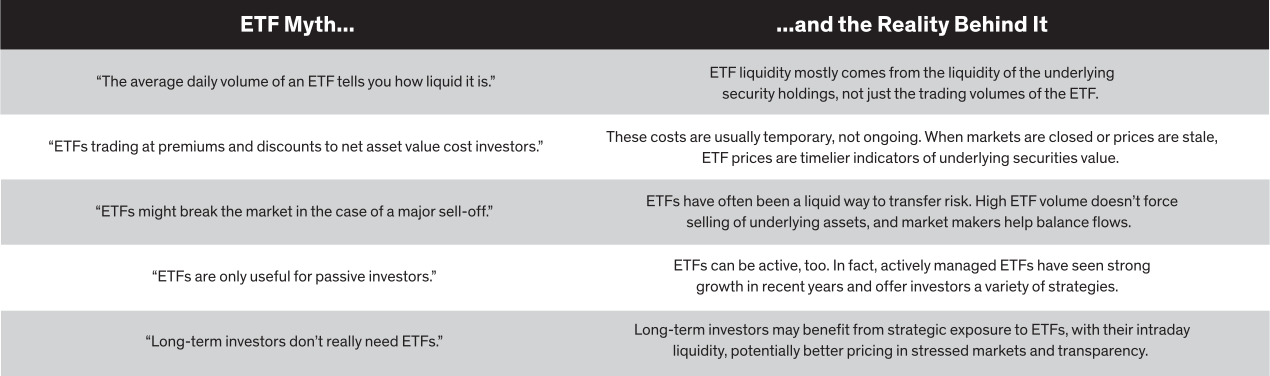
The Reality Behind the Five Biggest ETF Myths

ETFs have served many investors well, but misperceptions linger about what they are, how they trade and the roles they can play in investors’ portfolios.

Current assessment does not guarantee future results.

As of May 31, 2026
Source: AllianceBernstein

There is no guarantee that any investment objectives will be achieved.

What to Consider When Accessing Active ETFs

Choosing an active ETF means evaluating more than the ETF structure itself. The investment capabilities and resources of active managers matter, too.

Depth of Research and Investment Capabilities: In our view, active managers should bring together broad capabilities including fundamental research, quantitative insights and technology across asset classes. This enables them to take distinct approaches to tackling diverse investment challenges, ranging from thematic investing to systematic security selection.

Dedicated ETF Expertise: Delivering an investment strategy effectively through an ETF vehicle requires strong specialist capabilities that reach beyond portfolio management. Dedicated ETF resources can help support advisors with due diligence, trading insights, portfolio comparisons, client education and implementation.

Relationships Within the ETF Ecosystem: Relationships with ETF market makers and authorized market participants help support key aspects of ETF investing such as liquidity, trading efficiency and smooth execution for investors.

Ultimately, the ETF is the delivery vehicle—what matters is the investment capability inside the wrapper and the resources surrounding it. Deep investment research, active management and dedicated ETF expertise help advisors access differentiated investment capabilities through the ETF structure.

Associated Risks: Investment markets, and their movements, are the biggest risk when it comes to ETFs and investors may not get get back the full amount they invested. Liquidity risk can also affect ETFS and investors may be unable to buy or sell shares at a price that reflects the ETF’s true value. This risk can arise when there are too few market participants or when the ETF’s underlying holdings are themselves difficult to trade. In such conditions, price swings can become more pronounced, contributing to broader market volatility. market index.

In Summary…

The combination of active-management potential and a flexible, efficient vehicle is making active ETFs an increasingly popular choice as a strategic complement to passive strategies in diversified portfolios. When choosing an active ETF, it’s also important to assess the broader ETF resources and ecosystem that support the fund.

Julie Gunts
Julie Gunts Global Head of ETFs
Brett Sheely
Brett Sheely Head of ETF Specialists

Market Matters

Delivering timely research-driven insights for navigating dynamic markets.

Discover More

The views expressed herein do not constitute research, investment advice or trade recommendations and do not necessarily represent the views of all AB portfolio-management teams. Views are subject to revision over time.

    Terms of Use Privacy Policy Cookie Settings Management Company Important Disclosures Modern Slavery Statement

    This is a marketing communication. This information is provided by AllianceBernstein Limited, 60 London Wall, London, EC2M 5SJ. Registered in England, No. 2551144. AllianceBernstein Limited is authorised and regulated in the UK by the Financial Conduct Authority (FCA - Reference Number 147956).  It is provided for informational purposes only and does not constitute investment advice or an invitation to purchase any security or other investment. The views and opinions expressed are based on our internal forecasts and should not be relied upon as an indication of future market performance. The value of investments in any of the Funds can go down as well as up and investors may not get back the full amount invested. Past performance does not guarantee future results. This information is directed at Professional Clients only and is not intended for public use.

    © AllianceBernstein L.P.