Investors are grappling with a host of issues relating to AI. We would classify three of the biggest conundrums as the inter-related and thorny questions of 1) What is the potential productivity gain from AI? 2) How much of a productivity gain comes from displacing labor vs enhancing labor, with the attendant worry of what this means for the jobs market? 3) Does the extraordinary flow of capital into AI capex constitute a bubble? In this note we focus on the latter question.
When we meet with clients, the term “AI bubble” is now frequently used by investors. In fact, the sheer casualness with which that phrase is cast around sits oddly juxtaposed with the evidence of flows still accruing into equities and the wave of capital seeking a home in AI-linked investments across private markets.
We should remark upfront in our note the irony of all this. In those prelapsarian days before COVID, the discussion was about the falling need for physical capex. There were serious academic discussions about how the nature of capitalism was changing if there was no longer any need for capital.1 Yet now we are witnessing what, on some metrics, might be the most intense wave of capex in history. Thus, rather than pondering what capitalism looks like without a need for capital, we are instead left contemplating what capitalism looks like without a need for labor. This is a very abrupt change of profound importance philosophically. It matters financially, too. We note in fact that this could be part of a deeper challenge to capitalism—see our recent discussion in Dystopian Symbiosis: Passive Investing and Platform Capitalism.
The use cases of AI are slowly emerging, albeit it’s frankly too early to really lay out a high confidence path. However, memories of the tech bubble frequently emerge in conversations with clients, as do analogies with the railway-building frenzy of the nineteenth century and other episodes where the adoption and economic benefits of a new technology took much longer than investors first hoped, and where the ultimate beneficiaries were not clear. The case for and against the bubble-like quality of AI presents itself as a vertiginous dialectic that permeates the outlook for most asset classes. On the one hand, companies have never grown as fast as the numbers required to justify current valuations; on the other hand, these are already companies that are bringing in revenue, unlike in the tech bubble. More fundamentally, there is a promise of untold productivity growth, and yet on the other side the realization that such growth might come at the expense of a job-free future, with profound social questions in the form of inequality, not to mention planetary impact.
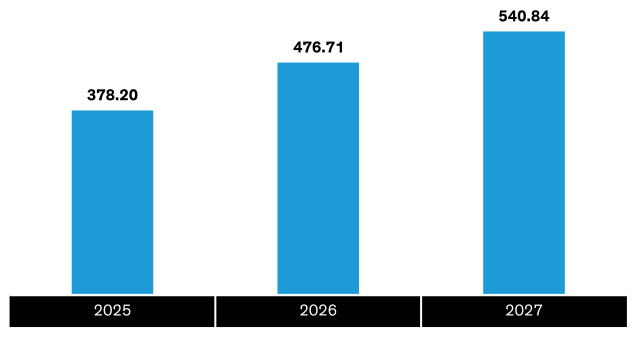
We try to think about the extraordinary capex plans for AI both from the point of view of the tech sector itself and also from the perspective of the US economy overall. In 2025, the amount spent on building data centers is likely to be approximately $400 billion. The amount forecast to be spent by the main hyperscalers by the end of 2027 is more than $1 trillion (Display 1). And it does not include all of OpenAI’s spending, which alone has committed to 30GW of data center capacity from AMD, Broadcom, NVIDIA, Oracle and other partners, at a cost of more than $1.4 trillion.2