Getting the best out of private assets needs more than just off-the-shelf solutions.
Defined contribution (DC) pension fiduciaries are increasingly seeking to integrate private markets into their investment programmes in pursuit of improved returns and diversification. But these markets can create constraints for DC plans in terms of liquidity and manager access that we believe are best handled using a custom target-date solution.
The Private-Markets Opportunity
Private assets markets are vast and diverse, presenting an opportunity set that lawmakers are advocating for pensions investments and that DC fiduciaries can no longer overlook. Private credit, for instance, after a decade of exceptional growth is now roughly the same market size as high-yield credit (according to Empirical Research Partners LLC). Meanwhile, private real estate is many times larger than its public equivalent. And while private equity amounts to a small subset of quoted equity markets, it still provides valuable diversification opportunities: large numbers of mostly old-economy, stable-cash-flow names have migrated to private markets, and may help balance growthier public-market exposures.
Private markets have historically provided premium returns over public markets. This underpins their attraction for DC pension fiduciaries at a time when both pension savers and public-market forecast asset-class returns are under pressure.
Challenges For DC in Private Markets
Despite their many attractions, private markets have also posed implementation challenges for DC pensions fiduciaries. Notably, the illiquidity inherent in private assets is a problem as DC savers’ accounts can be redeemed at will. Manager access presents several challenges: identifying strong private asset managers; hiring them at acceptable fee levels; monitoring and measuring their performance; and terminating them expeditiously and without disruption to the wider investment programme.
The investment industry has historically addressed new challenges by launching new product solutions or by adapting existing products. But for private assets in DC investment programmes, we believe this product-driven approach involves constraints and compromises that may crimp performance. In our analysis, getting the best out of private assets requires a custom solution delivered through a target-date fund (TDF) strategy.
Drawbacks of Private-Market Products
Investment managers have mostly addressed the private assets DC challenge in two ways:
- “Partial solution” products aim to complement an existing DC public-asset investment programme. These fund products include interval funds in the US or Long Term Assets Funds (LTAFs) in the UK; they offer “evergreen” solutions with inbuilt liquidity and limited withdrawals on a monthly or quarterly basis.
- “Complete solution” products include proprietary asset manager multi-asset funds and TDFs that have integrated allocations to private assets.
While they may offer easier access for some investors, interval funds and LTAFs both involve compromises and drawbacks for DC savers. Redemptions are limited and performance may be impacted by the sizeable cash buffers maintained for liquidity purposes. Also, private asset manager access can be suboptimal in terms of investment quality, flexibility and cost compromises. In particular, reliance on in-house managers and/or larger managers with lower performance potential are common issues. Products structured as fund-of-fund vehicles can provide greater manager diversification but usually charge higher fees.
Multi-asset fund and TDF products have the potential to overcome many liquidity and private asset manager access issues. In practice, however, depending on the asset manager and the product, private asset manager choice and quality may be limited. Similarly, fiduciaries may be constrained in their ability to switch products.
Custom TDF Solutions Can Offer Complete Flexibility
DC plan providers that utilize custom TDFs have been accessing private assets for over a decade. We believe such custom solutions can provide unrivalled private asset benefits in terms of governance, transparency, liquidity, manager access and manager diversification, and operational excellence.
Governance and transparency: custom solutions can tailor both investment strategy and investment reporting to meet clients’ specific requirements. Custom TDF managers can also provide fiduciaries with expert insights into the complexities of private asset manager research and performance measurement.
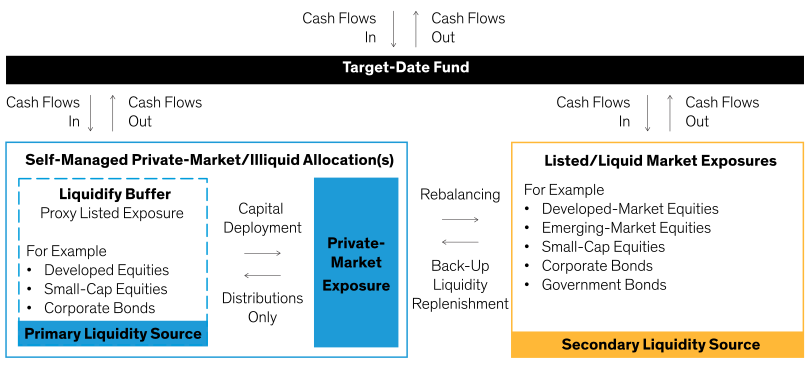
Liquidity management: a TDF structure has an inherent advantage over interval funds and LTAFs: liquidity can be managed most efficiently at the total multi-asset strategy level rather than at the level of a single asset class. Day-to-day cash flows from redemptions and subscriptions can be aggregated and offset across asset classes and cash buffers minimized, mitigating performance drag. In the Display below we show an example cash-flow management schematic based on actual custom client experience.