
Seven Reasons Why UK DC Savers Need a Lifetime Income Default Strategy

01 May 2025
5 min read

Only a minority can access high quality pension advice—the majority need a lifetime default option.

Former UK chancellor George Osborne’s “Freedom and Choice” pension reforms opened up wider retirement opportunities for DC savers; those with investment savvy and larger pots have been well-placed to capitalize on the changes by using expert independent advice and appropriate investments. Sadly, the majority of UK DC savers fall outside this advantaged bracket. Our research shows that most DC savers facing retirement don’t have, and can’t access, the necessary resources to strategize for themselves. We believe a default strategy can make better investment decisions for them—for a lifetime.

Freedom and Choice Means Opportunities and Dangers

The 2015 reforms abolished compulsory annuitization and allowed DC savers to make their own decisions about generating retirement income. Yet the new freedoms also introduced dangers such as making suboptimal investment choices and over-optimistic drawdown rate assumptions. Ten years later, these risks are widely recognized. For instance, in their 2025 report, the Institute and Faculty of Actuaries "remains concerned that many UK households are …not accessing free guidance or paid-for financial advice and remain ill-equipped to deal with the risk of running out of money in retirement”. But effective solutions have been lacking—until now.

Investment Expertise and Lifestyle Flexibility Are Must-Haves

We believe that savers invested in a DC default accumulation strategy need an equivalent “do it for me” professionally managed solution, designed to provide a sustainable income in retirement. That strategy should offer DC savers full flexibility to access their capital at any time, and to switch their retirement income stream on and off at will. Here are seven reasons why we think this type of lifetime income default approach aligns with savers’ needs.

  1. Planning Is Hard.


    In our experience, most DC savers don’t plan far ahead. All too often, they only get to grips with issues such as spending needs and potential health issues after they’ve retired. We’ve explored these issues in both our UK and US DC member surveys, and always with the same findings. Life is unpredictable, particularly for savers with modest pots and limited financial security. Some need to take a break from work to care for a relative, or to return to work when they face unexpected expenses. So planning is hard, and lifestyle flexibility ranks as DC savers’ number one priority.

  2. Investing Takes Expertise.


    DC savers mostly have a limited understanding of finance and a poor grasp of how much of their pension pot they can draw down without running out of money. Our survey respondents mostly don’t know or overestimate their sustainable withdrawal rate, a metric crucial for avoiding hardship in later life. A lifetime income default strategy manages each saver’s retirement income stream automatically, and should include regular reviews by investment professionals to ensure that the withdrawal rate will likely remain sustainable.

  3. It’s Easy to Panic.


    Successful investing is about buying low and selling high. But DC savers struggle to cope with behavioural risks associated with market volatility and may rush into buying and selling decisions they later regret. For instance, uncertainty over US tariff policy and the escalating trade war has driven market turmoil in early 2025, leaving savers bemused and concerned. Anxiety often derails sound long-term investing principles, so in our view, defaulting plan members into a lifetime income solution could help keep their retirement savings on track.

  4. Expert Independent Advice Is Expensive.


    It’s hard for most DC savers to find high-quality financial advice, considering the small size of their retirement savings. For ongoing advice and management, experienced and well-qualified financial planners typically only accept clients with pots above minimum size thresholds—and they’re mostly out of reach for DC savers. In fact, according to the CIO of Phoenix Group (the UK’s largest long-term savings and retirement provider with more than 12 million customers) only 10% of pension savers access independent advice on their journey to and through retirement. To us, that means up to 90% could benefit from a lifetime income default strategy.

  5. Cost Control Is Crucial.


    Keeping investment costs and charges low is imperative for DC savers. Currently, many migrate to high-cost retail drawdown products when they retire. But in our view, an institutional-quality and price-point default solution can give them a better chance of adequate returns, net of fees and charges.

  6. Adequate Returns May Be Harder to Achieve.


    Challenging conditions call for smarter strategies. In an investment regime where returns may be lower and more volatile, access to the full range of investment opportunities can help DC savers grow their savings. In the Display below, we show our 5–10-year risk and return forecasts for a range of asset classes and compare them with historical equivalents. Traditional asset classes look set for disappointing returns and higher levels of volatility, in our view, resulting in a higher risk of DC savers’ pots falling short of their aspirations.

    Brace for Lower Real Returns with Higher Bond Volatility
    AB’s 5–10 Year Capital Market Forecasts Versus History
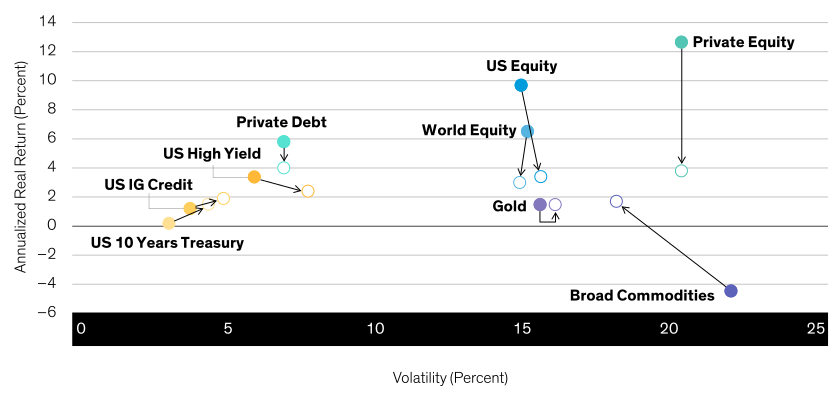
    AB’s forecasts suggests equity real returns will mostly  be lower and bonds will be more volatile in future.

    Historical analysis and current forecasts do not guarantee future results.
    Outlined circles represent AB forecasts for the next 5–10 years. Coloured circles represent actual real returns and volatility for January 2010 through December 2022.
    Private Equity return data: US Private Equity Index from Cambridge Associates, compiled from 1,562 funds, including fully liquidated partnerships, formed between 1986 and 2019. All returns are net of fees, expenses and carried interest.
    Private Equity volatility is estimated from MSCI US Small Cap Value index with 15% leverage. Private debt historic and future volatility expressed as volatility of public US investment grade credit. (The number is between the historic volatility of public US high-yield fixed income and Preqin Direct Lending return index).
    As of 30 June 2024
    Source: Cambridge Associates, FactSet, FRED, Ken French Data Library, Preqin, Thomson Reuters Datastream and AB


    That suggests a need for more sophisticated investments such as illiquid assets, factor premia, active alpha and leverage to bridge the gap. Managing these tools is beyond most DC savers’ capabilities—and beyond the mostly simple retail drawdown products currently on offer too. We believe a default option using sophisticated strategies that are dynamically managed by high-quality professionals offers an appropriate solution.

  7. Risk Could Be Harder to Diversify.

    Similarly, DC savers may need institutional-quality risk controls, as future asset-class correlations could be less predictable. In the Display below, we show the correlation between equities and treasury bonds over more than 250 years. The low to negative correlations of the last 30 years have helped investors manage risk using a straightforward mix of traditional asset classes. However, these return patterns may prove to have been an anomaly, based on the longer historical experience.

    Bonds May Be Less Effective Portfolio Diversifiers in Future
    Longer Term, the Stock-Bond Correlation Has Mostly Been Positive
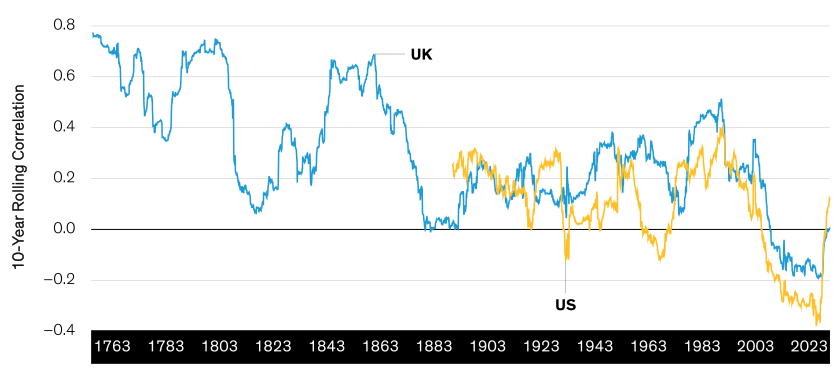
    Since 1763, government bonds have mostly been positively correlated with equities.

    Past performance does not guarantee future results.
    *Rolling 10-year correlation between stock and bond returns
    As of 31 January 2025
    Source: Global Financial data, LSEG Datastream, Shiller's database and AllianceBernstein (AB)

Savings Solutions for a Lifetime

Lifetime income default strategies are now available in the UK for the first time, packaged in a target-date format that is easy for savers to understand and simple for fiduciaries to administer. Savers can simply switch between accumulation and income-paying share classes at their point of retirement—and switch back again if necessary. By providing full access to capital, these strategies keep open savers’ options to annuitize, allowing them to secure a guaranteed income stream at a time of their choosing.

Ten years ago, DC savers gained freedom and choice for their retirement savings. Now, lifetime income default strategies at last bring them professional investment expertise and a flexible lifestyle in retirement too.

The views expressed herein do not constitute research, investment advice or trade recommendations and do not necessarily represent the views of all AB portfolio-management teams. Views are subject to revision over time.


About the Authors