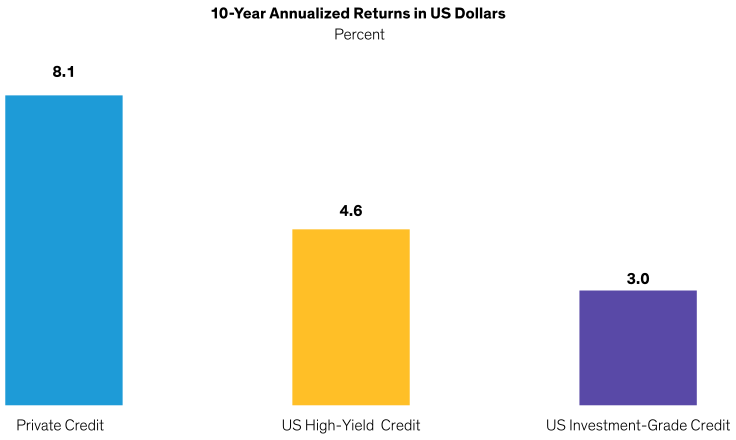
We think private credit’s more defensive profile results from structural features.
Private credit typically involves a single entity lending to a borrower, which creates important advantages. Since managers generally don’t actively trade in and out of loan positions (instead, holding them until they are repaid by borrowers), private credit is more insulated from the technical selling pressure that is typical in down markets in traditional, publicly traded asset classes.
Direct loans are often executed at the top of the capital structure and therefore benefit from large equity cushions to absorb potential declines in a borrower’s value. These loans are also typically structured to give lenders a priority claim on a borrower’s assets, including equity in the underlying business.
Lenders can negotiate protective covenants, such as a cap on the amount of borrowers’ leverage or a required minimum liquidity level. These covenants provide lenders with negotiating power to amend loan terms in their favour or to effect other resolutions if a borrower underperforms.
Unlike traditional publicly traded fixed income, most private credit loans are floating rate. In other words, the interest rates paid by borrowers move in tandem with changes in benchmark interest rates. This dynamic provides a natural hedge against rising interest rates and means that private credit is less sensitive to monetary policy (i.e. has no duration risk).
Private credit has relatively low correlations with traditional equity and fixed-income markets for both idiosyncratic and structural reasons. Within the broad private credit asset class, the diversity of available credit strategies means that investors can have greater control over their exposure to economic factors like the health of corporate borrowers and consumers, and to real assets.
Start with an Appropriate Investment Vehicle
Of course, illiquid investments have historically been difficult for DC investors to access, but today it’s possible to work around the implementation obstacles and achieve cost-effective exposure to assets such as private credit. Highly capable investment vehicles such as target date funds (TDFs) can incorporate complex asset classes while remaining simple for fiduciaries to use and easy for members to understand. DC savers invest in a single TDF corresponding to their desired retirement window, and the TDF glide path is actively managed in line with the target date.
With a TDF approach, professional investors oversee all asset allocation and cash flow decisions for each of the multi-asset funds in the TDF range. This helps avoid many of the complications associated with investing in illiquid markets. For example, there’s no need to use separate hybrid listed / private market fund exposures to facilitate cash flows; instead, DC TDF savers’ cash flows can be allocated to private market assets within their existing strategy.
This approach also avoids unnecessary private asset trading costs because liquidity needs can be met at the TDF strategy level. Governance, fee and cost issues are all addressed at the TDF strategy level, too.
Using Private Credit Across the Age Spectrum
The depth and variety of private credit markets enables different strategies according to DC savers’ ages and risk profiles. For instance, to add private credit in UK TDFs, we believe an allocation can be structured consisting of several distinct strategies—each used at different points along the journey to retirement and each offering differentiated approaches to private credit investment.
Given the growing scale and buying power of UK pension plans, further supported by the pooling effect of default strategies managed by pension providers and asset managers, we believe that fiduciaries can offset some of the upward fee pressure that active private market allocations involve. By extension, using TDFs can help keep the administrative costs and fee expense of such allocations to a minimum. With this approach, it’s possible to implement a meaningful private credit allocation with a minimal to very modest increase in total charges, with the exact cost depending on the glide path position. We believe that this level of increase in fees represents attractive value considering the private credit allocation size and expected long-term return enhancement.
In the evolving landscape of DC pension saving, private credit offers a promising avenue for higher returns and risk diversification. It’s time for fiduciaries to consider embracing this opportunity to help secure the future of DC savers.
For further details, download our White Paper: