Getting Ahead in the AI Race: A Guide for Asset Managers and Clients

03 October 2025
7 min read

What should clients look for to determine whether an investment firm is using AI effectively?

Asset management firms—like all companies—are racing to tap into the transformative potential of artificial intelligence (AI). But the challenge is enormous. It will take a coherent strategy, tactical acumen, and the right skills to successfully unlock investing efficiencies and client benefits.

As the volume and velocity of information flowing through capital markets surges, AI-driven systems can empower investment research teams in new ways. When implemented well, we believe AI can help generate faster insights, broader coverage and ultimately, better investing outcomes.

To reach those goals, we think integrating AI must be guided by human expertise. Clients shouldn’t be blinded by AI science or dazzled by technological gimmickry. Asset management firms should ensure that all use cases aim to create clear benefits for clients. Our AI framework targets three key improvements:

  1. Linear Improvements: More, Faster and Better

    Information overload is a modern scourge. For portfolio teams, getting control of information is the key to developing differentiated investment insights that can unlock opportunity. But what if an analyst had 10,000 competent interns available to perform tasks that previously took countless hours to complete? AI can play that role for investment teams.

    Consider an analyst who covers the small-cap industrials sector with 100 companies in her coverage universe, 10 of which are held in a portfolio. It’s nearly impossible to read thousands of pages of earnings transcripts each quarter. AI tools can instantly condense transcripts into digestible nuggets that can enhance investment insights.

    Securities research requires many mundane tasks that take a disproportionate amount of an analyst’s daily bandwidth. LLM-driven tools can help liberate analysts from time-consuming data gathering to free up time for analysis and synthesis. By completing tasks like drafting research notes or preparing for conference briefings, AI can help sharpen the quality of information at lightning speed.

    Speed isn’t just a fringe benefit. Faster information processing paves the way for faster decision-making. In other words, AI reduces the latency from the release of information to portfolio action. Detecting opportunities and risks ahead of the market can make a big difference in return outcomes.

  2. Exponential Improvement: Analysis That Was Previously Impossible

    The information matrix that influences a company’s fortunes is vast and unstructured, from millions of pages of earnings reports to new legislation and regulation.

    Developments in one industry might matter for an entirely different group of businesses, and human analysts can’t monitor so many sectors simultaneously. But AI can hunt for relevant trends across disparate sectors, such as technology developments that affect healthcare or evidence that wages are increasing in unfamiliar industries, which might signal a wider trend.

    AI can process mountains of information and synthesize it efficiently. It can read the entire One Big Beautiful Bill and tell an analyst how the new laws will affect a given industry. A healthcare investor can use AI tools to monitor all global healthcare regulatory bodies simultaneously. While a human analyst might only be able to monitor 10 competitors of a portfolio holding, it’s now possible to cast a much wider research net to watch 20 to 30 rivals.

    Analysts can use AI to uncover broader opportunities and risks that previously may have gone undetected. By expanding coverage, AI can synthesize cross-company and cross-sector trends in ways that weren’t possible before.

  3. Transformational Improvements: Sharpening Strategic Perspectives

    Evaluating the strategic issues facing a business is central to developing an investment thesis.

    Here, too, AI can create an edge. AI can be used to test arguments, frame scenarios or create “devil’s advocate” briefs that add clarity to investment decisions. For example, an analyst could prompt AI to deepen a strategic analysis by saying: “I’m a mid-market software company serving the auto industry. Here are our competitive pressures. What strategic moves should we consider? Be creative.”

    The net result? A much better sense of a target company’s strategy without consulting a network of experts. This, in turn, should lead to higher-conviction decisions on strategic business issues that can make or break a long-term investment case.

    Beyond investing, imagine if senior executives in an asset management firm could use AI to be a virtual board of experts. AI leaders can address strategic questions about their own businesses to serve clients better. What are our product gaps? How can we structure our businesses more effectively? What strategies can we use to improve collaboration of our teams? We can even use AI to learn how to use AI to facilitate insights. Making more informed decisions on bigger-picture questions can dramatically impact how an asset manager runs its business to help clients meet their needs.

How to Implement AI Tools

A strategic framework is the first step to AI success. Implementation is just as important.

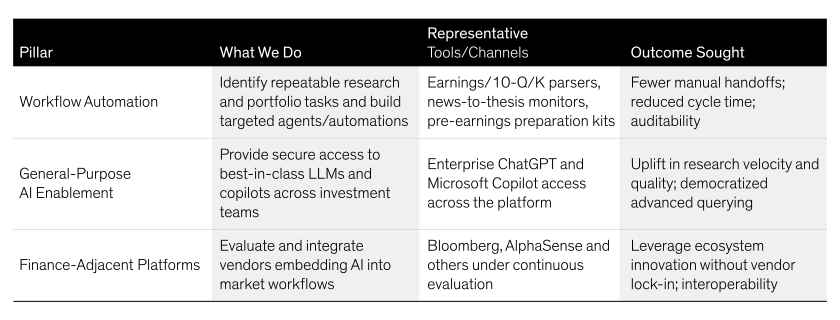
Our AI program is built on three pillars (Display). Each targets a clear goal, which helps identify the right tools to achieve the desired outcome.

Three Pillars for Effective AI Implementation
Table provides a framework for implementing AI at asset management firms, based on three pillars: workflow automation, general-purpose AI enablement and finance-adjacent platforms.

For illustrative purposes only.
As of September 30, 2025
Source: AllianceBernstein (AB)

Effective integration of AI also requires a cultural shift. Senior leaders should set an example by actively using and advocating for AI in their own workflows. Portfolio teams can publish internal agents and playbooks that others can adapt, compounding value across investment platforms. Senior investment leaders can also use AI to improve investment committee (IC) decisions and efficiency. For example, a CIO could input a deal memo ahead of an IC meeting and prompt AI to summarize the memo, suggest anticipated questions, and point out potential investment risks and concerns. And within teams, AI “power users” should mentor peers and share successful use cases.

Use Cases: Public Equities and Corporate Credit

In public equities and credit markets, investors are always looking for changes that can create opportunities or increase risk.

AI tools can be deployed to automatically extract shifts to management guidance and key performance indicators from earnings calls or events. With the right prompts, AI can compare transcripts and filings to previous materials to determine what’s changed, ready for analyst review.

News monitoring is another valuable function. With an investment thesis as a reference point, AI can provide alerts for sector or company news that might undermine confidence in an investment thesis.

At AllianceBernstein, many of our investment teams use both quantitative and fundamental analysis in security selection processes. AI enhances that collaboration, for example, by helping a quantitative analyst articulate a narrative to explain how a data-driven analysis argues for or against a holding. AI drafts devil’s advocate cases for debate so every fundamental thesis is confronted with counterpoints, which can improve the quality of investment decisions.

Use Cases: Private Credit and Specialty Strategies

Private credit investors face different challenges. Often, a single deal involves a massive number of documents. With an AI-powered triage, large document sets for prospective deals can be ingested to produce structured memos, key risk checklists and loan covenant summaries for human follow-up. This can dramatically decrease the time it takes an investment team to conduct a first-round review of a prospective deal.

Rising deal volumes can create big hurdles for private credit underwriting. Automation via AI can address that constraint directly by allowing teams to evaluate more opportunities without making significant headcount increases, saving costs and time.

For private credit and other investors, AI represents an opportunity to build your own IC stocked with respected experts and colleagues. We believe that allowing investors to have a vigorous debate and discussion with a customized and malleable IC should produce superior outcomes while consuming fewer total man hours.

Building Good Guardrails

In our approach, AI supports but doesn’t replace professional security selection, portfolio construction or risk decisions. Our guiding principle is Human in the Loop: we require analysts and portfolio managers to maintain ownership of their judgments and decisions.

Human-guided AI is rooted in our research culture of pairing quantitative analysis and data science with fundamental research. Quantitative models are used to pose better questions and structure debates rather than to autopilot portfolios.

Similarly, we think AI shouldn’t be used as a trading or security recommendation engine. AI model outputs should be treated as inputs to human analysis—not endpoints. Our AI philosophy aims to make our human analysts and investment teams better, enabling deeper and more creative thinking about complex issues that drive successful outcomes.

What Does AI Mean for Clients?

With the help of AI, investment teams can transform overwhelming market noise into actionable insights with unprecedented speed and precision. Faster decision-making processes can provide a competitive edge in an ever-evolving financial landscape.

AI can also enable customized research and reporting to align with specific mandates, and AI-driven processes can provide transparency, with clear evidence trails that support conclusions and foster trust and confidence among clients.

Clients must ask the right questions to understand the potential impact of AI on portfolios. Make sure that firms are using AI to empower people to make smarter decisions—not to replace smart people. Ask front-line analysts how they’re using AI day to day. Informed due diligence can help ensure that an asset-management firm is deploying AI to truly improve your investment journey.


The views expressed herein do not constitute research, investment advice or trade recommendations and do not necessarily represent the views of all AB portfolio-management teams. Views are subject to revision over time.


About the Authors