Income-seeking equity investors don’t need to sacrifice growth to capture the power of dividends.
Many companies say they pay dividends because it’s what their shareholders want. Yet CFOs of the same companies also typically tell us they only allocate capital to maximize shareholder returns. In today’s markets, these two points are often at odds and may create a conundrum for income-seeking equity investors.
Dividends are widely seen as a dependable source of income and are typically associated with strong equity performance. But conventional wisdom about dividends can be simplistic. High payouts today mean less cash to support future business growth, which could erode earnings and share-price return potential. Investors seeking equity income can resolve this quandary by understanding the dynamics of dividends, which can be traced back to their rising appeal 60 years ago.
A Brief History of Modern Dividends
At the beginning of the 1960s, powerful regional monopolies began to emerge across multiple sectors, including banking, energy, media and telecoms. These regional giants dominated their markets and enjoyed the benefits of local scale that eclipsed all competitors.
With healthy revenue and profit growth—and little incremental investment—these monopolies could distribute large sums of cash to shareholders (often including themselves) via the only route possible: dividends. At the time, share buybacks didn’t exist—they were only legalized in 1982 in the US and much later in Europe (Denmark only allowed buybacks in 2006). This golden age of dividend investing reigned supreme for years.
More than three decades later, the birth of the internet shook the foundation of dividend culture. In August 1995, Netscape went public. Despite generating just $1.4 million in revenue, Netscape ended its first trading day with a market cap of nearly $3 billion. The dot-com bubble had begun.
While the market madness lasted only six years, Netscape’s launch marked the start of the commercialization of the internet, which signaled the beginning of the end for most regional monopolies. Monopolists could no longer compete purely on a regional basis because what was once scarce had now become abundant and what was once local had become global. The game had changed.
The Reinvestment Requirement for Growth
In a world of abundance and global competition, the importance of reinvesting in a business became paramount for companies and their shareholders. Companies that do not or cannot reinvest back into their business face stagnation at best, oblivion at worst.
This explains why equities are one of very few assets that can grow without requiring significant reinvestment by investors. Cash is whittled away by inflation, bonds must be reinvested, and property needs constant maintenance. A stock’s value, however, may continue to grow completely untouched. The reason? Someone else is doing the investment for you—the underlying company.
Fast forward to 2025, and a new market force is redefining dividend dynamics. Passive assets that track indices are now the dominant force in markets, with AUM surpassing that of active managers. This shift in power has spurred a subtle change in markets that has upended the classic investing adage of buy low, sell high.
Indeed, the opposite is now true, because most indices are market-cap weighted. All else being equal, if a company’s share price falls, its market cap and index weight decline; vice versa when a share price rises. As a result, the weight of money in the market will buy stocks that go up and sell stocks that go down. In other words, buy high, sell low has become commonplace today.
The Interplay Between Dividends, Earnings and Share Prices
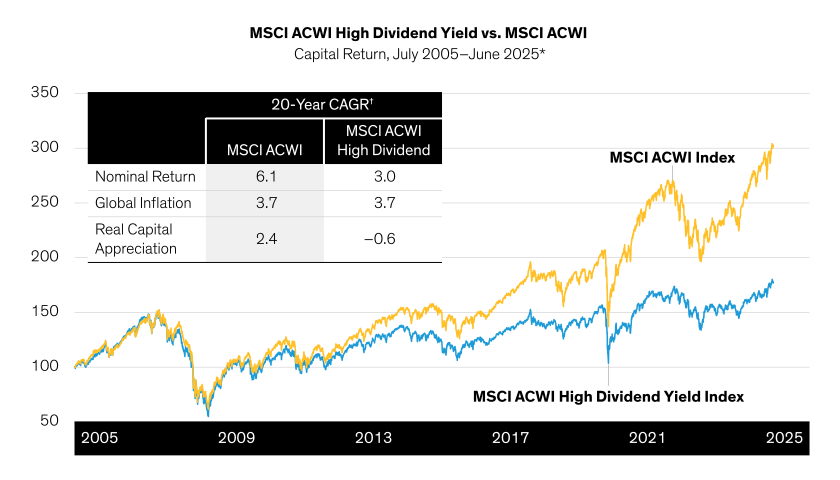
New market dynamics have changed the calculus for dividends, which aren’t necessarily aligned with strong stock performance anymore (Display). Yet many investors still like a dividend because it’s widely believed that by spending our dividends, we are protecting our capital. Sadly, in today’s world that’s not always true.