Sagredo: Thank you my friends for convening here on this beautiful morning in my favorite city. I am much moved and worried by what I read these days. I have been following the markets closely in recent years and am struck by how well the stock market has performed despite any recent nervousness. I am grateful that I followed advice and put my savings into stocks, as I paid heed to those who have said inflation will rise and one needs a high allocation to stocks in order to protect the power to purchase goods or services of the same value in the future (I am still some way to retirement, but you know one wants to keep watch on such things). I kept things simple and just bought passive exposure to stocks. It seemed like what so many people were doing, and the market has treated me well. But what worries me is this: so much of the gain is from a small number of stocks, and other people have been buying passive instruments as well. Is this riskier now than it was before? What transpires if something happens to one of these massive companies and people like me try to sell their passive instruments at the same time? Is it the fact that so many people have been buying these passive instruments that is responsible for why these few companies are so huge today? Did we cause this? Afterall, these passive instruments are weighted by market cap and I read that that is a choice, not something that needs be written in stone.
Pangloss: Let me stop you there my dear friend. You have been reading too much scaremongering. People who make their occupation by writing—whether they are in the employ of finance firms and engaged in research or are journalists, they all want the same thing! They need to shock you a little bit; if they just said everything is fine then no one would bother to read them. We are living in the heyday of capitalism, and capitalism is the best of all possible world systems!
Salviati: Your claim is hardly beyond doubt! I can think of countless objections. But even if one wants to accept that capitalism is the best of possible world systems, the world that we have arrived at today is only capitalism in name, or at least is more fragile than it should be!
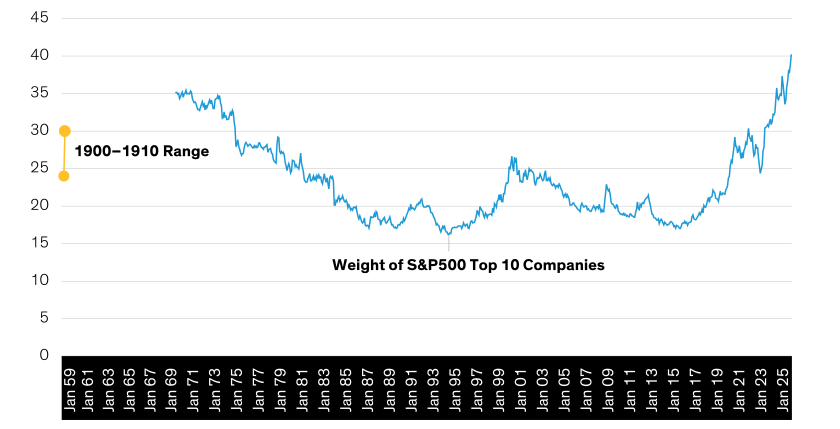
There are parallel, stark features of the corporate sector and the way that people invest today, These are the high concentration of the weight of the stock market into a small number of mega-cap names and the predominance of “passive” investment in cap-weighted indices, such that large flows into tracking funds direct an ever greater volume of capital to a small number of companies.
I suggest that these parallel features constitute a dystopian symbiosis. It’s a symbiosis, as the presence of massive platform companies and passive capital-weighted indices feed off each other like a marriage of convenience; it is dystopian because both stand in the way of competition and capitalism. The massive companies stifle competition, and the passive cap-weighted indices do nothing to aid the process of capital allocation in the economy as they are, by construction, backward-looking.
Sagredo: This sounds worrisome indeed. But are these two attributes symbiotic or causal? I am not gifted with enough intelligence to tell which might have caused the other, but maybe you can enlighten me? It seems that both have happened at the same time, that is to say over the course of the last decade and a half. Surely it seems like a coincidence for these to occur at the same time if one has not led to the other?
Salviati: Much as I worry about this topic, I don’t think I can ascribe causation between them. One might say that, when investors buy passive funds that are weighted by market cap, they promote companies that have been successful in the past, and hence force a momentum characteristic in the market higher. It is also true that when there are new flows into indices that are weighted by market cap, then the largest companies receive the largest extra flow of capital.
However, there are also perfectly natural reasons why concentration in the market has grown. There are the network and scale benefits of technology, be it the network effects of intangible capital or the scale advantages of data centers running at huge scale. One makes no moral judgement about this; if it is indeed the case that technology has a scale advantage, then it would be expected to lead, in equilibrium, to a group of larger companies.
My final reason for denying causation is that the high concentration of the market is not, actually, that unusual. In the US we have been close to here twice before. The Nifty 50 period of the late 1960s saw a very similar level of concentration, and concentration was also elevated from 1900 to 1910. Standard Oil was itself 10% of the US market in 1900, prior to its break-up in 1911. Moreover, other stock markets have been more concentrated than the current US level: look at Denmark or Israel to name but two. In fact, the odd outlier was the level of de-concentration of the 1990s. We are all shaped by our own journey and personal experience, and anyone who learnt their experience of the market in that period would find today’s level of concentration unusual.
This reminds me of the Arian heresy of the 4th century. Are these two forces—cap-weighting of passive investments and concentration of massive companies—of the same substance, or does one have primacy over the other?