
Three Reasons to Think Ultrashort Bond ETFs in 2026
Key Takeaways
- The opportunity cost to investors staying parked in cash or cash-like instruments may be growing with the Fed eyeing more rate cuts.
- Ultrashort bond funds are a popular destination, but the category is wide-ranging—including everything from three-month Treasury bill funds to floating-rate corporate bond funds.
- AB’s Ultra Short Income ETF (YEAR) offers active management, income and potential price gains as rates fall—without the volatility of long-term bonds.
Inflation seems likely to moderate in 2026, and the Fed could cut rates further. But there’s uncertainty around how many cuts will emerge. For investors with cash-like holdings to generate income and deploy as opportunities emerge, we see ultrashort bond funds as a way to capture attractive yields, with quality, in a more lasting way. They may also enhance returns in downturns, providing a cushion.
Here are three reasons for investors to consider incorporating an ultrashort bond fund today.
1. If More Fed Cuts Materialize, Cash Is Likely to Lag
With some level of policy rate cuts expected, many investors are taking a closer look at their portfolio’s cash exposure. Historically, yields on money-market funds and short-term instruments have reacted to Fed cuts in real time, so attempting to time the market can be perilous if those yields tumble.
2. Duration Could Be Your Friend if Interest Rates Fall
Even some duration exposure could be an opportunity. Ultrashort bond ETFs may benefit investors as yields start falling, and they don’t have the higher volatility of longer-term bonds. That sets up these strategies as a sound way to shift out of cash while staying relatively conservative.
3. Cash Is No Longer “Risk-Free”: Meet Reinvestment Risk
As rates fall, investors still in cash will be forced to reinvest it at falling yields. This could lock in lower returns for years. Ultrashort bond ETFs, on the other hand, offer investors the ability to lock in attractive income potential today, with possible capital appreciation as rates fall.
Consider AB’s Ultra Short Income ETF (YEAR)
YEAR is a diversified option for clients seeking attractive income with capital preservation, daily liquidity and duration under one year. It’s a thoughtful, measured step out of cash that offers potentially higher yields with more staying power. As history has shown, ultrashort bond funds have tended to outperform money-market returns in most periods—especially when yields are stable or falling (Display).
But the ultrashort category is a broad catch-all for funds with durations under a year: everything from three-month Treasury bill funds to floating-rate corporate bond funds. Money-market investors seeking to lock in attractive short-term yields with a similar experience should look to funds like YEAR: invested mainly in Treasuries and short-term investment-grade corporate bonds as well as properly sized opportunistic short-term assets. And YEAR’s active management is designed to capture relative-value opportunities in the short part of the yield curve.
Money-market investors want three things: stability, liquidity and yield. YEAR is built on that foundation.
Ultrashort Bond Funds Tend to Outperform Money-Market Funds in Most Periods—Especially When Yields Are Stable or Falling
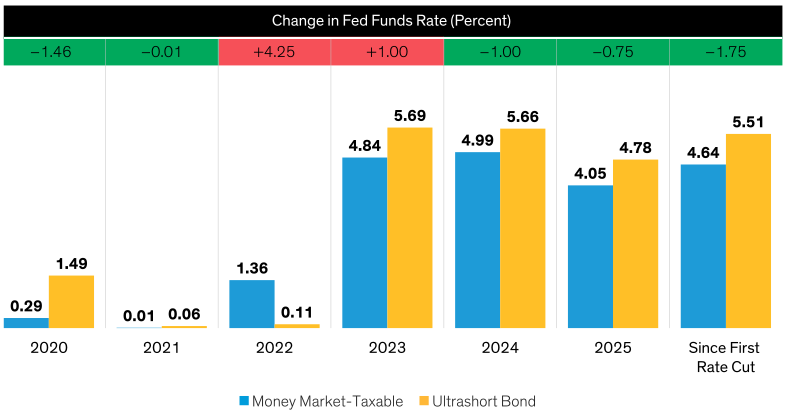
Historical analysis and current forecasts do not guarantee future results.
Represented by category averages: US Fund Money Market Taxable and US Fund Ultrashort Bond. Since First Rate Cut period: August 1, 2023–September 30, 2025
As of December 31, 2025
Source: Morningstar and AllianceBernstein
If you’re an investor looking for trading guidance, the AB ETF Capital Markets team offers complimentary trade advisory services. You can reach us at etf.capitalmarkets@alliancebernstein.com.
And you can find out more about AB’s actively managed ETFs here.
How to Take Action
The performance shown represents past performance and does not guarantee future results. Current performance may be lower or higher than the performance information shown. The investment return and principal value of an investment in the Portfolio will fluctuate, so that shares, when redeemed, may be worth more or less than their original cost. Performance assumes reinvestment of distributions and does not account for taxes.
30 Day SEC Yield 3.96 as of 03/31/2026
The 30-Day Yield represents net investment income earned by the Fund over the 30-Day period ended 03/31/2026, expressed as an annual percentage rate based on the Fund’s share price at the end of the 30-Day period. The 30-Day unsubsidized SEC Yield does not reflect any fee waivers/reimbursements/limits in effect.
Distribution rate is calculated on a 30-day rolling basis by annualizing the average of the dividends distributed over the most recent 30-day period and dividing that figure by the current NAV. The 30-Day Yield represents net investment income earned by the Fund over the 30-Day period, expressed as an annual percentage rate based on the Fund's share price at the end of the 30-Day period. The 30-Day unsubsidized SEC Yield does not reflect any fee waivers/reimbursements/limits in effect. The distribution yield calculation does not include long-term or short-term capital gains distributions.
Investing in ETFs involves risk and there is no guarantee of principal.
Investors should consider the investment objectives, risks, charges and expenses of the Fund/Portfolio carefully before investing. For copies of our prospectus or summary prospectus, which contain this and other information, visit our Literature Center or contact your AB representative. Please read the prospectus and/or summary prospectus carefully before investing.
Shares of the ETF may be bought or sold throughout the day at their market price on the exchange on which they are listed. The market price of an ETF’s shares may be at, above or below the ETF’s net asset value (NAV) and will fluctuate with changes in the NAV as well as supply and demand in the market for the shares. Shares of the ETF may only be redeemed directly with the ETF at NAV by Authorized Participants, in very large creation units. There can be no guarantee that an active trading market for the Fund’s shares will develop or be maintained, or that their listing will continue or remain unchanged. Buying or selling the Fund’s shares on an exchange may require the payment of brokerage commissions, and frequent trading may incur brokerage costs that detract significantly from investment returns.
Below-Investment-Grade Securities Risk: Investments in fixed-income securities with lower ratings (a/k/a junk bonds) are subject to a higher probability that an issuer will default or fail to meet its payment obligations. These securities may be subject to greater price volatility due to such factors as specific municipal or corporate developments and negative performance of the junk bond market generally and may be more difficult to trade than other types of securities.
Credit Risk: A bond’s credit rating reflects the issuer’s ability to make timely payments of interest or principal—the lower the rating, the higher the risk of default. If the issuer’s financial strength deteriorates, the issuer’s rating may be lowered, and the bond’s value may decline.
Derivatives Risk: Derivatives may be more sensitive to changes in market conditions and may amplify risks.
Foreign (Non-US) Investment Risk: Investments in securities of non-US issuers may involve more risk than those of US issuers. These securities may fluctuate more widely in price and may be more difficult to trade than domestic securities due to adverse market, economic, political, regulatory, or other factors.
Inflation Risk: Prices for goods and services tend to rise over time, which may erode the purchasing power of investments.
Interest-Rate Risk: As interest rates rise, bond prices fall and vice versa; long-term securities tend to rise and fall more than short-term securities.
Investment Securities Risk: To the extent the Fund invests in other funds, shareholders will bear to layers of asset-based expenses, which could reduce returns.
Leverage Risk: Trying to enhance investment returns by borrowing money or using other leverage transactions such as reverser purchase agreements—magnifies both gains and losses, resulting in greater volatility.
Market Risk: The market values of the Portfolio’s holdings rise and fall from day to day, so investments may lose value.
New Fund Risk: The Fund is recently organized, giving prospective investors a limited track record on which to base their investment decision.
Duration:
Duration is a measurement of a bond's interest rate risk that considers a bond's maturity, yield, coupon and call features
Distributed by Foreside Fund Services, LLC. Foreside is not affiliated with AllianceBernstein.
AB funds may be offered only to persons in the United States and by way of a prospectus. This website should not be considered a solicitation or offering of any investment products or services to investors residing outside of the United States.
Investment Products Offered: Are not FDIC Insured | May Lose Value | Are Not Bank Guaranteed
The [A/B] logo and AllianceBernstein® are registered trademarks used by permission of the owner, AllianceBernstein L.P.
©2026 Morningstar, Inc. All rights reserved. The information contained herein: (1) is proprietary to Morningstar and/or its content providers; (2) may not be copied or distributed; and (3) is not warranted to be accurate, complete, or timely. Neither Morningstar nor its content providers are responsible for any damages or losses arising from any use of this information. Past performance is no guarantee of future results.
AL-896805-2026-03-05