
Three Steps to Assess Thematic Investing’s Potential
Key Takeaways
- Artificial intelligence, defense modernization, energy transition and medical innovation are reshaping the way companies compete and economies grow.
- To tap into these themes, it takes much more than chasing today’s headlines. A three-step process can help determine a strategic place for thematic investing in portfolios.
- The AB Disruptors ETF (NYSE: FWD) is worth consideration. It’s an actively managed strategy with a thematic approach to identifying disruptive leaders across sectors and geographies.
A Framework for Evaluating Thematic Growth Opportunities
- Explore the Investment Case for Thematic Growth
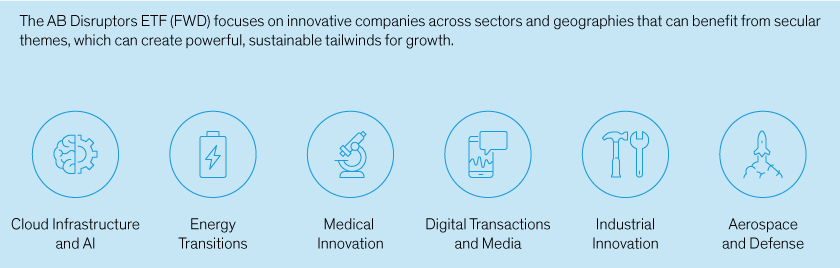
Big opportunities can potentially emerge from long-term structural changes. Disruptive themes like Artificial Intelligence (AI), healthcare innovation, defense and industrial modernization may create growth opportunities that market-cap indices, sectors and factors don’t fully capture. Pursuing multiple themes enables a strategy to lean on a broader opportunity set than a narrow trend or small group of companies.
Action item: Review your portfolio’s growth exposure to see if access to multiple sources of long-term innovation might help.
- Focus on Staying Invested—Not Chasing Today’s Hot Theme
As we see it, thematic investing is most effective when it’s tied to durable structural forces rather than short-term market leadership. Innovation cycles can move quickly, and individual themes, sectors or industries can fall in and out of favor even while the broader forces reshaping the economy remain intact. A diversified, multi-theme approach can spread exposure across growth drivers and can adapt as conditions change, which helps investors stay invested without constantly timing or rebalancing allocations to individual themes.
Action item: Consider whether a diversified, multi-theme strategy can serve as a strategic growth allocation, providing exposure to several long-term sources of disruption while reducing the need to independently size, time and rebalance a collection of targeted thematic, sector or industry strategies.
- Look for Discipline Behind the Opportunity
Not every company connected to an exciting theme is a compelling investment. A deliberate combination of top-down and bottom-up insights helps distinguish firms with durable business models from headline winners. Finding these businesses requires discipline and a broad view across sectors and regions to identify companies positioned to benefit as disruption reshapes industry profit pools.
Action item: Evaluate whether a thematic strategy has a repeatable investment process, clear risk controls and a defined role within the portfolio’s allocation.
AB Disruptors ETF (FWD): A Disciplined Approach to Thematic Investing
Thematic investing offers an avenue for portfolios to tap opportunities in market segments being reshaped by innovation and structural change. But understand the investment case, focus on long-term participation and choose a disciplined strategy that fits your portfolio’s broader goals.
We think the AB Disruptors ETF (FWD) could check the boxes. It seeks to outperform global growth equity markets by investing in innovative market leaders poised to disrupt their industries. The strategy combines top-down thematic research with rigorous, bottom-up fundamental analysis and robust risk management.
How to Take Action
FWD received a 5-star Overall and 5-star 3-Year Morningstar Rating™ as of July 31, 2026,
rated among 287 funds in the Morningstar Global Large-Stock Growth Category based on risk-adjusted total returns.
Investors should consider the investment objectives, risks, charges and expenses of the Fund/Portfolio carefully before investing. For copies of our prospectus or summary prospectus, which contain this and other information, visit our Literature Center or contact your AB representative. Please read the prospectus and/or summary prospectus carefully before investing.
Shares of the ETF may be bought or sold throughout the day at their market price on the exchange on which they are listed. The market price of an ETF’s shares may be at, above or below the ETF’s net asset value (NAV) and will fluctuate with changes in the NAV as well as supply and demand in the market for the shares. Shares of the ETF may only be redeemed directly with the ETF at NAV by Authorized Participants, in very large creation units. There can be no guarantee that an active trading market for the Fund’s shares will develop or be maintained, or that their listing will continue or remain unchanged. Buying or selling the Fund’s shares on an exchange may require the payment of brokerage commissions, and frequent trading may incur brokerage costs that detract significantly from investment returns.
Active Trading Risk: The Fund expects to engage in active and frequent trading, which will increase the portfolio turnover rate. A higher portfolio turnover increases transaction costs and may negatively affect the Fund’s return.
Currency Risk: Fluctuations in currency exchange rates may negatively affect the value of the Fund’s investments or reduce its returns.
Emerging-Market Risk: Investments in emerging-market countries may have more risk because the markets are less developed and less liquid, as well as subject to increased economic, political, regulatory or other uncertainties.
Equity Securities Risk: The Fund invests in publicly traded equity securities, and their value may fluctuate, sometimes rapidly and unpredictably, which means a security may be worth more or less than when it was purchased. These fluctuations can be based on a variety of factors, including a company’s financial condition; macroeconomic factors such as interest rates, inflation rates and global market conditions; and noneconomic factors such as market perceptions and social or political events.
Foreign (Non-US) Investment Risk: Investments in securities of non-US issuers may involve more risk than those of US issuers. These securities may fluctuate more widely in price, and may be more difficult to trade, than domestic securities due to adverse market, economic, political, regulatory or other factors.
Global Risk: The Fund invests in companies in multiple countries. These companies may experience differing outcomes with respect to safety and security, economic uncertainties, natural and environmental conditions, health conditions, and/or systemic market dislocations. The global interconnectivity of industries and companies, especially with respect to goods, can be negatively impacted by events occurring beyond a company’s principal geographic location, which can contribute to volatility, valuation and liquidity issues.
Non-Diversification Risk: The Fund is a "non-diversified" investment company, which means that the Fund may invest a larger portion of its assets in fewer companies than a diversified investment company. This increases the risks of investing in the Fund since the performance of each stock has a greater impact on the Fund’s performance. To the extent that the Fund invests a relatively high percentage of its assets in securities of a limited number of companies, the Fund may also be more susceptible than a diversified investment company to any single economic, political or regulatory occurrence.
Sector Risk: The Fund may have more risk because it may invest to a significant extent in one or more particular market sectors, such as the information technology sector. To the extent it does so, market or economic factors affecting the relevant sector(s) could have a major effect on the value of the Fund’s investments.
New Fund Risk: The Fund is recently organized, giving prospective investors a limited track record on which to base their investment decision.
AllianceBernstein L.P. (AB) is the investment adviser for the Fund. Distributed by Foreside Fund Services, LLC. Foreside is not related to AB.
The [A/B] logo and AllianceBernstein® are registered trademarks used by permission of the owner, AllianceBernstein L.P.
© 2026 AllianceBernstein L.P.
© 2026 Morningstar, Inc. All rights reserved. The information contained herein: (1) is proprietary to Morningstar; (2) may not be copied or distributed; and (3) is not warranted to be accurate, complete or timely. Neither Morningstar nor its content providers are responsible for any damages or losses arising from any use of this information.
The Morningstar Rating™ for funds, or star rating, is calculated for managed products (including mutual funds, variable annuity and variable life subaccounts, exchange-traded funds, closed-end funds, and separate accounts) with at least a three-year history. Exchange-traded funds and open-ended mutual funds are considered a single population for comparative purposes. The star rating is calculated based on a Morningstar Risk-Adjusted Return measure that accounts for variation in a managed product’s monthly excess performance, placing more emphasis on downward variations and rewarding consistent performance. The Morningstar Rating does not include any adjustment for sales loads. The top 10.0% of products in each product category receive 5 stars, the next 22.5% receive 4 stars, the next 35.0% receive 3 stars, the next 22.5% receive 2 stars and the bottom 10.0% receive 1 star. The Overall Morningstar Rating™ for a managed product is derived from a weighted average of the performance figures associated with its three-, five- and 10-year (if applicable) Morningstar Rating metrics. The weights are: 100% three-year rating for 36–59 months of total returns, 60% five-year rating/40% three-year rating for 60–119 months of total returns and 50% 10-year rating/30% five-year rating/20% three-year rating for 120 or more months of total returns. While the 10-year overall star rating formula seems to give the most weight to the 10-year period, the most recent three-year period actually has the greatest impact because it is included in all three rating period.
AL-984245-2026-08-10