A Super Cocktail Drives Markets…and Stimulus Pulls Returns Forward
The decades-long era of exceptional market returns investors have enjoyed didn’t emerge from nowhere. Starting in the early 1980s, a fundamental super cocktail of powerful forces converged to form the foundation: demographics, automation/technology, globalization and the resulting long decline in both inflation and interest rates.
The results were impressive. Since its inception in 1957, the S&P 500 has delivered annualized returns topping 10%. But since 1981, a blended portfolio of 60% stocks and 40% bonds has delivered roughly the same performance. And most striking, from 1981 through 1999, bonds alone delivered annualized returns of over 11%. The S&P 500? Over 18%...for nearly two decades.
Around 2000, the composition of return drivers started to change as the super cocktail tailwind began to ebb. For example, demographics became less favorable, as the oldest Baby Boomers started exiting their peak earning years. The gains that had accrued from a historic era of globalization and automation declined from very high levels. In concert, interest rates had fallen dramatically and valuations had climbed to historic peaks.
Increasingly, market returns were driven by growing government debt, ever-expanding valuation multiples and, later, repeated rounds of intended and unintended policy intervention. These included the historic response to the global financial crisis, the resulting “great beta trade” enabled the massive policy support, and a policy response to COVID-19 that was larger still. These interventions helped steady financial markets and support rising asset prices.
But stimulus from policy intervention also “borrows” future market returns. That approach can’t be repeated indefinitely, because it changes the math of market returns: valuations rise while forward return assumptions fall. This portfolio-construction challenge leaves investors wondering where the next fundamental return engine might come from and whether stimulus will save the day when the next crisis arrives. If returns moderate, the sequence in which they happen—particularly if cash flows are involved—grows more important.
Return Sequence Plays a Bigger Role in Success or Failure
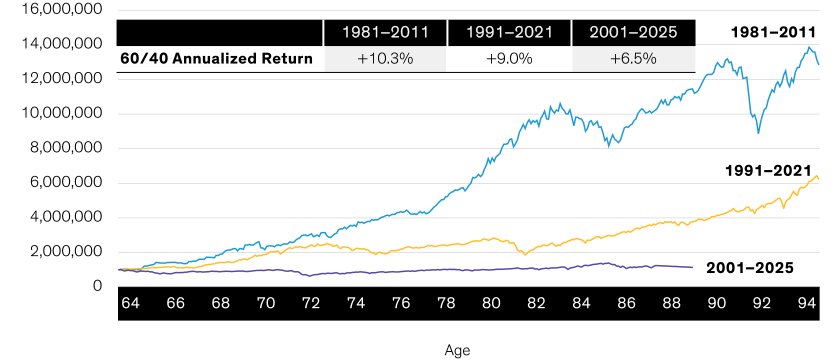
We can translate this challenge into the real world by looking through the eyes of retirees over the past four decades as returns moderated and retirement withdrawals came into play (Display).
Consider a person who retired in 1981 with $1 million, just as the long rally was starting. Withdrawing 4% annually adjusted for inflation, hoping for savings to last for decades of retirement spending. Thirty years later, well past that point, the account would actually have grown to $13 million. Someone retiring in 1991, experiencing slightly less robust returns, would have had more than $6 million in wealth remaining. A 2001 retiree may have missed the strongest years of the super cocktail but benefited from the era of policy stimulus, and would have had roughly $1 million remaining after 30 years of retirement. That’s still a solid outcome, though well below the other two scenarios.