Capital Markets Outlook 2Q 2026: At the Intersection of AI and All the Other Stuff

April 21 2026
5 min read

What You Should Know

As Middle East conflict rattles markets, we’re once again at a crossroads. AI’s long-run potential remains the primary economic and market driver, but lingering anxieties could create resistance in the transition from old to new economy. We still see upside, but more modest returns may be ahead.

Key Takeaways

  • As the second quarter unfolds, inflation continues to make slow progress, economic growth is solid but narrow, and labor markets remain in an uncomfortable balance.
  • Equity markets are adjusting to a more uncertain world and will likely remain volatile until the Middle East conflict resolves. However, there are high-conviction areas.
  • Together, bond yields and spreads are as high as they’ve been in a year, providing compelling all-in yields. High-yield credit is no exception.
  • In the municipal bond market, a barbell maturity structure helps maximize yield and roll potential. Credit exposure still offers the best yield opportunity for high-tax-bracket investors.

A Macro Picture That Refuses to Simplify Itself

Equity markets posted their worst two-quarter stretch since 2022, and the macro picture refuses to simplify any further. Looking through yet another supply-side shock, inflation continues to make slow progress in key areas such as housing, tariff sensitive goods and services non-housing. Economic growth is solid but narrow, and could be the key economic risk if the war is prolonged. The bottom 90% of the K-shaped economy has struggled; a drawn-out conflict would exacerbate their affordability problem and, unlike previous shocks, affect the upper part of the “K.”

The labor market remains in an uncomfortable balance. Much like growth, it’s vulnerable to a shock, though an uncomfortable balance is still a balance. How this “Holy Trinity” of inflation, growth and labor translates into monetary policy remains to be seen. Right now, the Federal Reserve sees the federal funds rate as “in the high end of neutral,” although we see rate cuts ahead, whether the war continues or not (Display).

The Fed Still Sees Rate Cut(s) Ahead…and We Agree
Number of Rate Hikes (+) vs. Cuts (–) Projected by Markets
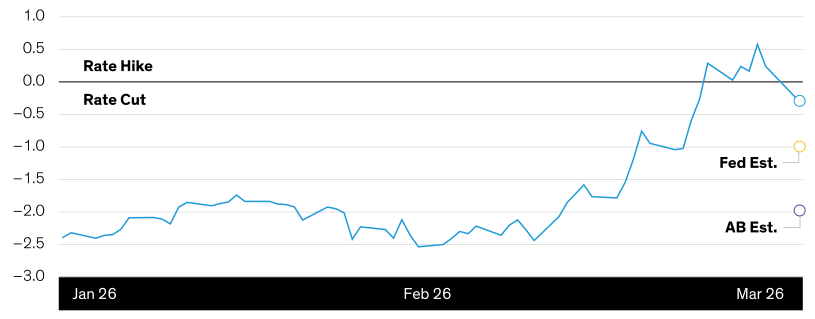
A history of market expectations for rate hikes, including current projections from the Fed and AB

Current analysis does not guarantee future results. 
As of March 31, 2026
Source: Bloomberg, Federal Reserve and AllianceBernstein (AB)

As Stocks Await Middle East Resolution, High-Conviction Areas Remain

Equity markets are adjusting to a more uncertain world where geopolitics, inflation risks and AI disruption have converged. S&P 500 earnings expectations have jumped, with AI’s momentum resilient, while valuations have tumbled as the Iran war reverberates. Until the Middle East conflict resolves and energy markets stabilize, markets will likely remain volatile, with capital discipline and adaptability being key.

In large-cap active core, investors should keep their options open, because factor and style rotations are becoming more frequent. Many value stocks are anchored in hard assets and shorter-duration cash flows, with more immediate, reliable earnings visibility. Sustainable dividend growers have outperformed many classic inflation hedges over time, especially when inflation retreats. Long-term trends offer many thematic avenues, and an opportunity set that intersects with traditional growth and value. Higher-quality, lower-beta names are typically more resilient in market pullbacks.

International developed markets offer competitive earnings growth compared with the US: their markets are less concentrated, and many stocks still trade at a discount. In emerging markets, opportunity has often knocked throughout history—when markets have been buffeted by extreme fear (Display), strong returns have typically followed.

Extreme Fear Has Preceded Strong Emerging-Market Equity Returns
A history of peak VIX Index levels and subsequent emerging-market equity returns

Past performance and current analysis do not guarantee future results.
EM: emerging market. *In US-dollar terms 
Left display through March 27, 2026; right display as of February 27, 2026
Source: Bloomberg, Cboe Global Markets, MSCI, S&P and AB

Bonds—Including High Yield—Offer Strong All-In Yields

In the first quarter, the US Treasury yield curve reversed some of its 2025 steepening, as short-term yields rose. Both yields and spreads have risen back to levels not seen in almost a year, creating an attractive entry point. High-yield bonds also look attractive today, with yields rising back above their long-term averages.

Credit spreads in high yield have tightened, given higher Treasury yields, which now account for a greater share of total yield than is typical. Spread tightening stems from several developments, including improved credit quality and shorter duration. Despite tighter spreads, a healthy all-in yield means that a sizable increase in interest rates would be needed to offset carry potential. Historically speaking, starting yields have been a strong indicator of returns ahead.

As the credit spectrum has evolved, the yield premium between BB-rated bonds, the highest-quality rung in the high-yield universe, and BBB-rated bonds, the lowest rung of investment-grade ratings, has shrunk considerably. In fact, about 40% of BBB-rated bonds now offer BB-like yields. That gives investors the opportunity to move up in quality from BB to BBB with little or no yield give-up (Display).

Move Up in Quality from BB to BBB Without Giving Up Much (or Any) Yield
The spread difference between BB and BBB corporate bonds, and yield comparisons by ratings cohorts

Past performance does not guarantee future results. 
Bonds are rated by a nationally recognized statistical rating organization; AAA is highest (best) and D is lowest (worst). BBB bonds are represented by the BBB cohort bonds in Bloomberg US Credit Corporate. BB bonds are represented by the BB cohort bonds in Bloomberg US High Yield Corporate.
As of March 31, 2026
Source: Bloomberg and AB

In Muniland, Curve Positioning and Credit Exposure Are Key

In the municipal bond market, a March yield spike erased January’s and February’s outperformance. The main reasons: strong technicals evaporated and the macro picture was shaken by volatility. Municipal market inflows, which had started the year strong, waned in March as supply rose.

The belly of the yield curve underperformed, a result of concentrated issuance and expensive valuations. We think yield-curve positioning will be key going forward. A barbell maturity structure, in our view, helps maximize potential yield and roll—attributes maximized in the 15- to 20-year maturity range. Historically, steepening yield-curve shifts have been followed by curve flattening; when this happens, long-term bonds tend to outperform.

As we see it, credit exposure remains the best yield opportunity for high-tax-bracket investors (Display). In the first quarter, credit held up better than high-quality munis, and high-yield municipals posted positive returns. Rainy-day fund balances remain steady, an indicator of fundamental support. However, selectivity is crucial for active muni investors.

Muni Credit Remains the Best Yield Opportunity for High-Tax Investors
Muni returns by rating, state rainy-day fund levels and tax-equivalent yield comparisons

Current analysis does not guarantee future results. There is no guarantee any investment objective will be achieved.
FY: fiscal year; HY: high yield. Fiscal 2025 is preliminary actual; fiscal 2026 is projected based on states’ enacted budgets. Three states (Georgia, Pennsylvania and Wisconsin) were not able to report on rainy-day fund balance projections for fiscal 2026. 
*Tax rate assumptions use a 40.8% rate.
As of March 31, 2026
Source: Bloomberg, National Association of State Budget Officers and AB

The views expressed herein do not constitute research, investment advice or trade recommendations, do not necessarily represent the views of all AB portfolio-management teams and are subject to change over time.