Equity Outlook: Middle East War, Energy Shock Test Fragile Markets

April 02 2026
8 min read

Markets are pricing in a wider range of scenarios as geopolitics and AI reshape the landscape.

Global equities declined during a volatile first quarter as the war in Iran roiled energy markets and fueled inflation fears that destabilized the economic growth outlook. Mounting geopolitical hazards add to existing worries around concentrated equity markets and the potential for AI to disrupt businesses.

Stocks began the year with gusto but retreated sharply in March after the US-Israeli attacks on Iran escalated into a regional war that threw energy markets into turmoil. Iran shut the Strait of Hormuz—a vital choke point through which about a fifth of the world’s oil is shipped—while launching counterattacks against Gulf Arab countries and Israel. The spiraling events raised concerns about a protracted Middle East conflict with complex risks for the global economy.

By quarter end, the MSCI ACWI Index was down by 3.2% in US-dollar terms. All major markets dropped after the war started. Emerging markets and Japan fell hardest in March but ended the quarter ahead of the global market due to stronger performance earlier in the year.

Global Stocks Declined as Middle East Conflict Fueled Inflation Fears
Left chart shows MSCI ACWI performance in 1Q 2026, annotated with major events. Right chart shows regional equity market returns in the first quarter.

Past performance does not guarantee future results.
*Australia represented by MSCI Australia Index, UK represented by MSCI United Kingdom Index, Japan represented by MSCI Japan Index, US small-caps represented by Russell 2000 Index, emerging markets represented by MSCI Emerging Markets Index, China represented by MSCI China A Index, Europe ex-UK represented by MSCI Europe ex-UK Index and US large-caps represented by S&P 500
As of March 31, 2026
Source: FactSet, FTSE Russell, MSCI, S&P and AllianceBernstein (AB)

Growth stocks underperformed, while quality stocks were in line with the broader market. Value and minimum-volatility stocks were relatively resilient, particularly in markets outside the US (Display). The consumer discretionary and technology sectors, which include the US megacaps, were among the worst performers, while financials were weak due to concern about private credit. Unsurprisingly, energy stocks surged on higher oil and gas prices.

Energy Sector Surged; Value and Minimum-Volatility Stocks Were Relatively Resilient
Left chart shows MSCI ACWI sector returns for 1Q 2026. Right chart shows US and non-US style index returns for 1Q 2026.

Past performance does not guarantee future results.
*US stocks represented by Russell 1000 Value, Russell 1000 Growth, MSCI USA Quality and MSCI USA Minimum Volatility indices. Non-US stocks represented by MSCI EAFE style indices.
As of March 31, 2026
Source: FactSet, FTSE Russell, MSCI and AB

Market Volatility and the Energy Shock 

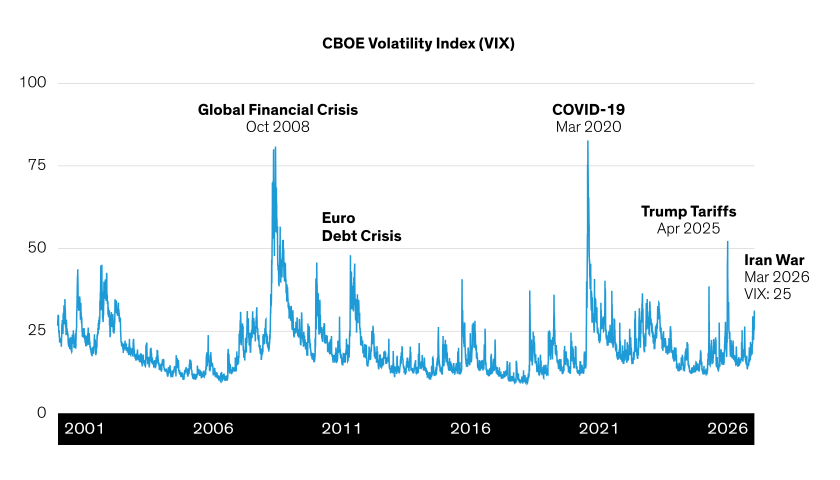
Market volatility jumped as the war escalated. However, the CBOE Volatility Index (VIX)—a barometer of US equity market volatility—didn’t reach peaks seen a year prior when President Donald Trump announced sweeping tariffs (Display). Still, as long as headlines spotlight regional destruction, the mounting death toll and the risk of a US military quagmire, we expect volatility to stay elevated.

Market Volatility Jumped but Did Not Reach Extreme Levels by Quarter-End
Chart shows CBOW VIX Index from 2001 through 2026, annotated with major events that prompted spikes in market volatility.

Past performance does not guarantee future results.
The CBOE Volatility Index (VIX) measures the market’s expectation of 30-day volatility for the S&P 500
Through March 31, 2026
Source: Bloomberg, CBOE Global Markets and AB

We believe energy shocks pose the most immediate risk to equities. By quarter-end, Brent crude traded at $103.9 a barrel, up 69% on the year, while gas prices had nearly doubled. Sustained hikes in energy costs could push inflation higher globally, complicating the outlook for interest rates at a time when markets anticipated monetary policy relief. This, in turn, could stunt economic growth, leading to stagflation. And if monetary easing is halted, equities could come under continued pressure.

Effects on companies will vary. While energy producers benefit from rising oil and gas prices, energy-intensive businesses, from airlines to manufacturers, could see operating costs increase sharply. Companies with strong pricing power should be better-positioned to maintain margins as input costs rise.

Much depends on the war’s duration. Macro, micro and market outcomes will be dramatically different if the war ends swiftly or drags on for weeks, months or longer. Investors must prepare for a wider range of outcomes than expected before the war, while keeping in mind that a resolution could prompt a rapid snapback in equity markets.

Beyond the War, Signs of Market Broadening

Even as the Middle East commands investor attention, equity markets are still undergoing a broader realignment.

Beneath the index returns, our research shows that 103 stocks in the S&P 500—more than a fifth of the index—rose or fell by more than 20% during the quarter (Display). Companies with strong balance sheets, high capital intensity and attractive returns on invested capital outperformed high-beta stocks and companies with unfavorable debt-to-equity. In the past, such wide return dispersions typically occurred during crises or market turning points. We believe the current rotation from the narrow set of return drivers of the past three years, alongside the broader geopolitical and macro uncertainty, suggests that this episode is consistent with previous market pivots.

US Market Trends Indicate Widening Dispersion, Potential Rotation
Left chart shows dispersion of S&P 500 returns by the degree of gain or decline during 1Q 2026. Right chart shows key S&P 500 factor returns for 1Q 2026.

Past performance and current analysis do not guarantee future results.
*Factor returns are calculated by the relative performance of the top-quintile cohort vs. the bottom-quintile cohort within the S&P 500.
As of March 30, 2026
Source: FactSet, S&P, Piper Sandler and AB

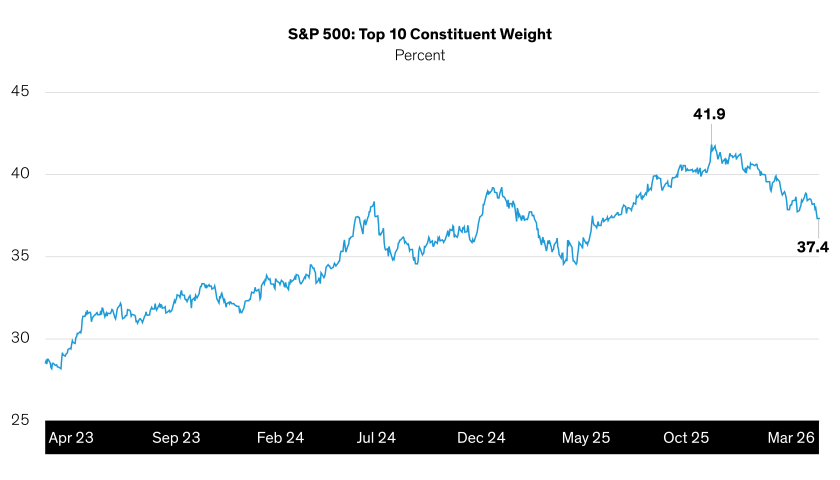
During the quarter, signs of a broadening US market were also seen in sector trends. AI-driven megacaps underperformed and “old economy” sectors such as energy, materials and utilities outperformed. As a result, the weight of the top 10 stocks in the S&P 500 fell from a peak of 42% last September to below 38% by quarter-end (Display).

Declining Market Concentration Reflects a Broadening Market
Line chart shows the weight of the top 10 constituents of the S&P 500 from March 2023 through March 2026.

Current analysis and forecasts do not guarantee future results.
As of March 30, 2026
Source: FactSet, S&P and AB

Technology weakness extended beyond the biggest names. In particular, shares of software companies fell sharply on concerns that AI would upend business models across the industry. Increasingly capable AI agents led investors to sour on software companies of all types and sizes—a sea change for an industry that has enjoyed positive sentiment for years.

Over time, the investing challenge will be to distinguish between the most vulnerable names and those with durable moats. For software companies, the key questions are whether products are mission-critical and deeply embedded within the enterprise; whether regulation creates meaningful barriers; and whether the data and services provided are truly differentiated. As the AI narrative evolves, active managers should monitor these factors to assess whether a company’s historical competitive advantages can withstand AI disruption.

Is Private Credit Sending AI Warning Signals?

Software stocks weren’t the only manifestation of AI concerns. In the private credit markets, pockets of stress among software-heavy and tech-enabled borrowers have investors worried about a higher rate of defaults that hasn’t been seen in these markets.

Private credit has become an important provider of capital to the hyperscalers building out AI infrastructure. As we see it, recent stresses reflect a natural cyclical normalization of credit conditions. Moreover, the hyperscalers tapping the private credit markets have strong balance sheets, solid net cash and the ability to tap the equity markets—or their own cash reserves—as needed. That means they’re better-positioned to absorb AI-linked volatility.

We’ll continue to monitor developments in private credit and across the financial sector for early warning signals of stress in the AI ecosystem.

Positioning in Stressed Markets

Given the combination of geopolitical stress and AI-driven market dynamics, how can equity investors allocate prudently?

Mounting inflation risks underscore the importance of equity allocations. That may sound counterintuitive when the odds of an economic slowdown are rising. But our research suggests that equities have consistently outpaced inflation over 100 years through 2024, providing attractive real return potential through periods of rising prices.

Diversifying allocations with intent is especially important in uncertain conditions. That means searching for sources of resilience across a broader array of regions and styles. Active management can also stress test business models to identify stocks that are most susceptible to fast-changing macroeconomic conditions and AI’s evolutionary path while applying risk-management tools to help shield allocations from market fallout.

Defensive stocks deserve special attention, in our view, as they’ve historically offered refuge in periods of volatility and inflation. We think the stable earnings and recurring revenue streams of defensive stocks offer a crucial source of returns today and are likely to perform their traditional role in an allocation if the Middle East conflict drags on.

Meanwhile, value stocks stand out as inflation and AI disruption increase uncertainty. Many value companies are anchored in hard assets and shorter-duration cash flows, which offer more immediate, reliable earnings visibility when long-duration growth assumptions are being questioned.

Even before the war, companies were coping with deglobalization and the need to fortify supply chains. We believe firms with strong balance sheets, shorter-duration cash flows and pricing power are best-positioned for the current environment. Businesses with efficient manufacturing scale should benefit from high barriers to entry that can survive AI disintermediation. And if input costs rise, weaker business models could be exposed, while companies able to pass costs on to customers should be well-placed to outperform.

Timing Turbulent Markets Is Tricky 

Periods of crisis can often tempt investors to beat a hasty retreat. But trying to time market inflection points is always risky. If Middle East tensions ease, sidelined investors could miss out on market recovery potential. We believe staying invested through uncertainty is critical, even when the news flow and market volatility is uncomfortable.

Over the longer term, history suggests that wars don’t typically have lasting market effects. After eight major conflicts over the past five decades, the S&P 500 was remarkably resilient—climbing by 7% on average just one year after the onset of conflict. While the sample size is small and some wars have led to steeper equity declines, the historical record suggests that staying invested is a strategic imperative for long-term investors.

Global equities are likely to remain volatile until the conflict in Iran is resolved and energy markets can stabilize. Markets typically struggle to price extreme risks, which explains recent turbulence. And even if the war ends, AI disruption concerns may continue to drive market dispersion. These risks—both real and perceived—underscore the importance of staying true to a robust investment process and avoiding headline chasing.

In times of turmoil, investors should have clearly defined goals and a disciplined framework that prioritizes intentional diversification of return sources with active pursuit of stocks that can surmount uncertainty and identify winning business models. Over the coming months, the ability to focus on what matters most for long-term equity return potential could be the best way to tune out what doesn’t.

The views expressed herein do not constitute research, investment advice or trade recommendations and do not necessarily represent the views of all AB portfolio-management teams. Views are subject to revision over time.

MSCI makes no express or implied warranties or representations, and shall have no liability whatsoever with respect to any MSCI data contained herein. The MSCI data may not be further redistributed or used as a basis for other indices or any securities or financial products. This report is not approved, reviewed or produced by MSCI.


About the Authors