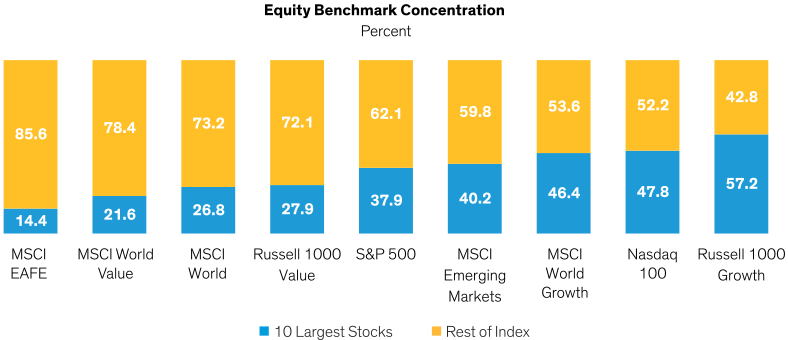
This doesn’t mean investors should avoid mega-cap technology companies. Many are strong businesses with durable competitive advantages. But in our view, owning or avoiding these stocks must be a deliberate decision rooted in a portfolio’s philosophy rather than a reflexive response to benchmark weight or market momentum.
AI Spending Raises the Stakes
Risk management has become especially challenging because of the AI build-out. The five biggest hyperscalers—Amazon, Microsoft, Alphabet (Google’s parent), Meta Platforms and Oracle—are on pace to pump $1.0 trillion into AI-related investments in 2027, according to our research, up from $96 billion five years ago. For investors, the key questions are whether that spending will translate into attractive long-term returns—and for whom. In a period of transformational disruption, it’s extremely difficult to predict which companies will be the ultimate winners.
Of course, when mega-caps and marquee initial public offerings (IPOs) dominate headlines, the fear of missing out can be powerful. But FOMO isn’t a substitute for an investment process. A popular tech IPO may not meet the criteria of certain active strategies if valuation, profitability or free-cash-flow profiles don’t align with the portfolio’s mandate.
Lessons From the Dot-Com Era
Today’s technology leaders aren’t dot-com replicas. Many have healthier businesses, deep competitive moats and strong operating cash flows.
But there are parallels. In the late 1990s, circular investment helped inflate fragile business models. Lucent Technologies, for example, extended billions of dollars in vendor financing to smaller internet and networking companies; when the bubble burst, uncollectible loans contributed to its demise, destroying $250 billion of shareholder value.
Today, a similar concern is emerging as chipmakers, cloud providers and AI model developers are increasingly each other’s investors, suppliers and customers. This raises the risk that capital circulating within the AI ecosystem is artificially inflating reported demand.
Even if the AI cycle is built on stronger foundations than the dot-com era, potential vulnerabilities deserve attention. Hyperscaler capex could outstrip cash flows, and we believe the underperformance of this group so far in 2026 may signal a shifting investor focus toward free cash flow, returns on capital and financial resilience. Meanwhile, imminent IPOs from currently unprofitable tech firms (notably OpenAI and Anthropic) offer another echo of the dot-com era. Technical market drivers may be changing too, as stretched cash flows limit share buybacks.
Risk Relates to the Portfolio Objective
As we see it, these hazards should prompt investors to reassess their risk appetite. For some, relative performance is paramount: large underweights to dominant stocks can overwhelm relative returns. For others, the bigger risk is an absolute loss—the drawdown that damages compounding and jeopardizes long-term goals. In our view, a portfolio’s role within a strategic asset allocation should determine how managers balance these risks.
Different portfolio objectives can lead to vastly different portfolio characteristics. That’s why investment philosophy matters. A low-volatility strategy, a profitable growth strategy or a lower-risk core equity strategy shouldn’t all respond to AI concentration in the same way. Owning high-quality businesses of profitable compounders with durable cash flows is different from chasing hypergrowth companies whose valuations depend on more distant outcomes. Each portfolio’s manager should ask whether a company’s fundamentals, valuation, cash-flow profile and capital stewardship fit the process—and be prepared to explain why a large underweight is intentional, not accidental.
Challenge Every Exposure—and Every Omission
We believe active managers should continuously reevaluate both owned and unowned stocks as evidence changes.
- Is a company’s AI investment likely to earn an adequate return?
- Are cash flows durable enough to fund growth? Is the valuation rooted in reality?
- Could better opportunities capture the same structural growth themes at lower risk or lower prices?
- Does the nature of this investment fit my investment philosophy and time horizon?
Clients should ask these questions too. In concentrated markets, passive ownership doesn’t eliminate risk; it repackages it by embedding yesterday’s winners more deeply into portfolios. Underweight positions in large, outperforming stocks can contribute to weak relative returns in a concentrated market, but they are a calculated, strategic trade-off aimed at preserving a portfolio’s risk profile. We believe real discipline requires knowing what a portfolio owns, what it avoids and why those decisions support the portfolio’s long-term objectives.
Transformational disruption creates opportunity—and widens the range of outcomes. As concentration, correlation and capital intensity rise together, we believe investors need active managers who can look past index weight, test the fundamentals and make hard choices with conviction. The case for active stock selection is simple: when the benchmark gets crowded, the courage to say “no” may prove more valuable over time than defaulting to “yes.”