To pursue a better return path, think better betas, efficient structure and targeted alpha.
In part two of AB’s “Build a Better Path” Disruptor SeriesTM, we shifted from diagnosing the challenge of long-term investing to a potential approach for solving it. With practical, actionable steps, investors have the potential to translate the concept of improving up/down capture into strategies aimed at improving portfolio design. Here’s a summary of the discussion.
A Third Investing Dimension: The Sequence of Returns
As we discussed in part one of “Build a Better Path,” enhanced up/down capture offers a potential avenue for improving the path of portfolio returns. But to do that, investors must take a broader perspective to assessing risk and return.
Think of a typical scatter plot that arranges investments by their average volatility and average return along X and Y axes, respectively. In looking to improve the path of returns, we think it makes sense to add a third dimension—let’s call it “Z.” This variable describes the order of investment returns over time. If we think about it this way, improving portfolio design becomes about more than return and volatility—it also involves seeking to improve the sequence of portfolio returns.
Two portfolios could have the same average return and similar volatility but deliver very different outcomes if one has a more favorable return path—for example, a less severe downturn if a bear market happens early on. As we see it, a key element in that better sequence is designing a strategy with better up/down capture. The good news is that there are concrete steps to take: identify better betas, assemble them efficiently and incorporate sources of alpha.
Better Betas: Improving on Basic Building Blocks
At their simplest level, betas are the fundamental market exposures in a portfolio. They could be a combination of large-cap equities, emerging-market stocks, government bonds and other investments. But not all betas are alike, and we believe that some of them have attributes and behaviors that could deliver better up/down capture over time.
In the equity world, for instance, many investors seek quality companies for their potential staying power. In our view, quality is a better beta. While it has lagged the S&P 500’s narrow market leadership lately, its longer history is more compelling, and quality stocks have rebounded effectively after downturns. Of course, quality has different definitions, and as with all better betas, we think the distinctions make a difference.
Then there are dividend growth stocks, with their regular income streams. Companies that can sustain and grow dividends, in our view, offer a better opportunity. Defensively oriented low-volatility equities may also help mitigate market downside. Value stocks have struggled since the global financial crisis but have rebounded lately as the supply chain of AI creates new opportunities. Value is arguably the original better beta, dating back to Graham and Dodd security analysis and the Fama-French value factor.
High-yield bonds are an interesting case. They live in the bond world but have historically acted equity-like because they’re similarly driven by economic growth and corporate profits. High yield also provides income payments that are contractually obligated. These provide not only return potential but also a possible cushion in equity downturns. Short-duration high yield, typically less volatile than the broad high-yield market, may refine that upside/downside profile.
Enhancing Portfolio Assembly with Efficient Structures
Better beta building blocks offer potential individually, but they also have different return drivers, so they haven’t historically moved in lockstep. This, from our perspective, gives them the potential to help diversify the return path—what we refer to as the “Z dimension.”
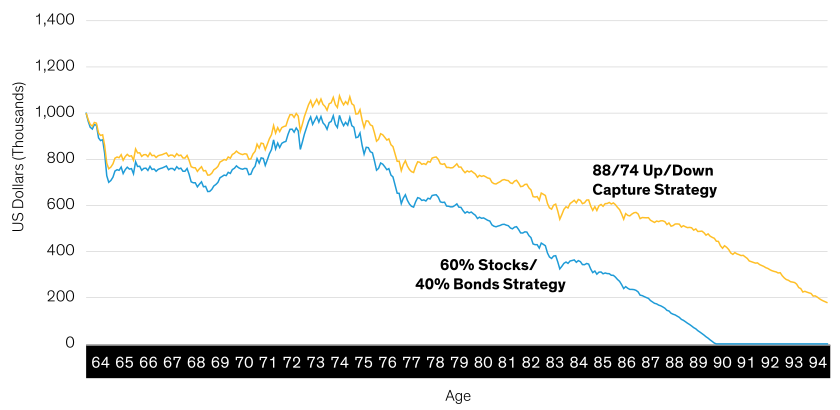
In part one, we discussed how a poor return sequence with a sizable market downturn early in retirement could hurt a retiree’s ability to make income last. A more efficient portfolio structure with better up/down capture than a traditional 60/40 stock/bond portfolio might have enabled assets to last through 30 years in retirement instead of running out at age 90 (Display).