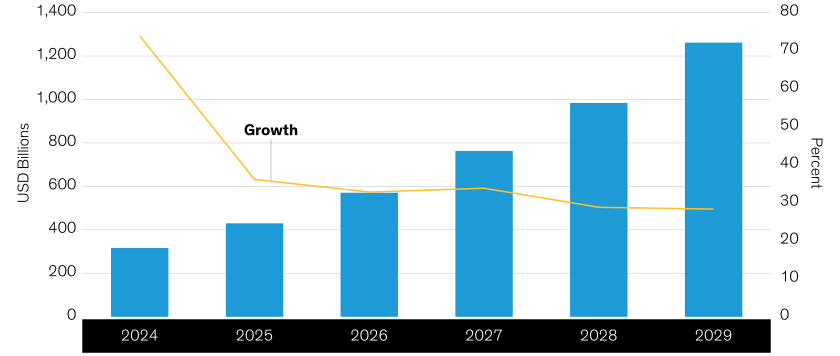
Eventually, hyperscalers hope to monetize these investments, turning AI’s large-scale learning models into long-lasting profit centers. Until then, we expect investors to face uncertainty and periodic market disruptions.
Diversification is one of the best ways to manage risk, and investments in AI are no exception. Fortunately for investors, AI credit issuers include not only tech behemoths but also utilities, grid operators, construction contractors and engineering companies—the first firms to benefit from the AI build-out.
But infrastructure providers earn returns only if assets are used and contracts are honored. These same firms could face real pain if AI adoption disappoints, demand gets misaligned, assets become stranded or technology reaches obsolescence faster than expected. Active managers can help determine which companies are best positioned to weather this unique brand of uncertainty—especially as supply increases.
An Explosion of Supply? Reality Check, Please.
Because both hyperscalers and smaller, AI-adjacent firms are tapping the bond markets to fund AI’s big dig, we expect investment-grade supply to climb to near-record levels over the coming year. Much of this issuance will be longer-dated. Of the more than $100 billion in investment-grade bonds issued by hyperscalers last year, roughly half comprises maturities longer than 10 years. Over time, this could contribute to steeper investment-grade yield curves as investors demand compensation for interest-rate risk.
Increased issuance raises the specter of too much AI concentration in the public investment-grade markets—a valid concern, but one we don’t share.
As it stands, hyperscalers make up only 3.5% of the investment-grade market, despite comprising 20% of equity benchmarks. But even these labels can be misleading. A regulated utility that spends heavily on data-center connections may be counted as AI, even if the bulk of its business comprises households and legacy industry. That doesn’t make the company an AI pure-play, so it shouldn’t be lumped in as AI-specific risk, in our view.
Moreover, the hyperscalers are generally well capitalized and boast sound balance sheets. They can tap the public bond markets if they choose. Alternatively, they can (and do) finance infrastructure needs with their own internal cashflows when needed. And with funding needs becoming more sophisticated, we expect private credit to absorb some of the riskier, AI-adjacent financing that public markets can’t—or won’t—provide.
Bottom line: We expect investment-grade concentration risk to remain modest for the foreseeable future.
Animal Spirits Could Put Investors in the Lion’s Den
Still, other risks remain, including what could broadly be termed too much, too soon. Ever-larger AI campuses, excessive compute capacity and overly optimistic assumptions around AI adoption are examples of the animal spirits that could put credit investors in jeopardy.
In our view, aggressive corporate behavior would primarily hurt highly leveraged fringe players. With hyperscalers playing such a prominent role, we’re not yet seeing the kind of indiscriminate borrowing that typically characterizes late-cycle excess in public credit.
That doesn’t mean the markets won’t be rocky. Recent market volatility reflects concerns that infrastructure is being built ahead of sustainable demand and that some participants are relying more on optimism than on rigorous return arithmetic. We’ve also seen market uncertainty around industries that AI could disrupt, such as software credit, although in some cases we expect the risk will be largely borne by private credit.
We don’t believe market volatility portends a crisis. To us, it signals that investors are becoming more thoughtful about the ramifications of AI. In our view, AI will eventually create winners and losers, and active managers should capitalize on market volatility to separate contracted cashflows from mere conjecture.
High Yield Could Play a Supporting Role
Much of the discussion around AI credit involves investment-grade bonds, but the high-yield opportunity set is also expanding meaningfully—a trend we expect to continue. Here, counterparty strength, contractual protections and execution discipline determine outcomes.
Recent activity reflects a shift toward secured, asset-backed structures, with returns driven by tangible infrastructure rather than headline narratives. High-yield investors can choose from an array of bonds secured by AI power infrastructure, land and buildings. Although projects funded with high-yield bonds require disciplined execution, if done correctly they can broaden the investable universe toward contracted cashflows tied to real AI-connected assets.
Watch How Issuers React to Market Signals
As the AI build-out continues, we believe investors should pay close attention to how issuers react to shifting borrowing costs and spreads. For example, if spreads widen and deals stagnate, will hyperscalers borrow less in favor of internal cashflows? Or if demand slows, do issuers begin to sequence projects more carefully, aligning new builds with better return visibility?
In our view, building via cashflows is often preferable to layering on large amounts of debt before returns have been proven. But context is king, and active managers are best equipped to consider the implications of these market-signal reactions.
AI is transformative, but big breakthroughs rarely travel in straight lines. For investors, the challenge is to look past the extremes—especially during periods of market turbulence. We don’t believe it’s realistic to assume that AI will effortlessly pay for every dollar of capex—nor does volatility necessarily mean that the AI model is broken.
The reality, as always, is more nuanced, and investors could benefit by leaning into market disruptions instead of hitting the panic button too soon. Over time, we believe thoughtful security selection and disciplined risk management will allow investors to capitalize on the AI infrastructure build-out.