
DC Members Are Backing Britain—But Not at Any Price

16 June 2026
2 min read
How Important Is It to You That Your Pension Fund Invests in UK Companies and Projects?
AllianceBernstein (AB) YouGov UK DC Survey Findings (Percent)
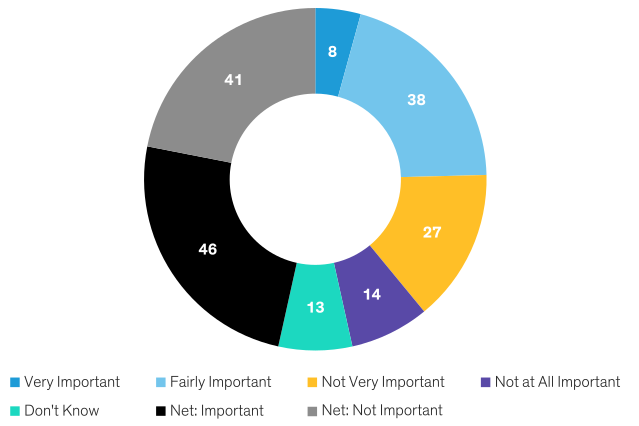
A small – but not overall – majority of DC survey respondents considered investing in the UK important.

Unweighted base: All GB employees with a defined contribution pension arranged through their current employer who expect to fully retire at some point
As of 9 September 2026
Source: YouGov and  AllianceBernstein (AB)

As the UK government seeks to enlist pension savers’ capital for productive investment in the UK economy, our latest YouGov research suggests defined contribution (DC) savers are open to the idea in principle—but that support is sensitive to potential trade-offs in returns.

When respondents were asked, “How important is it to you that your pension fund invests in UK companies and projects?”, 46% said “very” or “fairly” important, compared with 41% who said “not very” or “not at all” important (Display, above).

However, enthusiasm softens when the question is framed in financial terms. When asked how they would feel if UK investing meant potentially lower returns versus investing globally, only 35% said they would accept lower returns, irrespective of the benefit to the UK economy, versus 56% who rejected the idea.

These findings show a strong alignment between trustees and their members to put financial interests first, and they illustrate a tension with supporting the government’s domestic policy objectives.

The survey results also suggest that any shift toward UK assets is likely to be longer-lasting when it’s grounded in a credible risk/return case, rather than relying on pressure to “do the right thing.” This suggests that if the UK government wishes to mobilize DC capital into UK private assets, the opportunity set needs to be genuinely investable and compelling. In our experience, capital follows opportunity; it doesn’t create it.

In our view, trustees would be more amenable toward investing locally if the government were to:

  • Ensure a significant pipeline of scalable UK projects with robust risk/return characteristics.
  • Use the public balance sheet selectively to enhance risk-adjusted return potential without forcing allocations or increasing costs. An example would be refocusing existing tax incentives from private savers to institutional savers, such as fee offsets in areas including venture capital.
  • Create initiatives aimed squarely at improving members’ financial outcomes, as opposed to reducing costs and increasing scale.

The views expressed herein do not constitute research, investment advice or trade recommendations, do not necessarily represent the views of all AB portfolio-management teams and are subject to change over time.


About the Authors