For disciplined lenders, the opportunity set remains attractive.
AI-related disruption, asset valuations and borrower stress have put private credit under a microscope lately. Is this a market facing its first major test after a decade of rapid growth? If it is, we expect it to pass comfortably.
Today’s environment feels less like an existential turning point than a case of credit conditions normalizing as part of the cycle. Sentiment has weakened in some areas, but overall underlying fundamentals are strong. This is true across asset classes. Investors shouldn’t expect private credit to behave differently from more liquid assets during times of stress.
As we see it, private credit will remain a key part of the credit ecosystem—and we think disciplined lenders with available capital can thrive.
High interest rates are squeezing some borrowers, whether they’re middle market companies or consumers with credit card and auto payments. But we think a good amount of the current stress in private credit stems from lax underwriting earlier in the decade when interest rates were at cyclical lows. We see a cyclical tightening of credit conditions, not a crisis.
Wider Spreads and Mark-to-Market Volatility
Investors fretted in the first quarter after the rollout of new AI tools, including ones designed to automate sales, legal and analysis functions. It was interpreted as a threat to private equity–owned software-as-a-service (SaaS) companies that provide accounting, security, data analysis and other essential services to corporate clients.
Unease spread across industries, elevating redemption requests in non-traded, semi-liquid private credit funds, on fears that some loans were being held at stale valuations. Meanwhile, banks have been providing less short-term funding and leverage for private credit strategies.
As a result, performance in direct lending strategies in the first half was shaped mainly by wider spreads and mark-to-market volatility, not deterioration in underlying credit quality or borrower distress. We saw similar dynamics in the early months of COVID-19 and during the Fed’s rate-tightening cycle that began in 2022. Both brought asset markdowns that ultimately recovered.
While investor sentiment has weakened and there’s less capital chasing deals, we think underlying fundamentals remain strong. In our view, this should create attractive opportunities over the next 12 to 18 months for investors with dry powder to invest in diversified portfolios of performing loans at attractive valuations.
SaaSpocalypse? Not Quite, in Our View
Despite recent media headlines, credit fundamentals across much of the market still seem strong. Non-accrual rates, the percentage of loans that have stopped paying scheduled interest, have edged up from recent years’ unusually low levels, according to Cliffwater, which tracks loans across non-traded business development companies. But they’re still near historical averages and below long-term averages.
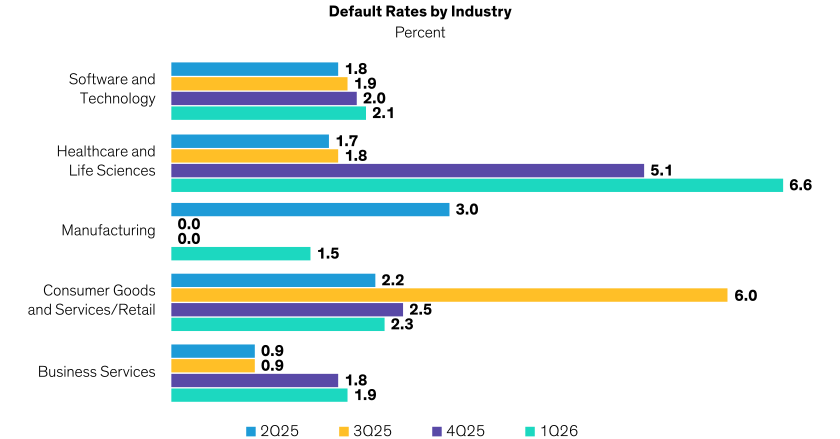
A closer look at what the media has dubbed the “SaaSpocalypse” offers insight. SaaS companies aren’t all cut from the same cloth. Enterprise software providers that act as a “system of record” for everything from clients’ day-to-day operations to customer data security and supply chain procurement have high switching costs, durable cash flows and strong customer retention. We view that as strong insulation against disruption. The rise in software and technology default rates remains modest (Display).