
Actively Managed ETFs Are on the Move
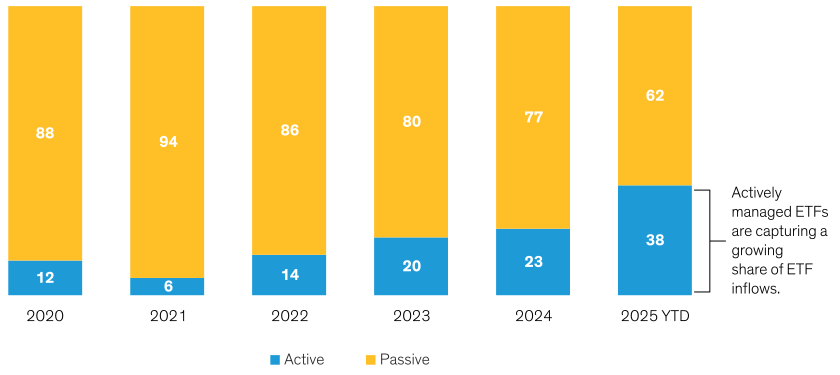
When all is said and done, 2025 could be a pivotal point for actively managed exchange-traded funds (ETFs). For much of the ETF market’s history, flows into passive funds have dominated. This year, though, just over a third of all ETF flows are headed into active ETFs (Display). It underscores a pronounced change in what investors are looking for.
In our view, this trend sets up a clear opportunity for financial advisors to upgrade their portfolio construction toolkits and take advantage of an increasingly popular choice. Passive ETFs play a useful role, of course, especially for inexpensive exposure to more efficient commoditized market segments. But that’s not the only way to put ETFs to work.
In other market arenas that are less efficient or where investors want more than broad passive exposure, active ETFs can make a difference. As we see it, financial advisors who integrate these solutions into their toolkits today are positioning themselves and their clients to tap opportunities and manage risks—not just track the market.
Active ETFs Are Rising
Active and Passive Shares of ETF Market Inflows (Percent)
Historical analysis is no guarantee of future results.
YTD: year to date
© 2025 Morningstar, Inc. All rights reserved. The information contained herein: (1) is proprietary to Morningstar and/or its content providers; (2) may not be copied or distributed; and (3) is not warranted to be accurate, complete or timely. Neither Morningstar nor its content providers are responsible for any damages or losses arising from any use of this information.
As of June 30, 2025
Source: Morningstar and AB
Shaping Market Exposures to Clients’ Needs
With active ETFs, advisors can target the specific outcomes clients demand, such as generating income or managing volatility. This enables advisors to align portfolios more closely with their clients’ goals, differentiating their value proposition in the process.
- Income Generation: Active high-dividend strategies have the potential to enhance yield relative to market benchmarks while balancing exposures to avoid unintended sector tilts.
- Volatility Management: Buffered and low-volatility strategies use tools to manage downside participation or reduce standard deviation versus benchmarks with the intent of reducing factor exposures that passive approaches commonly create.
- Active Credit Selection: Active management in high-yield and short-duration high-yield bonds has the potential to enhance income while lowering default risk by avoiding weaker bond issuers.
Adapting to Market Conditions
Unlike rules-based index strategies, active management provides the flexibility to respond to changing market environments. This adaptability supports more consistent alignment with investors’ objectives and allows managers to capitalize on dislocations.
- Tax-Aware and International Strategies: Managers can opportunistically shift between municipal and taxable exposure. They can also participate in new issues, and those beyond the benchmark may provide advantages in yield, total return and risk management.
- Thematic Strategies: Secular growth trends can be used along with signals like earnings revisions to capture momentum in fast-evolving market segments.
Professional Management and Structure that Reduces Friction
With active ETFs, investors have access to professional investment management, with experienced teams combing the markets for opportunities while managing risks that evolve daily. It forms a powerful combination with the structural advantages of ETFs:
- Tax Efficiency: The mechanics of ETFs may help mitigate capital gains distributions.
- Liquidity: ETFs are tradeable during the day, giving investors and advisors substantial flexibility and control.
- Cost Advantage: Because they have lower expense ratios than traditional active funds, ETFs may reduce fee drag.
- Flexibility: Unlike rules-based passive strategies, active ETFs can raise cash from where the manager best sees fit and can put new cash to work where most opportunistic.
- Transparency: Daily disclosure of portfolio holdings enables a clear understanding of exposures so financial advisors can properly manage and monitor risks.
Together, these ETF features reduce the frictions that have historically limited active management’s impact relative to market benchmarks.
What Active ETFs Can Do for Your Clients…and for You
Actively managed ETFs are one of the most important growth areas in portfolio construction. Areas where they can consistently provide an advantage—tapping into inefficient markets, managing volatility or enhancing income—make sense as long-term strategic allocations. Other market segments may benefit from a tactical mix of active and passive, with advisors shifting the mix based on evolving risks and opportunities.
The bottom line is that flows into active ETFs are accelerating, and failing to consider them raises the risk of falling behind financial advisors who do. A thoughtful blend of passive and active strategies can target investors’ desired outcomes more effectively and keep advisors at the forefront of innovation in ETF portfolio design.
About the Author
Related Content

The AB Emerging Markets Opportunities ETF (NYSE: EMOP) uses active management to zero in on what we believe to be the right companies at the right price and the right time.

The opportunity to transition from cash into a municipal strategy like the AB Tax-Aware™ Short Duration Municipal ETF (TAFI) has rarely seemed more compelling.

When municipal bond markets are unsettled, AB’s active ETFs have the tools that may help investors steer through the currents.
Sign Up
Visibility Into Our ETF Insights.
Get periodic insights, tools and access to events from AB’s ETF experts.
Thank You
Thank you for contacting us. Expect a reply soon.