
With Tax Day Here, It’s Time to Revisit Investment Vehicles
With Tax Day as a reminder, many advisors are focused on a simple question: How much of the return can their clients keep after taxes? For taxable accounts, the answer depends not just on the investment strategy but also on the vehicle it lives in. Both exchange-traded funds (ETFs) and separately managed accounts (SMAs) offer features that may help reduce tax burdens.
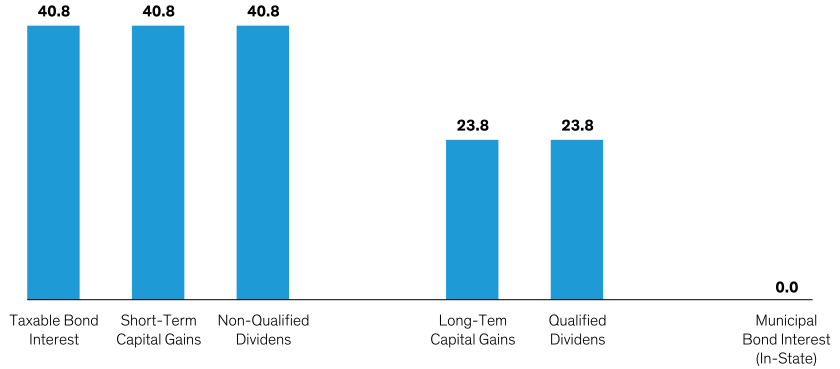
Tax rates vary substantially (Display), underscoring the importance of managing tax exposure. The top federal capital-gains tax on investments held more than a year is 20% (23.8% with the Medicare surtax). For short-term gains, it’s a whopping 37% (40.8% with the Medicare surtax). Qualified stock dividends (that meet a holding-period test) are taxed at the long-term capital gains rate; non-qualified dividends face a much higher rate.
Tax Rates Make a Big Difference in Both Gains and Income
Representative Tax Rates for Capital Gains and Income
Current analysis does not guarantee future results.
As of December 31, 2025
Source: Interenal Revenue Service and AllianceBernstein (AB)
How Do ETFs and SMAs Help Investors Manage Taxes?
Both ETFs and SMAs can provide diversified exposure, support long-term portfolio construction and play an important role in taxable accounts, but they help manage taxes in different ways.
ETFs offer tax efficiency at the vehicle level, with a structure that may help manage capital-gains distributions. This benefit may make them a strong fit for clients seeking broad exposure, transparency, liquidity and a generally tax-efficient wrapper. But capital-gains management isn’t guaranteed, and different ETF sponsors have different depths of tax-management processes in place.
SMAs can offer tax management at the account level, which is different from ETFs. SMA clients own the underlying securities directly, so SMAs may allow for tax-loss harvesting, management of capital gains and the transition of legacy holdings. They may also be customized to align with a client’s broader tax picture. The flexibility of SMAs can be especially valuable for high-net-worth clients who have meaningful amounts of taxable assets.
The key distinction is simple: ETFs may help improve tax efficiency because of their structure, while SMAs may help improve tax outcomes because they can be customized.
An ETF may be a better fit for clients who want efficient, scalable exposure with a tax-aware vehicle. An SMA may be a better choice for clients who put a premium on personalization, direct ownership and more control over realized gains and losses. In many cases, the best answer may be both: ETFs for efficient core investment exposure and SMAs for customization and added tax management.
Asking the Tough Questions About Taxes When Assessing Investments
Improving after-tax returns is rarely as simple as increasing returns before taxes or paring back tax expenses. There are a lot of moving parts, which is why we favor a holistic, “all of the above” approach. For investors with taxable assets who are considering a new investment, it’s important to ask key questions:
- How does the investment strategy generate its return?
- Are the taxable capital gains likely to be mainly short-term or long-term?
- Can the strategy accommodate a tax-management overlay?
- Will the tax overlay impact the strategy’s pre-tax returns?
- Is the strategy available in a tax-efficient vehicle?
The Bottom Line: Vehicle Choice Matters in Tax Management
In our view, it takes more than focusing only on pre-tax returns or minimizing tax expenses to deliver strong after-tax performance. Instead, a robust set of tax-management strategies tailored to each investor’s specific situation may help investors with taxable assets keep more of what they earn.
As advisors review clients’ taxable portfolios around Tax Day, vehicle choice deserves a closer look. Yes, the right strategy matters, but accessing it in the right wrapper can also influence after-tax results. When the goal is to improve after-tax returns, the conversation shouldn’t end at which investments to own—it should include a discussion of how to own those investments.
If you’re an investor interested in learning more about AB’s ETFs, please visit our website or email ETF-Specialists@alliancebernstein.com. To learn more about AB’s SMAs, please visit our website or email SMA-Specialists@alliancebernstein.com
The views expressed herein do not constitute research, investment advice or trade recommendations and do not necessarily represent the views of all AB portfolio-management teams. The views should not be considered legal or tax advice. Tax rules are complicated, and their impact on a particular individual may differ depending on that individual’s specific circumstances. Views are subject to revision over time.
Investors should consider the investment objectives, risks, charges and expenses of the Fund/Portfolio carefully before investing. For copies of our prospectus or summary prospectus, which contain this and other information, visit our Literature Center or contact your AB representative. Please read the prospectus and/or summary prospectus carefully before investing.
Distributed by Foreside Fund Services, LLC. Foreside is not affiliated with AllianceBernstein.
AB funds may be offered only to persons in the United States and by way of a prospectus. This website should not be considered a solicitation or offering of any investment products or services to investors residing outside of the United States.
Investment Products Offered: Are not FDIC Insured | May Lose Value | Are Not Bank Guaranteed
The [A/B] logo and AllianceBernstein® are registered trademarks used by permission of the owner, AllianceBernstein L.P.
SMA-914014-2026-04-09, AL-914022-2026-04-09