
Are Global Investors Ready For China?

11 June 2018
5 min read

What You Need to Know

China onshore stocks and bonds account for around less than 2% of most foreign investors’ portfolios. But this will soon change, with major consequences for global investors and financial markets. Our survey assesses how well investors understand the market—and how ready they are for what’s next.

80%+
of respondents don’t have a specific plan
about investing in China
80%+
of equity investors prefer
actively managed strategies
46%
of respondents haven’t made an investment decision
on China’s onshore bond market

According to an exclusive survey conducted by AllianceBernstein (AB), a significant proportion of global investors have yet to position themselves to take advantage of the opportunities likely to flow from China’s entry into global capital markets.

Despite China’s rise to become the world’s second largest economy (and the largest on a purchasing power parity basis1), during the last 10 years or so, its weight in international investment portfolios remains extremely small. China onshore stocks and bonds account for around less than 2% of most foreign investors’ portfolios.

But this will soon change, with major consequences for global investors and financial markets. We decided to conduct a survey to assess the level of understanding in the market of, and the level or preparedness for, what’s about to happen.

The survey – Are Global Investors Ready for China? – polled a range of institutions in the US, Asia and EMEA (Europe, Middle East and Africa) and showed that many institutions, with US retirement plans prominent among them, have yet to engage meaningfully with China’s investment potential.

There have been times over the last few years when China’s economic challenges and policy shifts appeared to weigh on its efforts to open its economy and financial markets to offshore investors.

The country has faced external challenges, too: the survey, for example, was conducted during the first quarter of 2018, when the possibility of a trade war between the US and China dominated headlines.

Even then, however, a steady flow of news stories continued about China’s progress in opening its capital markets and financial-services sector to overseas interests, and this continued progress, in our view, underlines the relevance and timeliness of this survey.

Background to the Survey

In attempting to understand China’s potential impact on global investment markets, we think it’s important to consider its liberalization program in the context of the size of its onshore equity and bond markets, as well as how China’s inclusion in global indices will trigger large-scale portfolio reallocations.

Among the key financial market reforms China has made during the last few years are the launch of Stock Connect in 2014 and Bond Connect in mid-2017, schemes that enable foreign investors and investors from mainland China to trade in each other’s equity and fixed-income markets.

The moves have significantly improved offshore investors’ access to, respectively, China’s A-shares market, the world’s second largest stock market with a market capitalization of US$8 trillion (Display), and its huge US$11 trillion onshore bond market.

Display 1: China Equity, the World's Second Largest Stock Market, Is Now Accessible to Any Offshore Investors
Equity Market Capitalization (USD Trillions)
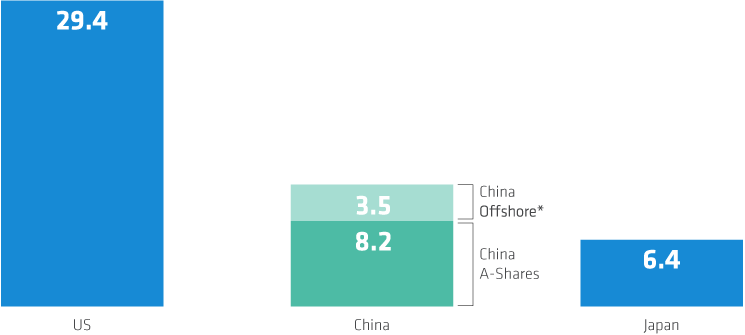
As of March 31, 2018
*China Offshore includes the Hong Kong-listed stocks (H-shares, red-chips and P-chips) and the China stocks that have American depositary receipts (ADRs) listed on the New York Stock Exchange (NYSE), NYSE American or Nasdaq, excluding OTC stocks.
Source: Bloomberg, Hong Kong Stock Exchange (Main Board and GEM), NYSE, Shanghai Stock Exchange, Shenzhen Stock Exchange and Tokyo Stock Exchange, Goldman Sachs

MSCI’s inclusion in August 2018 of A-shares in its Emerging Markets Index will result in a new class of investors—those who follow the MSCI index—accessing China’s onshore stock markets. While the A-shares’ presence in the index will be small initially, it could grow to the point where China accounts for nearly 43% of the index.

1International Monetary Fund, October 2017

Past performance, historical and current analyses, and expectations do not guarantee future results. There can be no assurance that any investment objectives will be achieved. The information contained here reflects the views of AllianceBernstein L.P. or its affiliates and sources it believes are reliable as of the date of this publication. AllianceBernstein L.P. makes no representations or warranties concerning the accuracy of any data. There is no guarantee that any projection, forecast or opinion in this material will be realized. Past performance does not guarantee future results. The views expressed here may change at any time after the date of this publication. This document is for informational purposes only and does not constitute investment advice. AllianceBernstein L.P. does not provide tax, legal or accounting advice. It does not take an investor’s personal investment objectives or financial situation into account; investors should discuss their individual circumstances with appropriate professionals before making any decisions. This information should not be construed as sales or marketing material or an offer or solicitation for the purchase or sale of any financial instrument, product or service sponsored by AB or its affiliates.

The views expressed herein do not constitute research, investment advice, or trade recommendations and do not necessarily represent the views of all AB portfolio-management teams.

MSCI makes no express or implied warranties or representations, and shall have no liability whatsoever with respect to any MSCI data contained herein. The MSCI data may not be further redistributed or used as a basis for other indices or any securities or financial products. This report is not approved, reviewed or produced by MSCI.