Trend-following may struggle in range-bound markets, but it’s not the only macro approach.
Macro investing is a cornerstone of the hedge-fund industry. With some $1.3 trillion in assets under management, macro strategies encompass a wide array of investments across asset classes and geographies designed to provide diversification beyond stocks and bonds.
But the category is a broad one, and diversification within it is equally important—particularly in today’s uncertain market environment. The universe can be divided into two buckets: directional strategies and relative-value strategies. We believe there’s a strong case for investors to include both types in their allocations.
Trend-following, the most common directional macro subcategory, seeks to capitalize on sustained price movements. The assumption is that trends often persist because it takes time for markets to fully reflect changes in macroeconomic conditions.
Relative-value strategies focus on exploiting pricing inefficiencies within related assets, such as equities, interest rates and commodities. They do this by relying on signals like price convergence rather than by following a trend.
The way we see it, an allocation to both macro approaches has the potential to generate higher returns with similar levels of volatility to investing in either one on its own and greater potential downside mitigation.
Regime Shift? Or Temporary Disruption?
The relative-value approach is well-established among equity investors, but when it comes to macro strategies, directional approaches typically dominate.
Nearly all macro managers have an allocation to trend strategies, and for good reason. Trend strategies have performed well during market “regime shifts,” which typically trigger prolonged equity market sell-offs and start new trends. The 2008 housing market collapse that sparked the global financial crisis and the era of zero interest rates that followed is a good example. A more recent shift was the 2022 surge in inflation and interest rates that in retrospect closed the book on the post-crisis period of rock-bottom rates and ample liquidity.
Over time, trend strategies have helped to insulate hedge-fund allocations in sustained equity market downturns, often providing positive returns.
But there’s a catch: These strategies can be less effective when markets lack clear direction. That’s important, because regime shifts are rare. Most shocks are idiosyncratic, typically sparking a brief period of poor risk asset performance, followed by a rebound.
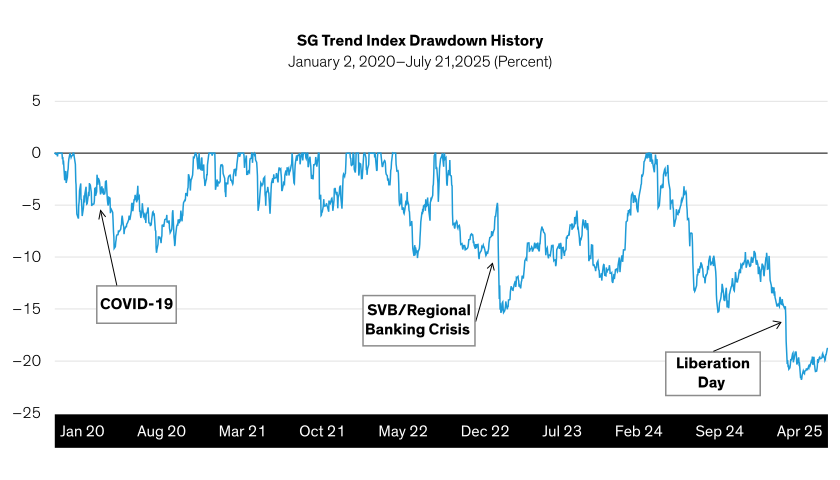
For instance, markets swooned after the Trump administration announced sweeping tariffs in early April, but then rebounded sharply when the White House paused their implementation and began negotiating with trading partners. Asset prices traced similar patterns over the first month of the COVID-19 pandemic in early 2020 and during a short-lived US regional banking crisis in 2023. Likewise, there were sharp moves in the SG Trend Index, which follows the performance of large trend-following strategies (Display).