menu AllianceBernstein AllianceBernstein
  • Funds
  • Our Clients
    Overview Global Insurance Family Offices
  • Capabilities
    Alternative Strategies Equity Strategies Fixed Income Strategies Multi-Asset Strategies Institutional Solutions Group Responsible Investing
  • Investment Spotlight
    Systematic Fixed Income Emerging Markets Alternatives. We Deliver, Differently
  • Insights
    All Insights Institutional Research AB IQ Investment Insights Retirement Insights Market Matters Podcasts The Book
  • About Us
    Why Us Awards Corporate Responsibility Contact Us
  • Our Firm & Sites
 

Market Matters

Healthcare Stocks: An Investing Prescription for Growth and Stability

8 July 2025
7 Minute Read
Robertas Stancikas, CFA
Robertas Stancikas Investment Strategist
Jane Bleeg
Jane Bleeg Portfolio Manager—Global Healthcare

Healthcare stocks present an exciting investment opportunity, with attractive valuations and strong growth potential driven by demographics and AI adoption. Despite policy uncertainty, healthcare’s defensive nature also offers stability for volatile times.

Three Drivers for Healthcare Growth

Market conditions are rapidly changing, driven by megatrends such as deglobalization and mounting public debt. We think these forces will lead to lower equity returns and greater market volatility than we’ve seen over the last 15 years. In the hunt for assets that can work harder, the healthcare sector deserves closer attention for several reasons:

An aging population should drive increasing demand for healthcare products and services, supporting structural, long-term growth.

New diagnostics and treatments are improving patient outcomes. People are consuming more healthcare services and products as new therapies for previously untreatable diseases come to the market and enable longer, healthier lives.

Innovation will benefit from AI applications that could increase productivity, cut drug-development costs, improve research-and-development (R&D) success rates and provide better customer services and care.

Market Trends Reflect Negative Sentiment

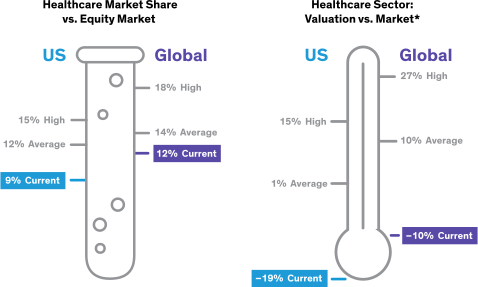
After several years of weakness and outflows, the healthcare sector comprises only 9.3% of the MSCI USA market share—the lowest in 15 years. Valuations are well below the long-term average, with healthcare stocks trading at a record price/forward earnings discount of 19% to the MSCI USA (Display), making it the cheapest sector relative to the US market. Global healthcare stocks, too, are relatively inexpensive.

There’s a flip side to negativity. Attractive valuations mean strong pent-up return potential if the market rewards healthcare businesses for their fundamental quality. And healthcare can help diversify investors away from the market concentration in expensive technology stocks. We think these are big strategic benefits in today’s uncertain market conditions.


Market Share and Valuations Are Extremely Low

June 1, 2010–May 12, 2025

Past performance does not guarantee future results

*Price/forward earnings ratio

US equity market represented by the MSCI USA Index. Global equity market is represented by the MSCI World Index.

As of May 12, 2025

Source: FactSet, LSEG Data & Analytics, LSEG I/B/E/S, MSCI and AllianceBernstein (AB)

What About Policy Changes?

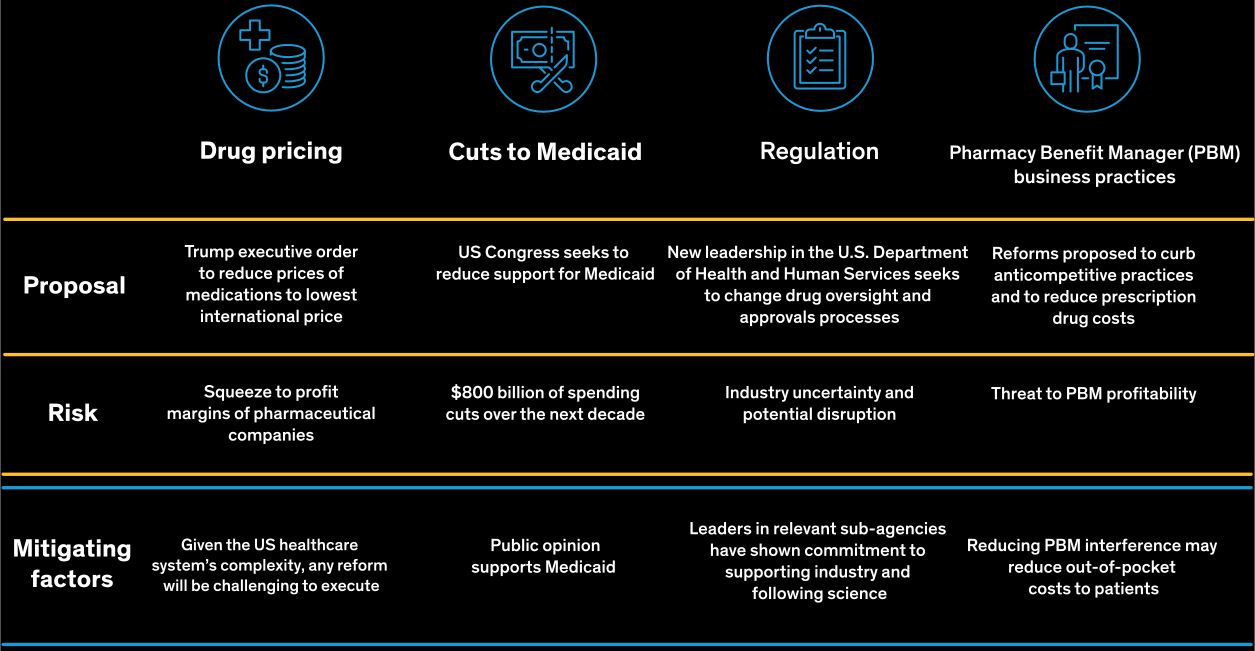
It’s true that healthcare is vulnerable to more policy uncertainty than other sectors. In early May, President Trump signed an executive order aimed at forcing pharmaceutical companies to lower the prices of medicines. We believe the risks can be reduced by active investors who focus on companies with strong business fundamentals that can thrive in changing policy environments.

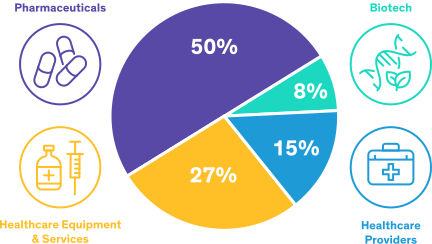
Another mitigating factor is the significant change in the healthcare sector’s structure. Pharmaceutical companies historically dominated the sector, but they now represent only half of the sector’s market capitalization (Display). Industries like healthcare equipment and healthcare providers, as well as the healthcare technology sub-sector, offer an array of quality businesses with diverse earnings and return streams that are less vulnerable to policy changes.

Global Healthcare Sector Structure

Healthcare Sector Industry Weights

Current analysis does not guarantee future results.

As of June 6, 2025

Source: LSEG Data & Analytics, MSCI and AB

As of May 31, 2025

Source: AB

Earnings Growth Looks Healthy

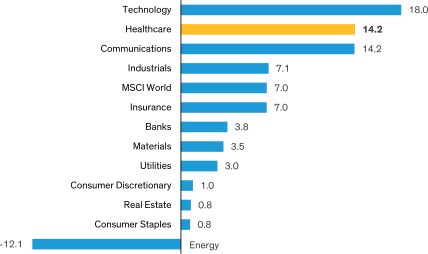
Much political uncertainty is already priced into healthcare stocks. Meanwhile, long-term earnings-growth prospects look solid, with the sector projected to deliver long-term earnings growth of 14.2% (Display).

Breaking it down by sub-industry, medical technology looks particularly resilient to political uncertainty; since medical devices are mostly purchased by hospitals, pricing dynamics should be much steadier over time.

Healthcare Earnings Outlook Looks Favorable

MSCI World: Consensus Earnings Estimates, 2025 (Percent)

Past performance does not guarantee future results.

As of June 6, 2025

Source: LSEG I/B/E/S, MSCI and AB

A Strong Antidote for Inflation

Inflation may have eased since the post-pandemic peaks. Still, our research suggests investors must prepare for a world of structurally higher inflation than we’ve seen in the past decade.

Healthcare has a strong track record of growing earnings faster than inflation, which provides evidence of the sector’s pricing power and innovation. We believe the ability to grow earnings above inflation will become increasingly more valuable in this new macro regime. As an antidote to inflation, we think healthcare stocks will deserve a premium valuation multiple over time.

“

Healthcare has a strong track record of growing earnings faster than inflation.

Demographics: The Durable Demand Driver

Forecasting demand is never easy in any business. Yet many healthcare companies enjoy a consistent source of demand from a rapidly aging population worldwide.

Across the developed world, the share of the population aged 65 and up has risen dramatically over the last 20 years and is projected to reach 28% in 2060, based on United Nations data. Even in the US, where the population is somewhat younger, the 65+ cohort is growing fast. And in China, the elderly will surge to 37% of the world’s second-most populous nation by 2060.

Older people account for more than double the healthcare spending of any other age group. More people living longer lives creates a structural tailwind for higher spending on healthcare goods and services, from medicines to technology to social care.

AI Adoption to Augment Advantages

The healthcare sector is set for major benefits from AI adoption.

AI is already helping to lower costs and enhance efficiency of drug discovery. Medical technology companies are leveraging AI for better diagnostics and personalized treatments. Digitizing medical records and automating workflows can free up doctors to focus on patient care while enabling nurses to review documents quickly.

Through improved R&D success rates, operational efficiency and automation of routine tasks, AI can help cut costs and boost profit margins for healthcare companies—supporting return potential for investors.

“

AI can help cut costs and boost profit margins for healthcare companies—supporting return potential for investors.

Focus on Business, not Science

Even the best scientists in the world cannot reliably forecast drug-test results, so why should investors gamble? Quality businesses are key for healthcare stocks.

In our view, innovative healthcare companies that are positioned for long-term success amid pricing pressures and shifting policy sands should demonstrate the following attributes:

  • High or improving returns on invested capital
  • Strong reinvestment rates
  • Healthy balance sheets
  • Businesses with durable competitive advantages

Be wary of companies that pursue earnings growth at the expense of profitability. Highly acquisitive companies should also be scrutinized closely, especially if they have a lot of debt and/or sales concentrated in a small group of products. And companies that rely on a single successful drug test to drive future growth should be handled with extreme care, in our view.

Investing effectively in healthcare stocks requires a unique set of skills. It’s not about scientific insight. By applying a disciplined investment process that integrates the diverse factors that affect healthcare businesses, investors can access sources of strong return potential that can invigorate an equity portfolio for the long term.

Supporting Stability Through Uncertainty

Equity investors have faced fierce volatility in the first half of 2025. Even after President Trump took steps to de-escalate the US-China trade war, we expect policy uncertainty to remain high for some time.

Historically, the healthcare sector has acted as a defensive allocation and has endured much lower drawdowns when market stress has been high.

Healthcare stocks offer an uncommon combination of strong long-term growth potential and defensiveness, which makes the sector an appealing component of an allocation for turbulent times.

In Summary…

Current valuations of healthcare stocks reflect concerns about policy uncertainty, which should help reduce risks. We believe investors should consider a strategic overweight in the sector to capture strong growth prospects from structural forces. Healthcare’s defensive nature also provides a cushion for portfolios during periods of macroeconomic uncertainty and market stress.

Robertas Stancikas, CFA
Robertas Stancikas Investment Strategist
Jane Bleeg
Jane Bleeg Portfolio Manager—Global Healthcare

Market Matters

Delivering timely research-driven insights for navigating dynamic markets.

Discover More

The views expressed herein do not constitute research, investment advice or trade recommendations and do not necessarily represent the views of all AB portfolio-management teams. Views are subject to revision over time.

MSCI makes no express or implied warranties or representations and shall have no liability whatsoever with respect to any MSCI data contained herein. The MSCI data may not be further redistributed or used as a basis for other indices or any securities or financial products. This report is not approved, reviewed or produced by MSCI.

    Terms of Use Privacy Policy Cookie Settings Management Company Important Disclosures Modern Slavery Statement

    This is a marketing communication. This information is provided by AllianceBernstein (Luxembourg) S.à r.l. Société à responsabilité limitée, R.C.S. Luxembourg B 34 305, 2-4, rue Eugène Ruppert, L-2453 Luxembourg. Authorised in Luxembourg and regulated by the Commission de Surveillance du Secteur Financier (CSSF). It is provided for informational purposes only and does not constitute investment advice or an invitation to purchase any security or other investment. The views and opinions expressed are based on our internal forecasts and should not be relied upon as an indication of future market performance. The value of investments in any of the Funds can go down as well as up and investors may not get back the full amount invested. Past performance does not guarantee future results.

    This information is directed at Professional Clients only and is not intended for public use.

    © AllianceBernstein L.P.