


menu AllianceBernstein AllianceBernstein
  • Funds
  • Our Clients
    Overview Global Insurance Family Offices
  • Capabilities
    Alternative Strategies Equity Strategies Fixed Income Strategies Multi-Asset Strategies Institutional Solutions Group Responsible Investing
  • Investment Spotlight
    Systematic Fixed Income Emerging Markets Alternatives. We Deliver, Differently
  • Insights
    All Insights Institutional Research AB IQ Investment Insights Retirement Insights Market Matters Podcasts The Book
  • About Us
    Why Us Awards Corporate Responsibility Contact Us
  • Our Firm & Sites
 

Market Matters

Systematic Fixed Income: A New Approach to Bond Investing

9 February 2026
4 Minute Read
Bernd Wuebben
Bernd Wuebben Director, Systematic Investing and Quantitative Research
Souheir Asba
Souheir Asba Portfolio Manager—Investment Grade Credit

Systematic fixed income is a new way for investors to seek active returns in bond markets. Because systematic approaches use different performance drivers, their returns will likely differ from—and complement—traditional active strategies.


What Is a Systematic Approach to Fixed-Income Markets?

Systematic fixed-income investing is an active strategy that aims to beat bond-market returns. In this approach, fixed-income experts create a multi-factor model that generates investment decisions based on predictive factors. These factors, derived from analysis of market data, capture the characteristics that drive performance. A quantitative process scores and ranks each bond in the market based on its alignment with these factors and so aims to generate outperformance (alpha) through picking high-scoring bonds.

Systematic strategies can help diversify bond portfolios that use traditional discretionary approaches, which mostly emphasize interest-rate and credit-market exposures (beta) and sector tilts.

Attractive
Aims to deliver attractive risk-adjusted returns
Repeatable
A dynamic multifactor approach repeatedly and consistently identifies bonds with attractive return potential
Uncorrelated
Strong diversifier because excess returns are uncorrelated with discretionary strategies

There is no guarantee that any investment objectives will be achieved.

“

Systematic fixed income is still early stage and offers a new frontier with untapped potential and opportunities for attractive risk/reward.

How Do Predictive Factors Work?

Familiar risks such as credit risk (the risk of bond-issuer default) and interest-rate risk (duration) drive bond prices. Advanced systematic strategies aim to discover less-known bond-price drivers and to use these insights to identify predictive factors that can repeatably find bonds with superior risk-adjusted return potential. Systematic models analyze large volumes of historical market data, using the predictive factors to identify bonds with the right characteristics to have an above-average probability of outperforming the market.

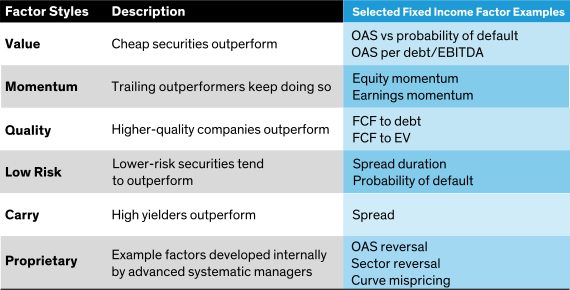
Example Fixed Income Factors

For illustrative purposes only. There can be no assurance that any investment objective will be achieved.

EV: enterprise value; FCF: free cash flow; OAS: option-adjusted spreads

As of October 31, 2025

Source: AB

“

Advanced strategies go beyond traditional factor styles to include those that incorporate proprietary measures and capture differentiated market signals.

Managing Factor Strategies in Practice

What does it take to systematically uncover fixed-income opportunities? Deep research databases and in-house cutting-edge quant platforms are essential to identify and access hundreds of proprietary factors. Not all will be implemented continuously in a portfolio, but they can be rotated as market conditions and investment regimes change, which often prompts changes to the efficacy of factors.

Fixed-income markets are larger and more complex than equities and fragmented across disparate trading pools. These features make liquidity and pricing harder to discover in bond markets.

For these reasons, advanced technology and analytics are vital in systematic fixed income. And though academic research supports the case for predictive factors in fixed-income investing, it takes rigorous testing and practical implementation skills to create successful systematic portfolios.

“

Cutting-edge technology and data analysis are key to systematically identify undervalued opportunities in the fixed-income markets.

Creating a Systematic Portfolio: Combining Predictive Factors

With a systematic approach, each bond in the benchmark is scored on a range of predictive factors, resulting in an array of scores for each security. As one example from many possible permutations, a bond might have a high score on value but a low score for momentum. A factor combination model then rolls up the different factor scores to produce a single composite total factor score for each bond.

The model adopts two criteria to create a portfolio using the factor scores: predictive efficacy and correlation with other factors. Factors are weighted using an algorithm determined by a machine learning technique. This ranks the total factor score for each bond subject to other optimization and risk constraints, principally: bond, issuer, sector, ESG, duration, spread, liquidity and transaction cost limits. Balancing predictive efficacy with rigorous risk controls is key to the model’s success in pursuit of risk-adjusted returns.

Questions for Your Prospective Systematic Manager

Does your process manage factors dynamically, and how many factors does it use?

We find that systematic strategies using a dynamically weighted and wide range of factors are positioned to deliver better outcomes than those that rely on fewer factors and static factor weights.

Have you embedded liquidity analysis in your investment process?

Compared with equity trading, fixed income is much more problematic: bond trading is more manual, less transparent and less liquid. Advanced systematic approaches incorporate liquidity information to help source the exact bonds their model selects to buy.

How extensive are your data?

Abundant, clean data compiled rigorously and covering many years’ history are the foundation of robust systematic investing.

How do you integrate AI into your process?

AI enhancements range from time-saving and efficiency gains (identifying price patterns to impute missing data quickly and reliably) to qualitative advances (improving analytics across multiple valuation factors to help find new signals and make existing signals more effective).

Is your investment approach exclusively quantitative?

We believe that integrating quantitative experts within a broader fixed-income team can bring big benefits: better execution, practical insights and sanity checks to help evaluate factors and fine-tune models.

Does your process create a black box?

Systematic fixed income is an active approach that depends on discovery, selection and monitoring of predictive factors. While a model determines the factor weights and is instrumental in back-testing the data, human involvement is critical in testing the factors and in deciding to add new ones and remove others.

Summary...

We believe systematic fixed-income investing is an idea whose time has come. It provides an active way to find opportunities that can help achieve attractive, repeatable and uncorrelated risk-adjusted returns through bottom-up selection and structuring of many independent holdings, with a high level of risk control to help guard against big drawdowns.

Bernd Wuebben
Bernd Wuebben Director, Systematic Investing and Quantitative Research
Souheir Asba
Souheir Asba Portfolio Manager—Investment Grade Credit

The value of an investment can go down as well as up and investors may not get back the full amount they invested. Capital is at risk.

Market Matters

Delivering timely research-driven insights for navigating dynamic markets.

Discover More

The views expressed herein do not constitute research, investment advice or trade recommendations and do not necessarily represent the views of all AB portfolio-management teams. Views are subject to revision over time.

    Terms of Use Privacy Policy Cookie Settings Management Company Important Disclosures Modern Slavery Statement

    This is a marketing communication. This information is provided by AllianceBernstein (Luxembourg) S.à r.l. Société à responsabilité limitée, R.C.S. Luxembourg B 34 305, 2-4, rue Eugène Ruppert, L-2453 Luxembourg. Authorised in Luxembourg and regulated by the Commission de Surveillance du Secteur Financier (CSSF). It is provided for informational purposes only and does not constitute investment advice or an invitation to purchase any security or other investment. The views and opinions expressed are based on our internal forecasts and should not be relied upon as an indication of future market performance. The value of investments in any of the Funds can go down as well as up and investors may not get back the full amount invested. Past performance does not guarantee future results.

    This information is directed at Professional Clients only and is not intended for public use.

    © AllianceBernstein L.P.