At the same time, banks and the GSEs have retreated from this type of financing. That has helped to widen yield spreads on these assets and deepen the opportunity set for private credit providers, who can step in to finance originations or acquire existing loans in bulk purchases.
Scale and Sourcing Ability Matter
But doing this well requires a robust platform with the ability to source a large volume of loans from multiple channels while building and managing relationships with a network of partners.
For example, managers with strong sourcing and underwriting capabilities can acquire pools of newly originated or seasoned loans at a discount and repackage them into portfolios that meet specific insurer requirements. This might mean excluding mortgages with loan-to-value ratios above and FICO scores below certain thresholds.
An asset manager may also opt to enter into forward-flow arrangements with many partners. These agreements would supply either daily flow or a predetermined number of new mortgages from a bank or a private lender for a certain time, providing insurers with a steady pipeline of loans.
Private lenders also have the ability to set the terms on the loans they originate or acquire, which enables them to deliver high-credit-quality loans to prime borrowers with attractive yields that meet insurance companies’ risk and return requirements.
Diversification and Cash Flow
The potential advantages for insurers, in our view, are many. They include diversified exposure across the US mortgage market, predictable cash flow and coupons that range anywhere from 3% to 8%, depending on loan type and credit quality.
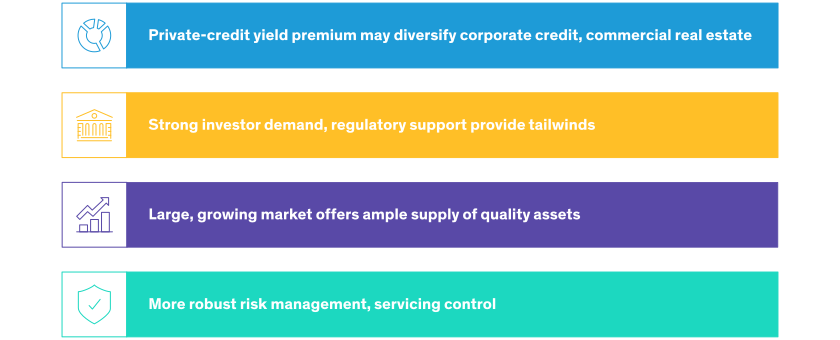
Whole mortgage loans also have the potential to diversify insurers commercial real estate and corporate credit holdings.
The size of this market requires the ability to analyze loans against a vast historical database and model multiple potential outcomes—from prepayments to defaults and beyond. That puts a high premium on underwriting skill that underpins security selection and pricing.
Convexity—Why it Matters
There’s one more feature associated with these loans that we think makes them a good fit for insurance balance sheets: a more balanced convexity profile. Agency mortgage-backed securities issued by Fannie Mae and Freddie Mac—once the mortgage mainstay of insurance company balance sheets—came with high negative convexity. That was mostly a function of prepayment risk—when interest rates declined, borrowers refinanced their loans, and the securities were often paid off prematurely.
Non-agency residential mortgages often behave differently. Pacing of deployment, prepayment restrictions, smaller balances, borrower “rate locks” and other common features of “non-qualifying” loans all have the potential to mitigate negative convexity in large pools of non-qualifying and seasoned loans.
Residential mortgage loans offer insurers a combination of yield, diversification, capital efficiency and liquidity that we think is difficult to replicate elsewhere in private credit. In a market shaped by structural housing undersupply, strong borrower credit and expanding non-agency issuance, we believe residential mortgages present a timely and scalable opportunity.