
Emerging Market Engines Shift into High Gear for Equity Investors

February 27, 2026
4 min read

Earnings growth could continue energizing an emerging-market stock recovery.

After underperforming for much of the last decade, emerging-market (EM) equities rebounded nicely in 2025. Is it too late to invest? We don’t think so. With valuations still attractive and earnings growth forecasts looking up, this could be the right time to give the developing world a closer look.

Earnings growth could be an important catalyst in 2026. When EM equities surged by nearly 33% last year, our research indicates that valuation expansion drove nearly half the increase.

That has since changed. Recent gains have been fueled largely by earnings upgrades—a trend we expect to continue. EM earnings are now projected to grow by 18% in 2026, according to consensus estimates, outpacing both the US and other developed markets (DM) (Display). In our view, this suggests a more sustainable foundation for future performance than multiple expansion.

Strong Earnings Could Support Emerging Market Returns
2026 Consensus EPS Growth (Percent)
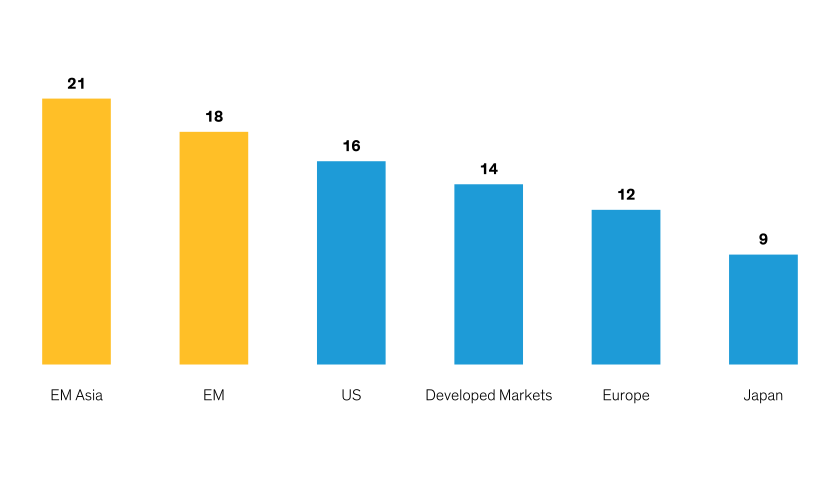
Bar chart showing consensus estimated EPS for EM and EM Asia exceeding that of developed markets in 2026.

Historical and current analyses do not guarantee future results.
Earnings growth is calculated based on the year-on-year change of market capitalization/market price/earnings ratio.
EM Asia represented by MSCI EM Asia; EM represented by MSCI Emerging Markets; US represented by S&P 500; Developed markets represented by MSCI World; Europe represented by MSCI Europe; Japan represented by MSCI Japan.
As of January 9, 2026
Source: Bloomberg, FactSet, MSCI and  AllianceBernstein (AB)

Attractive Valuations Reflect Underallocation

Despite last year’s gains, EM equities still trade at a sizable discount to their (DM) peers. For example, valuations in Brazil are more than 35% lower than the MSCI EM. The country appears to be at an important inflection point in its monetary policy cycle, with rates expected to come down from lofty levels. In Brazil and the rest of the developing world, underallocation by global funds is keeping a lid on valuations, (Display). This suggests that renewed interest in EM hasn’t translated into substantial participation.

EM Equities Have Traditionally Been Underowned
EM Equities as a Share of Global Assets Under Management (Percent)
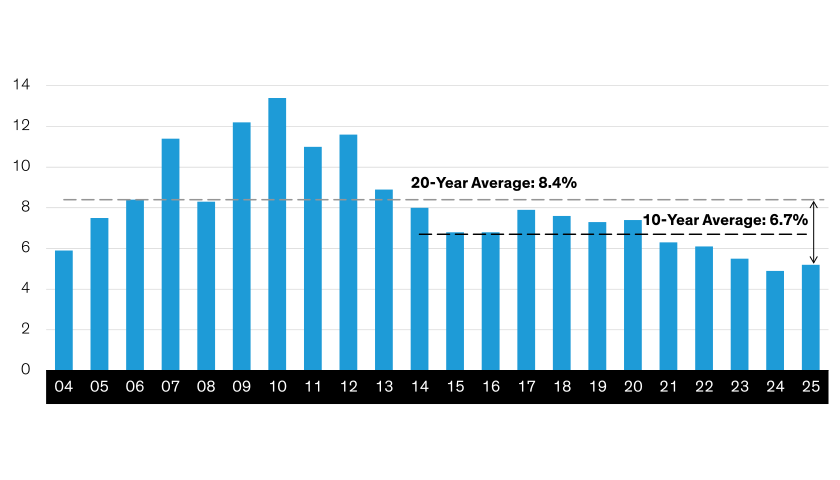
Bar chart showing EM equities as a percentage of global AUM below long-term averages.

Historical and current analyses do not guarantee future results.
Through November 30, 2025
Source: Emerging Portfolio Fund Research Global, JPMorgan Chase, MSCI and AB

We understand the hesitation. 

EM are not without risk and haven’t always lived up to their promise. Nonetheless, improving corporate fundamentals and corporate earnings growth could be signs that this isn’t just another short cycle rebound—especially given the structural trends creating new opportunities. 

Emerging Markets Offer a Back Door to AI 

AI is a great example of a supportive theme that investors may not associate with EM equities. Investing in AI can sometimes feel like chasing the most crowded—and expensive—parts of the US market. But, in our view, some of the more durable earnings streams could come from supplying the infrastructure that enables AI. That’s where we foresee EM gaining a unique foothold.

EM companies provide many of the critical building blocks for AI infrastructure, including everything from semiconductor foundries and high-bandwidth memory to data center power and thermal management systems. These “backdoor AI” firms tend to be less speculative and more grounded in long investment cycles. Many of these firms also boast high barriers to entry.

Regardless of size, many AI suppliers with operations in EM trade at a discount to their US peers. In contrast to the hyperscalers, which have gone on a spending spree, EM tech companies are less capital intensive than their DM counterparts (Display).

EM Tech Companies Offers Potential Upside with Lower Capital Intensity
Capex as a Percentage of Sales (Percent)
Two bar charts showing capex as a % of sales, with EM capex trending downward and hyperscalers trending higher.

Past and current analyses do not guarantee future results.
Left display of January 7, 2026; right display as of September 30, 2025.
Source: Bloomberg, company reports and AB

For investors, AI enablers have important implications for market volatility. Recently, concerns about software disruptions, monetization of escalating capex intensity and a possible AI bubble have buffeted flagship US AI megacaps. At the same time, hardware and component suppliers in the developing world were largely spared. 

Governance Reform: Turning Earnings into Shareholder Value

But even the strongest companies need stable backdrops in which to operate. Fortunately, corporate governance across the developing world is undergoing a quiet revolution with profound implications for investors. A case in point is South Korea’s “value-up” initiative, which just marked its second anniversary. While Japan’s corporate governance transformation unfolded over a decade, South Korea is still at the beginning of its journey, leaving significant room for improvement and a narrowing of the long-standing “Korean discount.”

South Korean financials are at the forefront of corporate governance reforms, while the country’s conglomerates, including world-leading franchises in memory, autos and defense, are just starting their value-up journey. Efforts to improve shareholder value are afoot in other regions as well. China has encouraged state-owned enterprises to prioritize valuations and shareholder returns, signaling a shift toward more market-friendly practices. As part of this initiative, record-high buybacks and dividends have driven shareholder returns. 

Global Polarization Is Creating New Opportunities

Emerging markets are no stranger to geopolitical risk. Trade tensions, policy uncertainty and currency volatility can all weigh on investor confidence. But polarization is reshaping global supply chains in ways that create new opportunities for EM companies. Many countries are rerouting trade, diversifying production and building new linkages—reflecting a world in which growth drivers are becoming less synchronized.

Energy is a good example. The surge in global demand for liquified natural gas (LNG) is creating more demand for LNG carriers, one of the most technically demanding categories in shipbuilding. Historically, Chinese and Korean shipyards have dominated this space, but shifting trade relationships are changing market-share patterns. As US–China tensions have intensified, many western companies have become more cautious about placing orders with Chinese yards involved in sensitive energy routes. Korean shipbuilders, with a long track record of strong safety credentials and established relationships, have been clear beneficiaries of this shift—an example of how trade tensions can create new opportunities.

Because the developing world is so immense, we believe it’s best navigated through skilled active management. Active, bottom-up investors can tap into a wide range of attractive investment opportunities at compelling valuations. EM have seen fits and starts before, but we see a clear difference between past short-cycle rebounds and what’s transpiring now—an increasingly earnings-based recovery that could have plenty of room to run. 

The views expressed herein do not constitute research, investment advice or trade recommendations and do not necessarily represent the views of all AB portfolio-management teams. Views are subject to revision over time.

MSCI makes no express or implied warranties or representations, and shall have no liability whatsoever with respect to any MSCI data contained herein. The MSCI data may not be further redistributed or used as a basis for other indices or any securities or financial products. This report is not approved, reviewed or produced by MSCI.

References to specific securities are presented to illustrate the application of our investment philosophy only and are not to be considered recommendations by AB. The specific securities identified and described do not represent all of the securities purchased, sold or recommended for the portfolio, and it should not be assumed that investments in the securities identified were or will be profitable.


About the Authors