
Portable Alpha Revival: A Solution to the Beta/Alpha Mismatch

April 29, 2025
3 min read

What You Need to Know

Investors face a new regime, with heightened geopolitical risks and beta sources expected to deliver lower returns than they have in years past. At the same time, market concentration still poses a challenge for active managers seeking to enhance those betas. We don’t think investors should by any means write off active management, but they’ll need to think differently about how to integrate it into their portfolios.

Doing this requires addressing a mismatch between desired portfolio beta exposures and the most fruitful alpha sources. Alpha potential is alive and well in less-efficient and less-exploited market segments, such as small-cap and emerging-market (EM) equities, but few investors are willing to budget substantial beta to those areas. Multi-manager hedge funds also seem like effective alpha generators, but how can investors connect their beta and alpha worlds efficiently?

We think one answer lies in a strategy familiar to many investors yet more refined than the version from decades ago: portable alpha. This solution can efficiently tap into a wide range of attractive alpha streams with capital efficiency while keeping strategic asset allocations on track. If investors implement and govern portable alpha correctly, it may be a powerful tool.

Additional Contributors: Harjaspreet Mand

A Tougher Road Ahead for Most Beta Sources

Investors face a unique mix of structural challenges today: deglobalization, demographics, climate change, record government debt and geopolitical uncertainty. One of the results could be higher inflation and interest rates, which might challenge the role of bonds as “safe” assets and diversifiers to equity exposure. Economic growth will likely be lower, too, implying reduced return potential for many equity markets and growth-sensitive assets. And with valuations high for most key asset types, multiples face mean reversion risk over a strategic horizon.

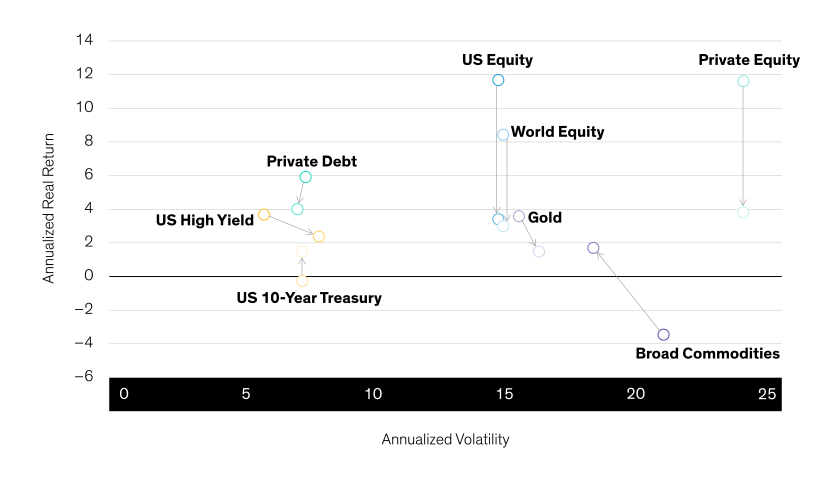
In our view, all this translates into a worse real-return outlook for many traditional asset-class beta sources (Display 1) and fewer diversification opportunities. This landscape is a far cry from 1980–2020, when rates were falling, disinflation was the norm and diversification was plentiful. The bottom line: traditional asset classes are more likely to underdeliver for investors, and the potential return boost from pivoting into riskier betas seems much more muted. This creates a tough spot for investors focused on total return or real return.

A More-Challenging Landscape Ahead for Traditional Assets Realized Risk and Return vs. Forecasts (Percent)

Current analysis and forecasts do not guarantee future results. 
Filled dots represent actual real returns and volatility for January 2010 through December 2024. Dashed dots represent the AB Institutional Solutions team's forecasts for the next five to 10 years. Private equity return data is the US Private Equity Index from Cambridge Associates, compiled from 1,562 funds, including fully liquidated partnerships, formed between 1986 and 2019. All returns are net of fees, expenses and carried interest. Data are provided at no cost to managers. Private equity volatility is estimated from the MSCI US Small Cap Value Index with 15% leverage. Private debt historical volatility is the volatility of the Preqin Private Debt return index. 
As of March 26, 2025 
Source: Cambridge Associates, FactSet, Federal Reserve Bank of St. Louis, Ken French Data Library, LSEG Data & Analytics, Preqin and AllianceBernstein (AB)

A difficult beta outlook intensifies the need for alpha (the return from active management above the market), but alpha seems harder to find. The median manager in US large-cap equities—the biggest beta pool and largest allocation in many portfolios—has generated zero alpha before fees and negative alpha after fees for at least a decade. Even top-quartile managers have beaten their benchmarks by only 0.6 % annualized over the past decade, on average. Managers using other large-cap developed equity benchmarks—growth, value and core—have also struggled to add value in recent years, a challenge exacerbated by the market’s high concentration in mega-cap tech—the Magnificent Seven problem.

Investors have responded by joining two of the biggest asset-allocation trends of the last two decades: exiting active equity strategies in favor of passive and moving from liquid public markets into private markets, especially private equity. Hedge funds, once a big beneficiary of the move into alternatives, have failed to keep pace, with investors’ allocations to these alpha-centric, low-beta portfolios largely stalling.

The views expressed herein do not constitute research, investment advice or trade recommendations, do not necessarily represent the views of all AB portfolio-management teams and are subject to change over time.


About the Authors